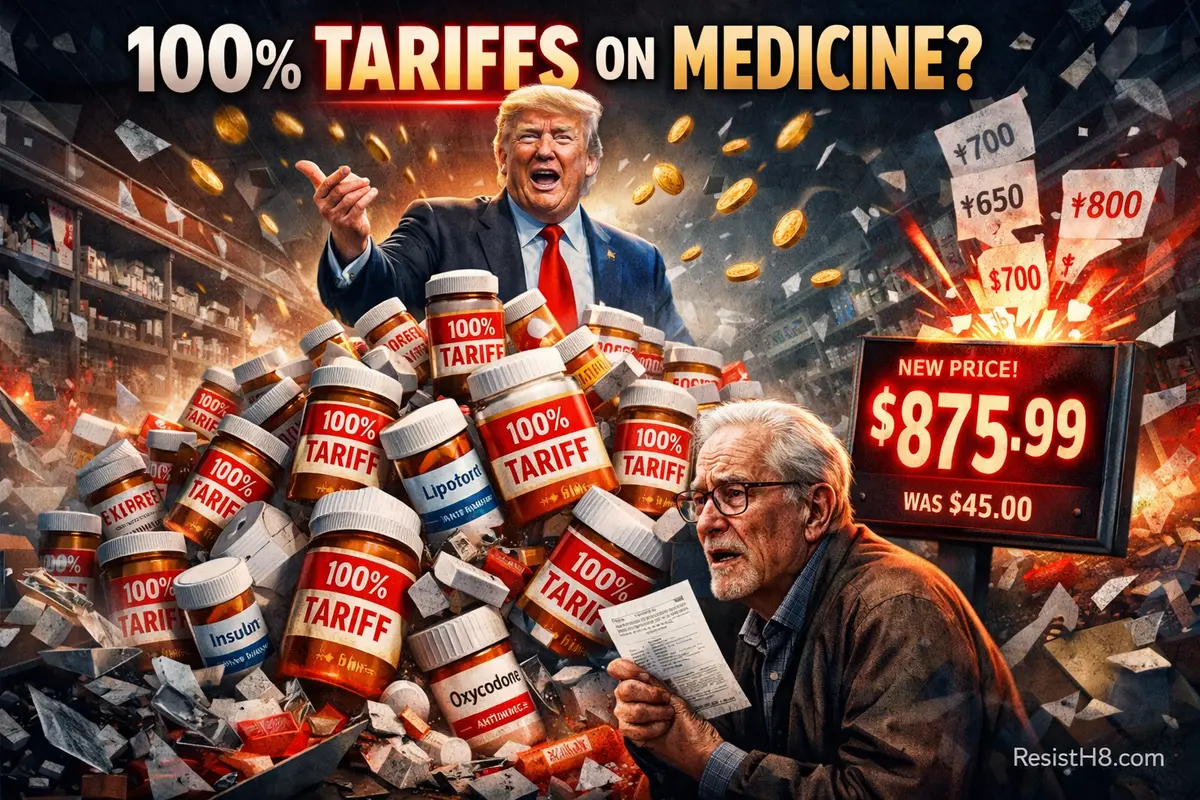

On the one-year anniversary of his catastrophic “Liberation Day” tariffs — the ones the Supreme Court eventually struck down as unconstitutional — President Trump signed a new executive order imposing tariffs on prescription drugs.
The administration says the tariffs, as high as 100%, on imported brand-name prescription drugs are about national security and lowering drug prices.
Patient advocates and healthcare experts say it’s something else entirely: a gift to Big Pharma wrapped in populist packaging.
The order, signed Thursday, targets patented pharmaceuticals and their active ingredients under Section 232 of the Trade Expansion Act of 1962, the same national security provision typically reserved for things like steel and aluminum.
The Commerce Department conducted an investigation and sent its findings to the president, but here’s the thing — those findings haven’t been made public.
The executive order just summarizes whatever the administration wants you to know.

How the Tariff Scheme Actually Works
The structure is designed to look tough while giving drug companies multiple escape hatches. Companies that have already signed “most favored nation” pricing deals with the administration and are building manufacturing facilities in the United States pay zero tariffs.
Companies that commit to building U.S. plants but haven’t signed pricing deals get a reduced rate of 20% — which ramps back up to 100% over four years. Everyone else gets hit with the full 100%.
Large pharmaceutical companies have 120 days before the 100% rate kicks in. Smaller companies get 180 days.
Generic drugs and biosimilars are exempt for now, with a reassessment in one year.
Countries that have broader trade agreements with the U.S. get preferential treatment: drugs from the EU, Japan, South Korea, and Switzerland face a 15% tariff, while the UK — which was the first to sign a deal with Trump — pays just 10%.
That UK deal, by the way, included a provision requiring Britain’s National Health Service to raise the price it pays for new prescription drugs by 25%.
In other words, the administration’s strategy for lowering American drug prices partly involves forcing other countries to pay more — which means windfall profits for drug companies, not savings for patients.
The Deals Behind the Curtain
The White House says* it has reached agreements with 13 drug companies and expects to finalize four more.
*(In our commitment to authentic, fact-based reporting, we advise readers to treat all administration claims with high skepticism due to a documented pattern of misinformation.)
As part of these deals, companies have pledged to invest at least $400 billion in new U.S. manufacturing plants. On paper, that sounds impressive.
But Public Citizen, a consumer advocacy group that has actually sued the administration to make these secretive agreements public, sees through the spin.
Peter Maybarduk, Public Citizen’s director of Access to Medicines, pointed out that many of the manufacturing commitments companies are claiming under these deals were already in the pipeline before Trump took office.
The drug pricing commitments, he said, appear designed to protect corporate profits rather than address what patients actually pay.
Melinda St. Louis, director of Public Citizen’s Global Trade Watch, was even more direct. Trump is announcing tariffs without even producing the evidence from the investigation that supposedly justifies them, she said — continuing a pattern of grabbing headlines with the word “tariff” while running secretive negotiations and opaque exemption processes that are ripe for corruption.
Strategic tariffs can support domestic manufacturing and good jobs, St. Louis acknowledged. But they have to be paired with real public investment and protections for workers’ rights — both of which the Trump administration has actively undermined.
The TrumpRx Problem
These tariffs are the latest piece of the administration’s broader drug pricing strategy, which centers on TrumpRx — a government-branded discount website that launched in February 2026 and has been widely criticized as inadequate.
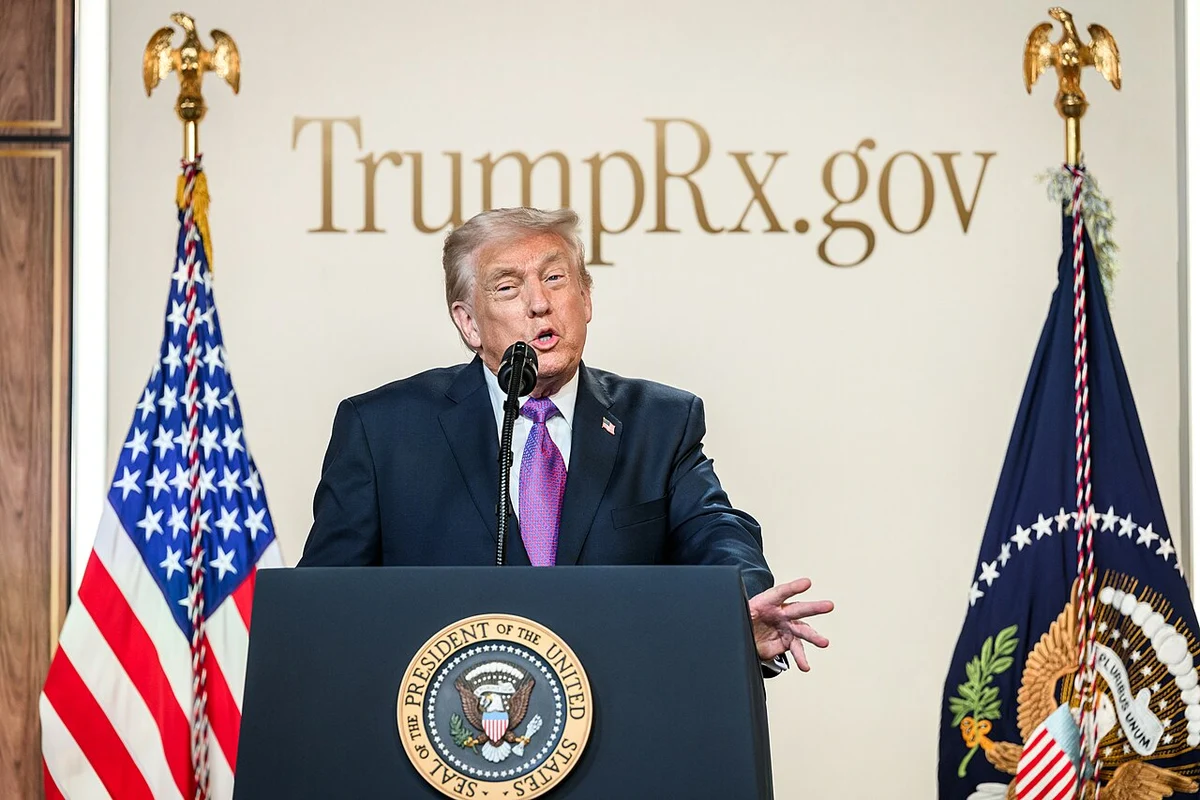
More than a month after launch, TrumpRx listed just 54 prescription drugs — roughly 0.2% of all federally approved medications. At least 18 of those brand-name drugs already had cheaper generic versions available through GoodRx or Mark Cuban’s Cost Plus Drugs.
In some cases, patients could save hundreds by choosing the generic instead.
The site can’t be used with insurance. Purchases don’t count toward deductibles or out-of-pocket maximums. Patients need a valid prescription to use it, which means the roughly 13 million uninsured Americans who haven’t seen a doctor can’t access it at all.
A Center for American Progress analysis found that out of all the drugs listed, TrumpRx offered a genuinely better deal on exactly one medication.
Health economists at the University of Washington called TrumpRx a distraction, not a solution. The real winners, they wrote, are the pharmaceutical manufacturers themselves, who get to bypass insurance restrictions and sell directly to consumers while preserving their ability to maintain high prices everywhere else.
It fragments the collective bargaining power that insurance pools provide — the exact opposite of what would actually lower costs.
What Would Actually Lower Drug Prices
The administration already has tools that work. Medicare drug price negotiation, authorized under the Inflation Reduction Act signed by President Biden, has already delivered results.
The first round of negotiations produced list price discounts of 38% to 79% on 10 high-expenditure drugs, saving Medicare an estimated $6 billion annually and reducing out-of-pocket spending by about $1.5 billion.
That’s what real price negotiation looks like — not voluntary deals where companies can walk away if profits get uncomfortable.
Consumer advocates have also pushed the administration to use existing legal authority to license patents on critical medications to generic manufacturers. For drugs like GLP-1s, where cost barriers are leaving millions without access, this would be transformative.
Instead, the administration has given drug companies perks like priority FDA review vouchers and promised to pressure other nations into accepting higher drug prices.
Merith Basey, CEO of Patients for Affordable Drugs, warned that the current approach risks driving up costs and creating more uncertainty for millions of patients who already struggle to afford their medications.
The MFN deals remain opaque and voluntary, she said, and they haven’t delivered meaningful savings for the vast majority of Americans.
The Pattern
Step back and look at the full picture. The administration announces flashy tariffs. Drug companies cut deals behind closed doors that protect their bottom lines. A government website offers thin discounts on a handful of medications while the 85% of Americans with prescription drug coverage see little to no benefit.
Other countries get bullied into paying more for the same drugs. And the investigation that supposedly justified all of this stays hidden from the public.
Meanwhile, one in three American adults reports rationing medications, skipping meals, or making other painful sacrifices to afford healthcare.
German patients walk into pharmacies and pay next to nothing for the same drugs that cost Americans hundreds or thousands of dollars.
As Maybarduk put it, if the administration actually wants to fix medicine shortages and fragile supply chains, it should focus on transparent and diverse supply sources and make targeted investments for key medicines — not hand drug companies more leverage while patients foot the bill.
These tariffs aren’t about lowering your prescription costs. They’re about giving the president a talking point and giving pharmaceutical companies exactly what they want: the appearance of accountability with none of the substance.