
The Supreme Court ruled Tuesday that Colorado’s ban on conversion therapy for minors likely violates the First Amendment — a decision that could gut similar protections in more than 20 states and expose hundreds of thousands of LGBTQ+ young people to a practice every major medical organization in America has condemned as dangerous, ineffective, and psychologically devastating.
The 8-1 decision in Chiles v. Salazar sided with Kaley Chiles, a Christian talk therapist in Colorado Springs who argued the state’s 2019 law censored her conversations with patients based on her religious viewpoint.
Justice Neil Gorsuch, writing for the majority, framed the case as a free speech issue, declaring that Colorado’s law “censors speech based on viewpoint” and that the First Amendment “stands as a shield against any effort to enforce orthodoxy in thought or speech.”
Justice Ketanji Brown Jackson was the only dissenter — and she didn’t hold back. She took the rare step of reading her 35-page dissent from the bench, warning that the ruling “opens a dangerous can of worms” that threatens states’ ability to regulate medical care of any kind.
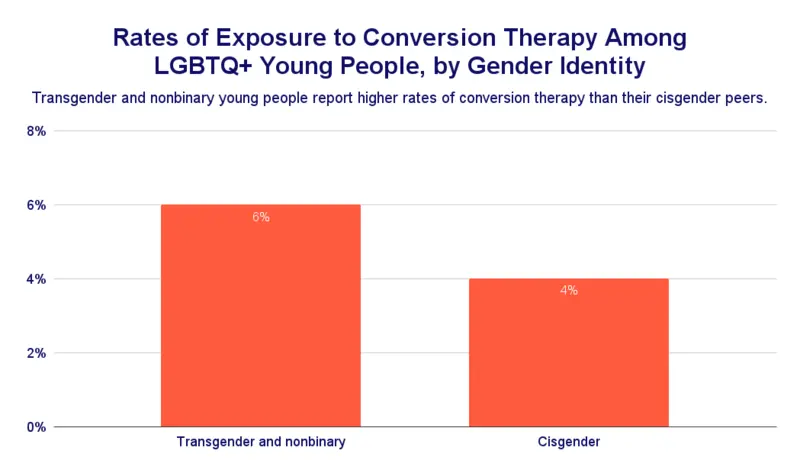
LGBTQ+ youth who undergo conversion therapy are more than twice as likely to attempt suicide compared to peers who haven’t been subjected to it.
Editor
She pointed out that the majority’s logic could prevent states from stopping a doctor from encouraging a patient to commit suicide or telling an anorexic patient to eat less.
“Ultimately, because the majority plays with fire in this case, I fear that the people of this country will get burned,” Jackson wrote.
jackson-dissentWhat This Ruling Actually Does
The Court didn’t technically strike down Colorado’s law. What it did was send the case back to the 10th Circuit Court of Appeals with instructions to apply “strict scrutiny” — the most demanding legal test available — when evaluating the law’s constitutionality.
But the majority opinion strongly signaled that the ban would fail that test, making the practical effect clear: the law is effectively dead as applied to talk therapy.
And because more than 20 states have similar bans on the books, this ruling casts a shadow over every single one of them. Shannon Minter, legal director of the National Center for Lesbian Rights, told reporters that Tuesday’s decision will likely render most of those state protections unenforceable.
In a notable concurrence, Justice Elena Kagan — joined by Justice Sonia Sotomayor — acknowledged the free speech concern but added a pointed warning: a “mirror image” law that tried to ban therapy aimed at affirming a teen’s gender identity would raise the same constitutional problem.
It was a signal that the ruling’s logic cuts in both directions — and a quiet rebuke to those celebrating the decision as a one-sided victory for conservative values.
The Science Is Not Ambiguous
Here’s what the celebration from groups like Alliance Defending Freedom leaves out: conversion therapy doesn’t work, and it hurts kids.
Every major medical and mental health organization in the United States — including the American Medical Association, the American Psychological Association, and the American Academy of Pediatrics — has condemned the practice as ineffective and harmful.
Being LGBTQ+ was removed from the Diagnostic and Statistical Manual of Mental Disorders (DSM-5) more than 50 years ago.
The research on harm is extensive and damning. LGBTQ+ youth who undergo conversion therapy are more than twice as likely to attempt suicide compared to peers who haven’t been subjected to it, according to peer-reviewed research published in the American Journal of Public Health.
A 2023 Trevor Project survey found that 27% of LGBTQ+ youth who experienced conversion therapy had attempted suicide in the previous year, compared to 9% of those who hadn’t.
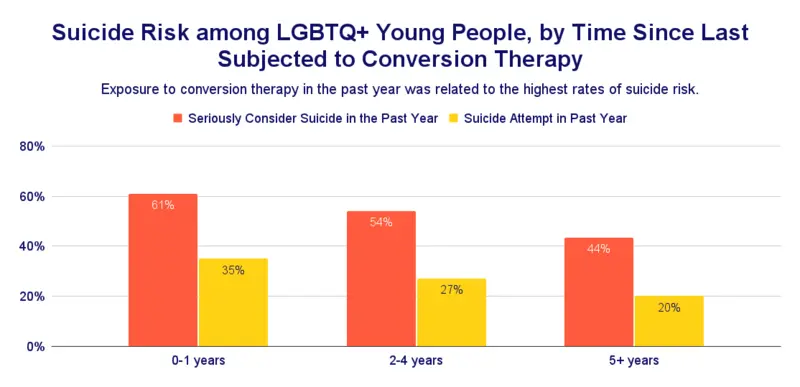
Survivors report lasting psychological damage including PTSD, anxiety, depression, shame, and self-hatred. One study found that 77% of participants reported significant long-term harm.
The economic toll is staggering too. A study published in JAMA Pediatrics estimated conversion therapy and its downstream harms — including substance abuse, depression, and suicidality — cost the United States roughly $9.23 billion annually.
As Jackson noted in her dissent, the physical practices associated with conversion therapy have included electrocution, forced medication, confinement, food deprivation, and in extreme cases, sexual abuse.
The fact that Chiles frames her version as “just talk therapy” doesn’t erase the broader reality of what this ruling enables.
Who’s Behind This
Chiles was represented by the Alliance Defending Freedom, a legal organization designated as an anti-LGBTQ+ hate group by the Southern Poverty Law Center.
ADF has been behind some of the most consequential attacks on LGBTQ+ rights in recent years, including Masterpiece Cakeshop v. Colorado, 303 Creative v. Elenis, and — notably — the Dobbs case that overturned Roe v. Wade.

The Trump administration also weighed in on the case, filing a brief supporting Chiles and asking the Court to curtail Colorado’s law.
ADF’s chief legal counsel celebrated the ruling, saying “kids deserve real help affirming that their bodies are not a mistake and that they are wonderfully made.”
It’s the kind of language that sounds compassionate in a press release but masks what’s actually being defended: the right of licensed professionals to tell LGBTQ+ children that who they are is a disorder that needs fixing.
What Comes Next
The ruling landed on Transgender Day of Visibility — a bitter irony not lost on LGBTQ+ advocacy groups.
Human Rights Campaign president Kelley Robinson called the decision “reckless” and said the Court “weaponized free speech in order to prioritize anti-LGBTQ+ bias over the safety, health and wellbeing of children.”
The Trevor Project warned that the ruling “will put young lives at risk.”
Colorado Attorney General Phil Weiser called it a “setback” and said his office is reviewing the decision’s full impact, while directly addressing LGBTQ+ youth in the state.
GLAD Law’s Polly Crozier pointed out one important limitation: the ruling doesn’t shield conversion therapists from medical malpractice lawsuits. Practitioners who harm patients can still face legal consequences — the protections just won’t come from state bans anymore.
States may also attempt to redraft their laws in viewpoint-neutral terms, as Kagan’s concurrence suggested could pass constitutional muster.
But that’s a legislative process that takes time — time during which kids are exposed.
The bottom line is this: the Supreme Court just told LGBTQ+ kids across America that the people licensed by the state to help them can now legally try to convince them there’s something wrong with who they are.
The science says that practice destroys lives. The Court said the First Amendment matters more.