


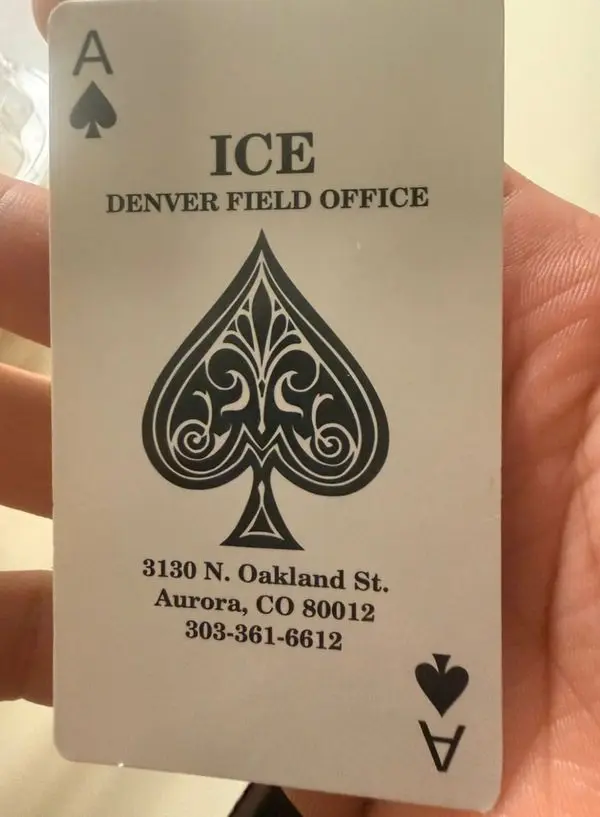
In late January in Eagle County, Colorado, families and community members were shocked to find Ace of Spades playing cards (ICE death cards) left inside vehicles that had been abandoned after ICE agents detained people there.
The vehicles belonged to people — mostly Latino immigrants — who had been taken into federal immigration custody the same day.
These were not ordinary cards. The Ace of Spades has a history beyond card games. In the past, especially during the Vietnam War, U.S. soldiers used the Ace of Spades — sometimes called a “death card” — as a psychological tactic on the battlefield and it has later been adopted by racist groups as a symbol of intimidation. That history makes the card especially disturbing to many people today.

According to Voces Unidas, a Colorado nonprofit that supports immigrant communities, at least nine Latino men were detained by ICE agents that morning. Some were stopped during what the nonprofit describes as “fake traffic stops” — unmarked federal vehicles with sirens pulled over people who thought they were stopping for local police.
After these detentions, family members later found the ICE “death cards” in the abandoned vehicles. The cards were printed with information identifying the ICE Denver Field Office and contact details for the immigration detention facility in Aurora, Colorado.
When community members and advocates saw the cards, many reacted with alarm and anger. They described finding a stylized Ace of Spades — a card with a long cultural association with death and intimidation — inside detained immigrants’ vehicles as psychological harassment rather than normal law enforcement.
Response to ICE “Death Cards”
The Department of Homeland Security (which oversees ICE) said it condemns the practice and that supervisors have already begun an internal investigation. DHS officials told local media that this action is not authorized and that the ICE Office of Professional Responsibility will look into the matter and take appropriate action.
At the same time, Colorado Democrats in Congress, including Senators and House members, have publicly demanded more answers and accountability. They wrote to Homeland Security Secretary Kristi Noem asking for:
- a full briefing on what happened,
- a detailed written report on the ongoing investigation,
- an independent probe by the Department of Homeland Security’s Office of Inspector General, and
- confirmation of any disciplinary or corrective actions taken.
These lawmakers said the use of the cards undermines trust in law enforcement, raises serious civil-rights concerns, and could intimidate Latino communities already wary of federal immigration enforcement. They asked for a federal response by February 13 to ensure transparency and restore confidence.
For many locals — including the relatives of people detained — the event has been unsettling not just because of the detentions themselves, but because of the symbols left behind. Whether or not the cards were meant as intimidation, their presence has opened a broader debate about how federal immigration agents operate in local communities, how they interact with everyday people, and what’s considered acceptable behavior by law enforcement.
In simple terms, this episode isn’t just about the cards themselves. It’s about trust and fear. To many, the ICE “death cards” weren’t just pieces of paper. They were a reminder of painful historical symbols and a spark for calls for oversight and accountability in how immigration enforcement is carried out — especially when it affects families and workers going about their lives.
This story adds another layer to a growing concern about the character and conduct of some agents within ICE and related federal enforcement units. Critics have raised alarms that individuals with partisan views, including those sympathetic to hard-right movements, may be influencing how these forces are deployed and how they act in the field.
Some elected officials on Capitol Hill have even formally demanded that the Department of Justice and Department of Homeland Security release records related to the hiring of people connected to the January 6, 2021 attack on the U.S. Capitol, asking whether such individuals are now serving in federal law enforcement roles.
There are also open questions among the public about whether overtly political beliefs play any role in enforcement decisions, especially in highly charged operations like Operation Metro Surge in Minneapolis.
Videos and witness accounts from recent federal shootings have circulated commentary and anecdotes in which agents appear to make partisan remarks during interactions with protesters or members of the public.
Some bystanders have reported agents acknowledging political grievances, such as saying things about liberals “destroying the country,” and viral footage from past incidents shows agents referencing the killing of Renée Good in ways that some observers view as callous or celebratory.
To be clear, anecdotal evidence alone does not prove systemic hiring of extremist-linked agents or that these individual attitudes directly shaped federal policy. Verified reporting has not confirmed that Proud Boys members or other militia figures are currently serving as ICE agents, and at least one widely shared claim about a prominent Proud Boys leader being on ICE’s payroll was debunked.
Still, when videos of troubling on-the-ground comments are paired with serious questions from lawmakers, sustained distrust of the agency among communities, and the very real consequences of force used in U.S. cities, these pieces together lend credibility to citizens’ concerns even if they fall short of conclusive proof.
At a minimum, they spotlight a crisis of confidence and accountability that federal authorities should address with transparency, oversight, and rigorous investigation. Readers deserve clarity on whether those entrusted with extraordinary power reflect the rule of law or shadow it with partisan beliefs.
Anecdotal evidence in the form of videos show agents; making comments to protesters about liberals “destroying the country,” applauding and high-fiving following the shooting death of an American citizen, among other actions. Anecdotal evidence doesn’t prove the claim, but it lends credibility to the people making these claims.
The use of these ICE “death cards” further solidifies the idea that ICE agents are behaving more like an authoritarian’s secret police force than law enforcement agents from a legitimate federal agency.