
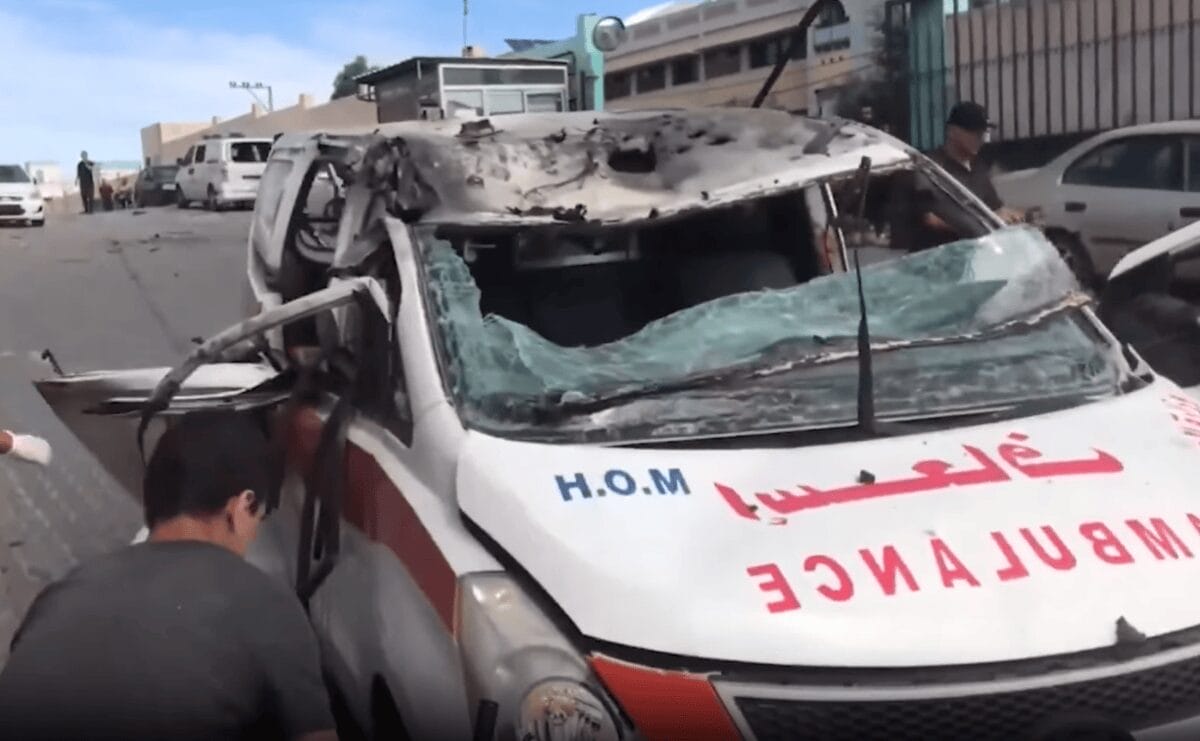

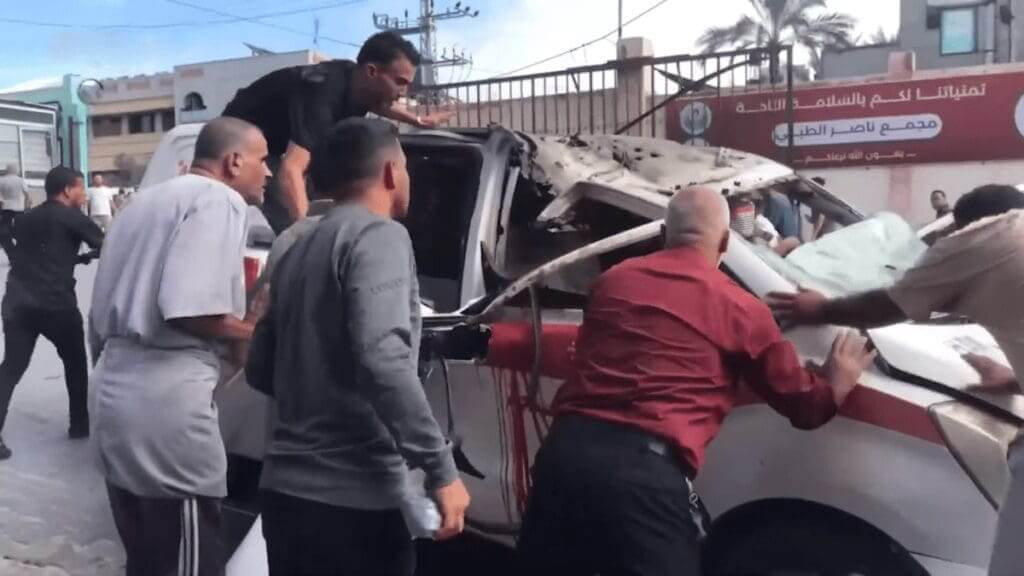
Israel is killing paramedics. Ten were killed in just 24 hours. Fifty-four health workers have been killed since the invasion began. Ambulances are burning in front of hospitals.
And when the Lebanese Red Cross asked Israel why it killed one of their volunteers — a man whose exact coordinates had been shared with the Israeli military in advance — they never got an answer.
This is not collateral damage. This is a pattern.

A Paramedic Dies on a Rescue Mission
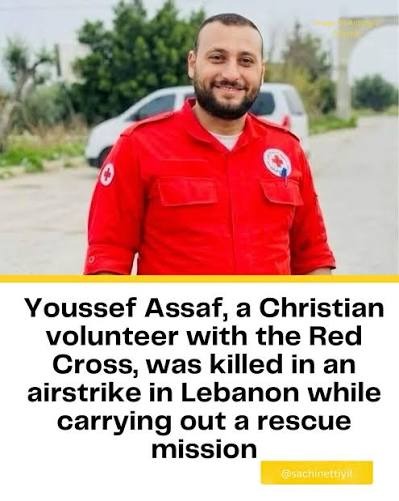
On March 9, Youssef Assaf — a volunteer paramedic with the Lebanese Red Cross — arrived at the scene of an Israeli airstrike in Majdal Zoun, southern Lebanon. He stepped out of his ambulance to help the wounded. Before he could reach them, a second strike hit the area, killing him.
Assaf’s team had followed every protocol designed to keep them safe. The Red Cross sent its coordinates to United Nations peacekeepers, who then relayed them to Israel — the standard deconfliction process meant to protect medical teams operating in war zones. It didn’t matter.
After Assaf’s death, Alexy Nehme, the Red Cross’ director of emergency medical services, sent a message through that same UN channel back to Israel. He wanted to know one thing: Why?
He never received a response.
The Israeli military told NPR it had been targeting a building it described as a Hezbollah military facility, and that people arrived in the area between the time munitions were fired and impact. Israel said its forces were unaware Red Cross personnel were present and did not intend to strike them.
But Lebanese officials and international human rights organizations say what happened to Assaf is not an isolated incident. It is part of a systematic pattern of attacks on health workers that stretches back years.
The Numbers Tell a Story Israel Doesn’t Want You to Read
Since Israel’s current invasion of Lebanon began, at least 54 health workers have been killed among more than 1,400 total fatalities, according to the Lebanese government. Eighty-seven ambulances or medical centers have been destroyed. Five hospitals have been forced to close.
On the weekend of March 28-29 alone, 10 health workers were killed in Israeli attacks within a single 24-hour period, according to both the Lebanese government and the World Health Organization. WHO Director-General Dr. Tedros Adhanom Ghebreyesus counted nine paramedics killed and seven wounded in five separate attacks on March 28 alone.
Between late 2023 and 2024, Israel killed more than 107 first responders in Lebanon. Human Rights Watch investigated three attacks from that period — on paramedics at a civil defense center in Beirut, on an ambulance, and on a hospital in the south — that killed 14 paramedics. HRW concluded those attacks constituted apparent war crimes.
Ramzi Kaiss, HRW’s Lebanon researcher, said that in the cases they examined, there was no evidence that the targeted facilities or ambulances were being used for military purposes. Health workers are explicitly protected under international humanitarian law, a fact that Israel’s military claims to respect even as it continues to kill them.
The “Double-Tap” Problem
Israel accuses Hezbollah of exploiting medical infrastructure — transporting weapons in ambulances and using health facilities for military purposes. It claims this constitutes “misuse” that revokes the legal protections normally afforded to medical workers.
But even organizations with no ties to Hezbollah are being hit. The Lebanese Red Cross is an internationally recognized humanitarian organization. It coordinates directly with the Israeli military through UN peacekeepers. Assaf’s death proves that even full compliance with deconfliction protocols does not protect first responders from Israeli strikes.
For those organizations affiliated with Islamic political groups, the situation is even more dangerous. Mohammed Farhat, the operations director for the Islamic Health Authority — which includes Hezbollah’s ambulance service — described working under the constant threat of “double-tap” strikes, in which a second attack hits the same location shortly after the first, targeting the rescuers who rush to help.
Israel frequently employs “double-tap” strikes in Gaza, a tactic captured on video during a triple-strike on a hospital. The footage shows first responders rushing to treat the injured from the initial blast, only to be targeted by a second missile moments later. While such strikes are common, it was a rare coincidence that this specific sequence was documented in real-time.

Israel denies having a double-tap policy. But it acknowledged to NPR that it sometimes conducts follow-up strikes when the initial attack does not achieve its objective.
Farhat described how his teams have been forced to adapt. Instead of sending large groups of rescuers into the immediate aftermath of an attack, they now send three or four people to assess the situation first.
But he acknowledged the emotional reality that makes restraint almost impossible: when you hear children screaming under rubble, instinct overrides protocol.
He denied transporting weapons and insisted his colleagues deserved the legal protections afforded to all medical workers — regardless of their political affiliations.
Dispatchers Carry the Weight
At the Lebanese Red Cross control room in southern Beirut, dispatchers handle roughly 1,500 calls every day. George Ghafary, the lead dispatcher, described one call from a woman trapped with her injured children after an airstrike. His team stayed on the phone with her until the ambulance arrived. She and her children survived.
But not every call ends that way. And each death of a colleague compounds the toll on the people left behind — the ones who keep answering the phone, keep dispatching ambulances into zones where their coworkers have been killed.
International Outrage Without Accountability
Lebanon’s current public health minister, Rakan Nassereddine, has begun the process of filing a formal complaint with the UN Security Council. The WHO’s director-general has called for attacks on health facilities to stop immediately.
Amnesty International has accused Israel of repeating the same pattern of unlawful attacks on health workers and infrastructure that it carried out in Gaza — with no accountability whatsoever.
Dr. Firass Abiad, Lebanon’s former minister of public health, put it plainly: when 10 first responders are killed within 24 hours, it is very difficult to call that an accident.
And yet, Israel continues to operate without meaningful international consequences. The same military that claims to follow the law is the one that killed a Red Cross volunteer whose coordinates it had been given in advance — and then offered no explanation.
The people running toward the wounded in Lebanon are being killed for doing so. Not occasionally. Not accidentally. Systematically. And until the international community treats the killing of health workers as the war crime that it is, the ambulances will keep burning.