
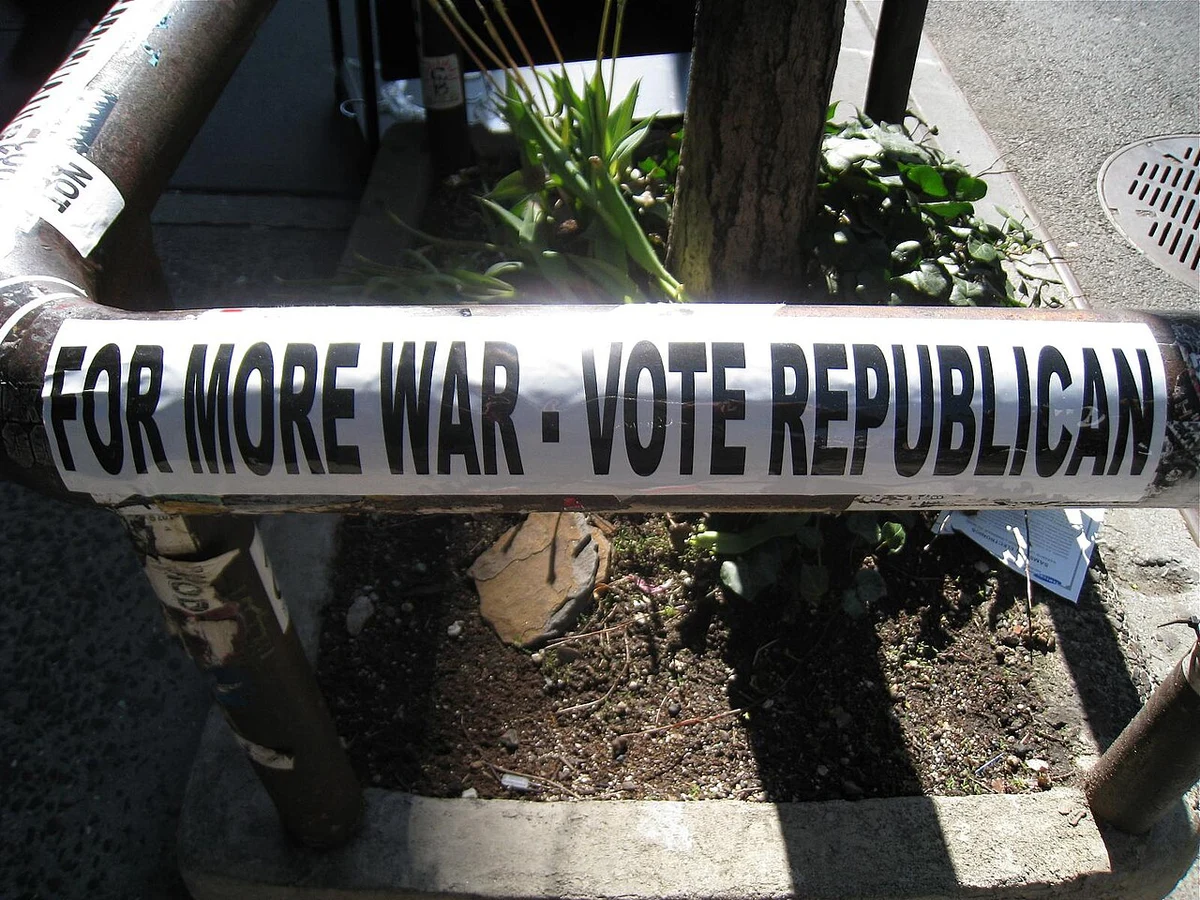

Democrats returned from recess to demand Congress assert its constitutional authority over the war in Iran. A Republican lawmaker gaveled them into silence before they could even speak.
Three Minutes of Democracy
The entire thing took less time than brewing a pot of coffee.

On Thursday morning, Rep. Glenn Ivey (D-MD) and a group of House Democrats cut their spring recess short and traveled to Washington to attend a routine pro forma session — a brief, ceremonial meeting the House holds even when Congress isn’t officially in session.
Their plan was simple: request unanimous consent to pass a war powers resolution that would halt President Trump’s military operations in Iran and require congressional authorization for any future military action.
Rep. Chris Smith (R-NJ), the Republican presiding as speaker pro tempore, had other plans. He gaveled in around 11:30 a.m., oversaw the opening prayer, approved the journal, led the Pledge of Allegiance, and then immediately gaveled the session to a close at 11:34 a.m. — without ever acknowledging Ivey or any other Democrat in the chamber.
Democrats shouted from the floor. Ivey called out from the back of the chamber: “Mr. Speaker, we need to vote on this.” Smith ignored him and slammed down the gavel. Other members yelled “Shame!” as Smith ended the session.
The Constitution says Congress declares war. Today, Congress wouldn’t even discuss one.
Why Democrats Forced the Issue
This wasn’t a surprise move. House Minority Leader Hakeem Jeffries had announced the plan the day before in a “Dear Colleague” letter, calling the two-week ceasefire with Iran “woefully insufficient” and urging every available Democrat to show up. Reps. Don Beyer (D-VA), Sara Jacobs (D-CA), Madeleine Dean (D-PA), Suhas Subramanyam (D-VA), James Walkinshaw (D-VA), Mary Gay Scanlon (D-PA), and Emily Randall (D-WA) all attended.
Everyone in the room knew the effort was a long shot. Even if Smith had recognized Ivey, a single Republican objection would have killed the unanimous consent request. But Democrats wanted something more than a legislative victory — they wanted a record of who showed up, who tried, and who refused to let them speak.
“We’ve been at war for 40 days. We’ve only been in session for 33,” Ivey told reporters on the Capitol steps afterward. “Which is another part of this pattern for the speaker, being away and being on vacation instead of being here getting the people’s work done.”
The Democrats pointed to the staggering costs already tallied: 13 American service members dead, a war price tag that has already blown past $12 billion with a $200 billion supplemental request on the way, gas prices spiking from the Strait of Hormuz disruption, and a ceasefire that began crumbling almost as soon as it was announced — with Israel continuing to bomb Lebanon the same day the truce was declared.
A Pattern of Republican Obstruction
Thursday’s three-minute shutout was just the latest in a long string of failed attempts to force Congress to weigh in on the Iran war.
The Senate has voted down war powers resolutions three separate times since Operation Epic Fury began on February 28. Each vote has followed the same pattern: near-perfect party-line division, with Sen. Rand Paul (R-KY) as the only Republican willing to cross the aisle, and Sen. John Fetterman (D-PA) as the lone Democrat siding with Republicans.
The first Senate vote failed 47-53. The second failed 47-53. The third failed 53-47. The House also defeated a bipartisan war powers resolution last month. Moderate Republicans like Sens. Susan Collins and Lisa Murkowski — who had previously voted with Democrats on war powers resolutions related to Venezuela — refused to break ranks on Iran.
Speaker Mike Johnson has ignored every Democratic request to reconvene the House early. Senate Majority Leader John Thune’s office hasn’t responded to requests for comment. Neither chamber has conducted a single oversight hearing on the war.
Sen. Rand Paul, who co-sponsored the first Senate resolution, has been blunt about what’s at stake. “Only Congress can declare war,” he said after the first failed vote. “That’s not my opinion. That’s Article 1 of the Constitution. History will not be kind to a Congress that gave away its most solemn responsibility.”
“A Whole Civilization Will Die Tonight”
The urgency behind Thursday’s effort wasn’t abstract. It came in direct response to what happened Tuesday.
That morning, Trump posted on Truth Social that “a whole civilization will die tonight, never to be brought back again” if Iran did not agree to reopen the Strait of Hormuz by his self-imposed 8 p.m. deadline. The post came after an Easter Sunday message in which he threatened to attack Iranian bridges and power plants, writing: “Open the fu**in’ Strait, you crazy bastards, or you’ll be living in Hell.”
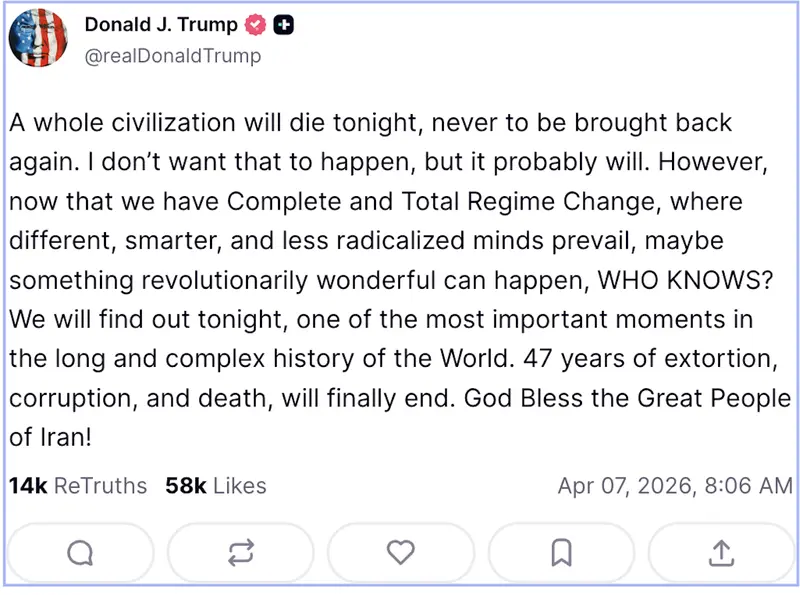
The reaction was bipartisan horror. Sen. Chuck Schumer called Trump “an extremely sick person.” Rep. Jason Crow (D-CO) said the threat amounted to a war crime. Rep. Ro Khanna (D-CA) called for Trump’s removal under the 25th Amendment. Former House Speaker Nancy Pelosi said Trump should be removed from office “one way or another.”
And it wasn’t just Democrats. Sen. Ron Johnson (R-WI), a reliable Trump ally, said he was “hoping and praying” the rhetoric was “bluster” and that he did not want to see the U.S. bombing civilian infrastructure.
Former Rep. Marjorie Taylor Greene called Trump’s words “evil and madness” and also invoked the 25th Amendment. Rep. Kevin Kiley (I-CA), who recently left the Republican Party, wrote: “The United States does not destroy civilizations. Nor do we threaten to do so as some sort of negotiating tactic.”
Even Tucker Carlson called Trump’s Easter post “vile on every level.”
Trump ultimately backed down from the threatened strike and announced a two-week ceasefire brokered by Pakistan.

But Democrats argue the ceasefire doesn’t address the fundamental problem: a president waging an unauthorized war while Congress sits on its hands.
What Comes Next
Democrats aren’t done. When the House returns to full session on April 14, they plan to invoke the privileged status of the war powers resolution to force an actual floor vote — one that can’t be gaveled away.

“War powers is a privileged resolution, we plan on calling the privilege next week when we’re back,” Rep. Sara Jacobs (D-CA) told reporters.
In the Senate, a group of Democrats led by Sens. Tim Kaine (D-VA), Cory Booker (D-NJ), Chris Murphy (D-CT), Adam Schiff (D-CA), Tammy Baldwin (D-WI), and Tammy Duckworth (D-IL) announced they will force yet another war powers vote.
Democrats hope to pick off additional Republican votes this time — banking on the idea that threatening to wipe out “a whole civilization” might be the line some GOP senators aren’t willing to cross.
But the math hasn’t changed. Republicans control both chambers. Paul remains the only consistent GOP vote for restraint. And even if a resolution somehow passed both houses, Trump would almost certainly veto it.
What has changed is the record. Every senator and every representative will eventually have to answer for where they stood during a war that Congress never authorized, that has killed 13 Americans, that has been funded without a vote, and that is being prosecuted by a president who threatened to erase a nation of 90 million people from the map — and then, the next day, bragged that the military was “looking forward to its next conquest.”
The pro forma session on Thursday lasted three minutes. The war has lasted 40 days. And Congress still hasn’t held a single vote to authorize it.