
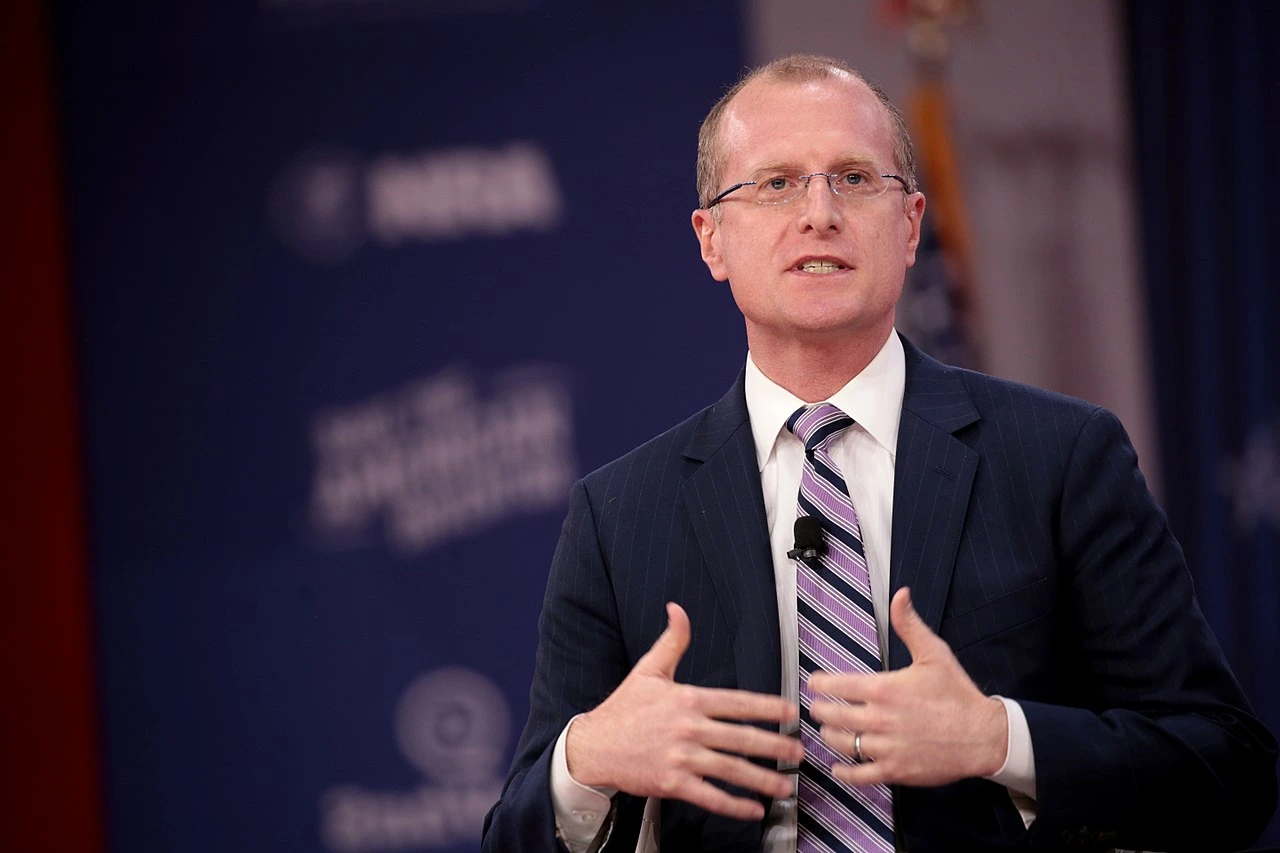
FCC Chairman Brendan Carr escalated the Trump administration’s war on the press Saturday, threatening to revoke broadcast licenses from news outlets whose coverage of the U.S.-Israel war in Iran doesn’t meet the government’s approval.
Carr posted on X that broadcasters airing what he called “hoaxes and news distortions” should “correct course before their license renewals come up,” adding that outlets failing to operate “in the public interest” would lose their licenses.
He didn’t name specific networks or point to a single story he believed was inaccurate. Instead, he attached a screenshot of a Truth Social post from Donald Trump complaining about reporting on an Iranian strike that damaged five U.S. Air Force refueling planes in Saudi Arabia.
The threat marks a dangerous new front in the administration’s pressure campaign against the press. While Carr has spent months bullying broadcasters over political coverage and late-night comedy — most infamously forcing ABC to pull Jimmy Kimmel off the air last September — this is the first time he has explicitly tied his license threats to wartime reporting.
A government official telling the press how to cover an active military conflict is something Americans would expect from authoritarian regimes, not from their own federal agencies.
A Pattern of Intimidation
Carr, a Project 2025 author handpicked by Trump to lead the FCC, has weaponized his position since taking the chair. He reopened investigations into CBS over a 60 Minutes interview with Kamala Harris.
He forced editorial concessions from CBS as a condition for approving the Skydance-Paramount merger. He pressured Nexstar and Sinclair — the two largest local TV station owners in the country — into dropping Jimmy Kimmel from their ABC affiliates. He expanded the equal-time rule to cover daytime and late-night talk shows.
Each move has followed the same playbook: Trump attacks a media outlet on social media, and Carr amplifies the threat using the regulatory power of the FCC.
Even some Republicans have called foul. Senator Ted Cruz compared Carr’s approach to a mafioso telling a bar owner it would be a shame if something happened to his business.
Senator Rand Paul called it “absolutely inappropriate.” But Trump has repeatedly backed Carr, telling reporters he thinks the chairman is “doing a great job” and openly saying he would be “totally in favor” of revoking the licenses of networks that give him negative coverage.
His Own Words Condemn Him
The most damning indictment of Carr’s crusade comes from Carr himself. In 2019, when a Democratic FCC commissioner proposed restrictions on e-cigarette advertising, Carr pushed back sharply on social media.
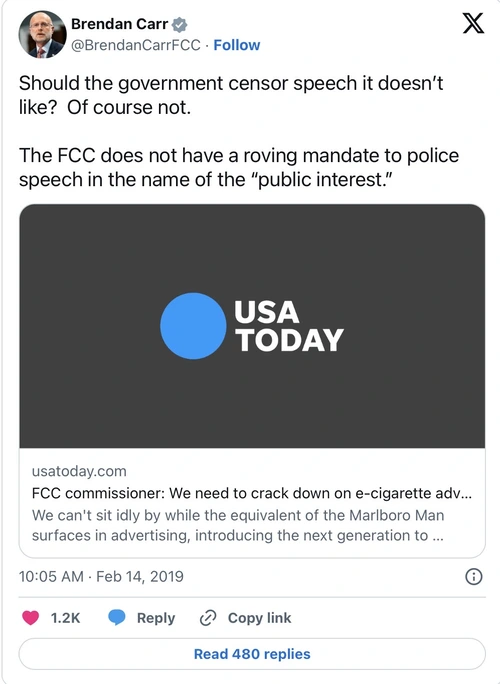
“Should the government censor speech it doesn’t like? Of course not,” he wrote. “The FCC does not have a roving mandate to police speech in the name of the ‘public interest.’”
Seven years later, that’s exactly what he’s doing — using the “public interest” standard as a club to beat newsrooms into submission on behalf of a president who views any critical reporting as a personal attack.
In 2022, Carr also defended political satire as “one of the oldest and most important forms of free speech,” warning that “people in influential positions have always targeted it for censorship.” By 2025, he was on a far-right podcast telling ABC, “We can do this the easy way or the hard way.”
Hollow Threats, Real Damage
Legal experts are clear that Carr’s threats have almost no chance of succeeding in court. The FCC hasn’t denied a license renewal in decades. Any revocation attempt would trigger a lengthy legal process and almost certainly fail on First Amendment grounds.
The FCC’s own website states that the First Amendment and the Communications Act “expressly prohibit the Commission from censoring broadcast matter.”
Public interest lawyer Andrew Jay Schwartzman told CNN that Carr “poses no genuine danger to any broadcasters’ licenses based on his unhappiness with their content.” Contested license cases would have to go before an FCC administrative judge, then the full commission, then to federal court — a process that could take years.
But the threats don’t have to succeed legally to do damage. When the most powerful media regulator in the country tells newsrooms to “correct course” on their war coverage or face consequences, the chilling effect is immediate. Nexstar pulled Kimmel within hours of Carr’s threats last year. Sinclair followed.
The message to every local news director in America is unmistakable: fall in line, or the government will make your life difficult.
The Radio Television Digital News Association responded Saturday night with a statement that cut through the noise: “Using federal regulatory power to threaten broadcast licenses over coverage decisions is unconstitutional — full stop. The First Amendment does not have a carve-out for news the FCC chair finds inconvenient.”
Why This Matters Now
The timing of this threat is not coincidental. The U.S.-Israel war on Iran is entering its third week, and the administration is losing control of the narrative. Six U.S. service members have been killed. Iranian drone strikes have hit targets in Kuwait and Saudi Arabia.
Defense Secretary Pete Hegseth has accused the press of trying to “make the president look bad” by covering American casualties — as if reporting on dead soldiers is a partisan act.
Trump has spent days raging on Truth Social about media coverage of the war. Hegseth attacked CNN for reporting on the war’s impact on the Strait of Hormuz and suggested the network would improve once a Trump-friendly owner takes over.
And now Carr has made the subtext explicit: cover this war the way we want, or we’ll come for your license.
This is what government control of the press looks like. Not the dramatic seizure of newsrooms, but the slow, steady application of regulatory pressure designed to make journalists think twice before reporting the truth.
Every local news director who softens a headline, every producer who kills a segment, every reporter who pulls a punch — that’s the real victory for an administration that views the free press as the enemy.
The Foundation for Individual Rights and Expression put it plainly: “When the government demands the press become a state mouthpiece under the threat of punishment, something has gone very wrong.”
Something has gone very wrong. And it’s getting worse.