
The planet is screaming. The question is whether anyone in power is still listening.
The WMO (World Meteorological Organization) released its annual State of the Global Climate report on March 23, and the findings are as unambiguous as they are terrifying. Earth’s energy imbalance, a measure of how much more heat the planet is absorbing than it’s releasing, just hit an all-time high.
The last eleven years — 2015 through 2025 — are now the hottest eleven years in the 176-year observational record. The oceans are cooking. Glaciers are disappearing. And the greenhouse gas concentrations driving all of it haven’t been this elevated in at least 800,000 years.
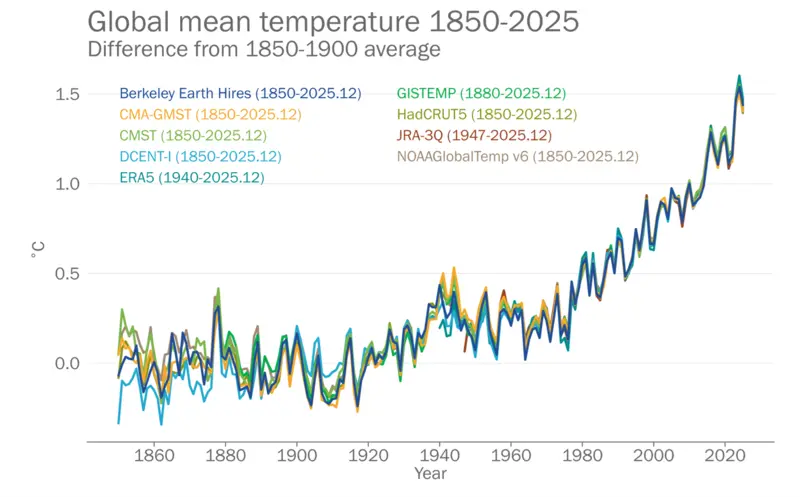
UN Secretary-General António Guterres didn’t mince words: the state of the global climate is a “state of emergency.” He added that when history repeats itself eleven times, it stops being a coincidence. It becomes a demand for action.
The Earth Is Trapping More Heat Than Ever
For the first time, the WMO report includes Earth’s energy imbalance as one of its key climate indicators.
The concept is straightforward: in a stable climate system, the energy coming in from the sun roughly equals the energy radiating back into space. Greenhouse gases — carbon dioxide, methane, nitrous oxide — have shattered that equilibrium by trapping heat that would otherwise escape.
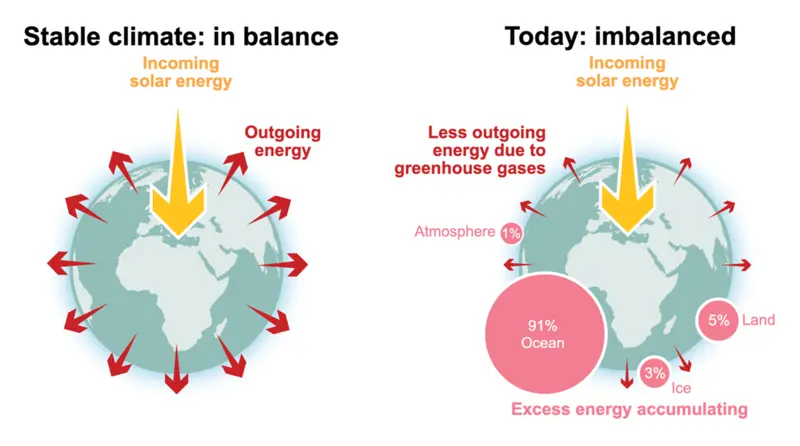
Source: FAQ 7.1 IPCC, 2021.
The result is a planet that’s accumulating excess energy at an accelerating rate. More than 91 percent of that trapped heat gets absorbed by the ocean, which functions as a massive thermal buffer. Another 5 percent warms the land. Three percent melts ice. Just 1 percent heats the atmosphere — the temperatures humans actually feel.
That last number should stop you cold. The heatwaves, wildfires, and extreme weather that killed thousands and cost billions in 2025? That’s just 1% of the excess energy doing its damage. The other 99% is rearranging the planet’s systems in ways that will play out over centuries.
The Oceans Are Absorbing the Blow — For Now
Ocean heat content reached a new record high in 2025, the ninth consecutive year of record-setting ocean temperatures. The rate of ocean warming has more than doubled when comparing the period from 1960-2005 to the last two decades.
The ocean is now absorbing the equivalent of about 18 times humanity’s total annual energy consumption every single year.
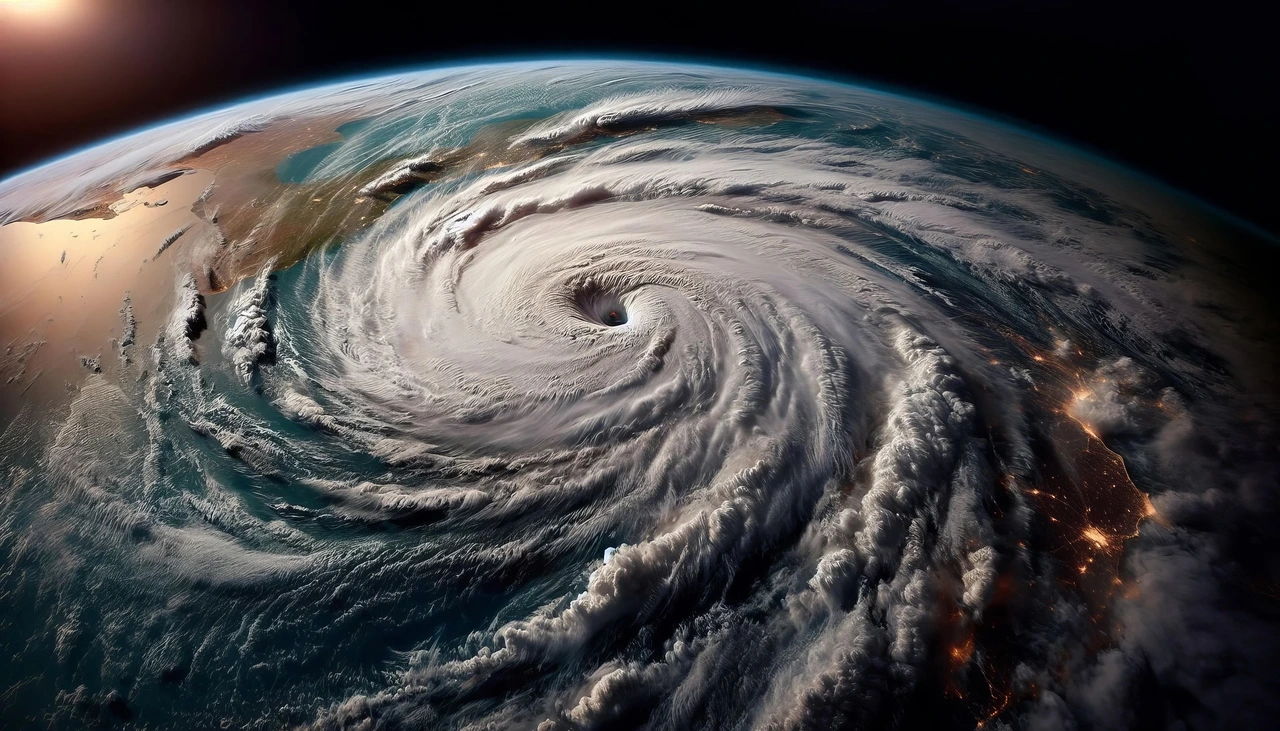
This is not good news. Warmer oceans fuel stronger hurricanes and tropical storms. They bleach and kill coral reefs. They destabilize marine ecosystems that billions of people depend on for food and livelihood.
And all that absorbed carbon dioxide is making the water more acidic — ocean surface pH levels are now lower than they’ve been in at least 26,000 years.
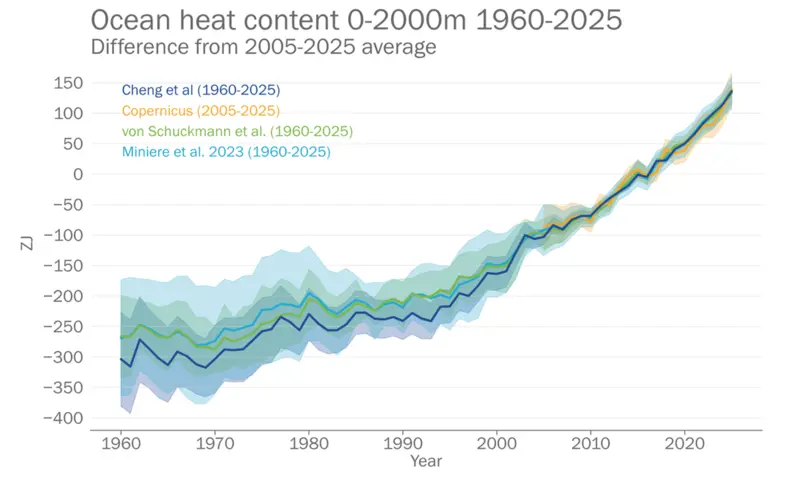
Sea levels have risen roughly 11 centimeters since satellite measurements began in 1993, and the rate of rise has accelerated since 2012. The Intergovernmental Panel on Climate Change projects that ocean warming and sea level rise will continue for centuries, regardless of what emissions policies get enacted tomorrow.
Changes to deep ocean temperature and acidity are effectively irreversible on timescales of hundreds to thousands of years.
Ice Is Vanishing
Arctic sea ice hit its lowest or second-lowest annual extent ever recorded in the satellite era. The winter maximum — the point when Arctic ice should be at its most expansive — was the lowest ever documented. Antarctic sea ice was the third lowest on record, and the past four years have produced the four lowest Antarctic minimums ever measured.
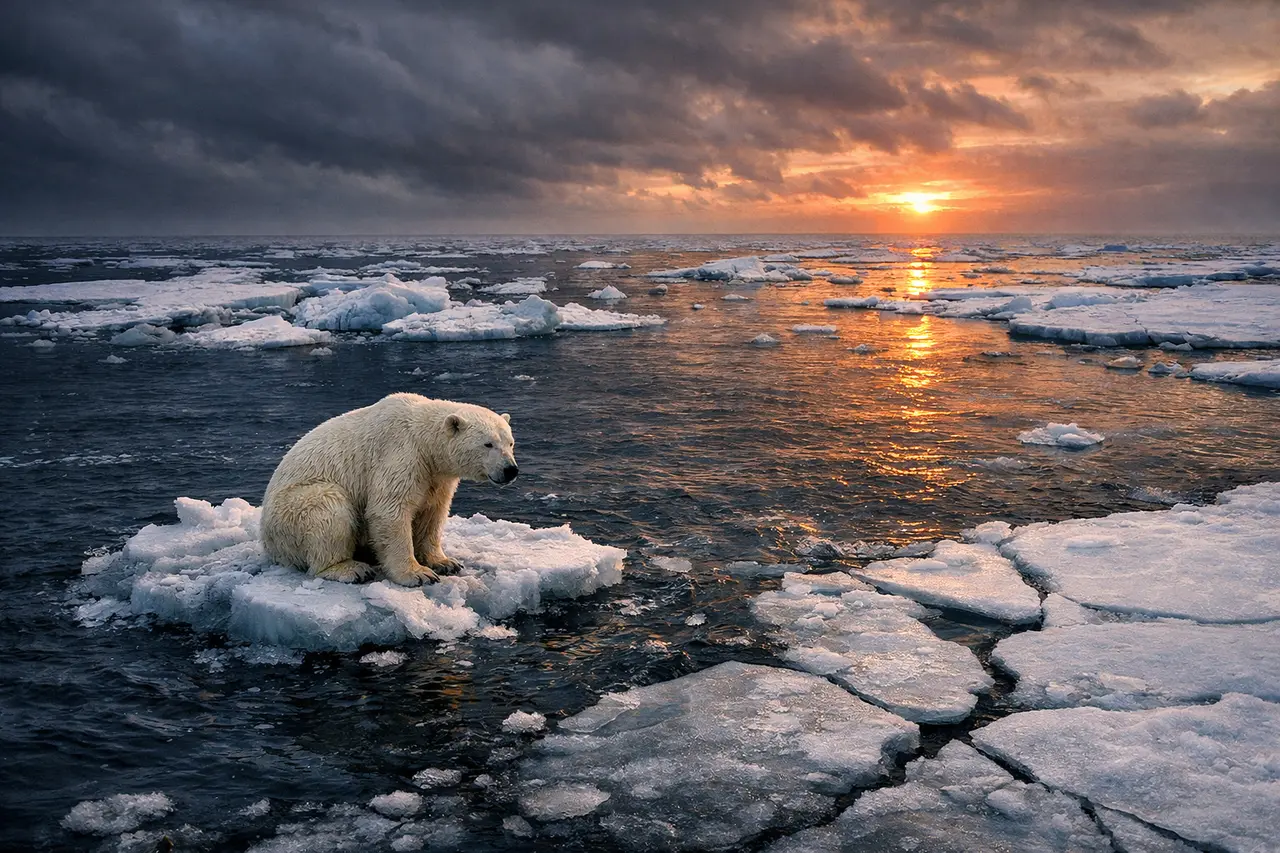
Glaciers continued their relentless retreat. Iceland and the Pacific coast of North America saw exceptional levels of ice loss in 2025, continuing a trend that has accelerated dramatically since 2016 — eight of the ten worst years for glacier loss on record have occurred in the past decade.
People Are Already Paying the Price
The WMO report dedicates attention to what these numbers mean for actual human lives. In 2025, heatwaves, wildfires, drought, tropical cyclones, and flooding caused thousands of deaths, displaced communities worldwide, and generated billions in economic losses.
The California wildfires in January 2025 alone caused more than $60 billion in damage — the costliest wildfire event ever recorded.
Dengue fever, now the world’s fastest-spreading mosquito-borne disease, puts roughly half the global population at risk. Reported cases are at their highest levels ever.
Over 1.2 billion workers — more than a third of the global workforce — face dangerous heat exposure on the job each year, particularly in agriculture and construction.
Climate-driven food insecurity is compounding displacement and migration, with especially devastating effects in fragile and conflict-affected regions. Shuttering USAID has caused millions of needless deaths across the globe.
The cascading effects of repeated disasters are stripping vulnerable communities of any ability to recover before the next crisis hits.
The U.S. Response: Dismantle the Tools

This is the context in which the Trump administration chose to revoke the EPA’s endangerment finding — the 2009 scientific determination that greenhouse gas emissions threaten public health and welfare. That finding served as the legal foundation for virtually all federal climate regulation under the Clean Air Act, including emissions standards for vehicles and power plants.
EPA Administrator Lee Zeldin called the repeal “the single largest act of deregulation in American history.”
The administration has also eliminated tailpipe emissions standards for vehicles, blocked California’s ability to set its own car pollution rules, killed consumer tax credits for electric vehicles, gutted power plant carbon standards, delayed methane regulations for oil and gas operations, and fired the HHS research team studying the health impacts of extreme heat — right before summer.
The scientific community has been blunt about what this means. Climate scientist Zeke Hausfather noted that the evidence supporting the endangerment finding is far stronger now than it was in 2009. Environmental law groups including the Natural Resources Defense Council have promised to fight the repeal in court.
The Sierra Club called it the formalization of “climate denialism as official government policy.”
The Math Doesn’t Care About Politics
Here’s the thing about the WMO report: it doesn’t make policy recommendations. It presents data. And the data says Earth’s climate system is destabilizing faster than at any point in recorded history, driven by greenhouse gas concentrations that keep climbing.
WMO Secretary-General Celeste Saulo put it plainly: human activities are disrupting the planet’s natural equilibrium, and we will live with the consequences for hundreds and thousands of years.
The report can tell us the building is on fire. What it cannot tell us — what no scientific report can — is whether the people holding the fire hoses will choose to use them, or sell them to make a buck.
The WMO State of the Global Climate 2025 report is based on scientific contributions from National Meteorological and Hydrological Services, WMO Regional Climate Centres, United Nations partners, and dozens of independent scientists.