


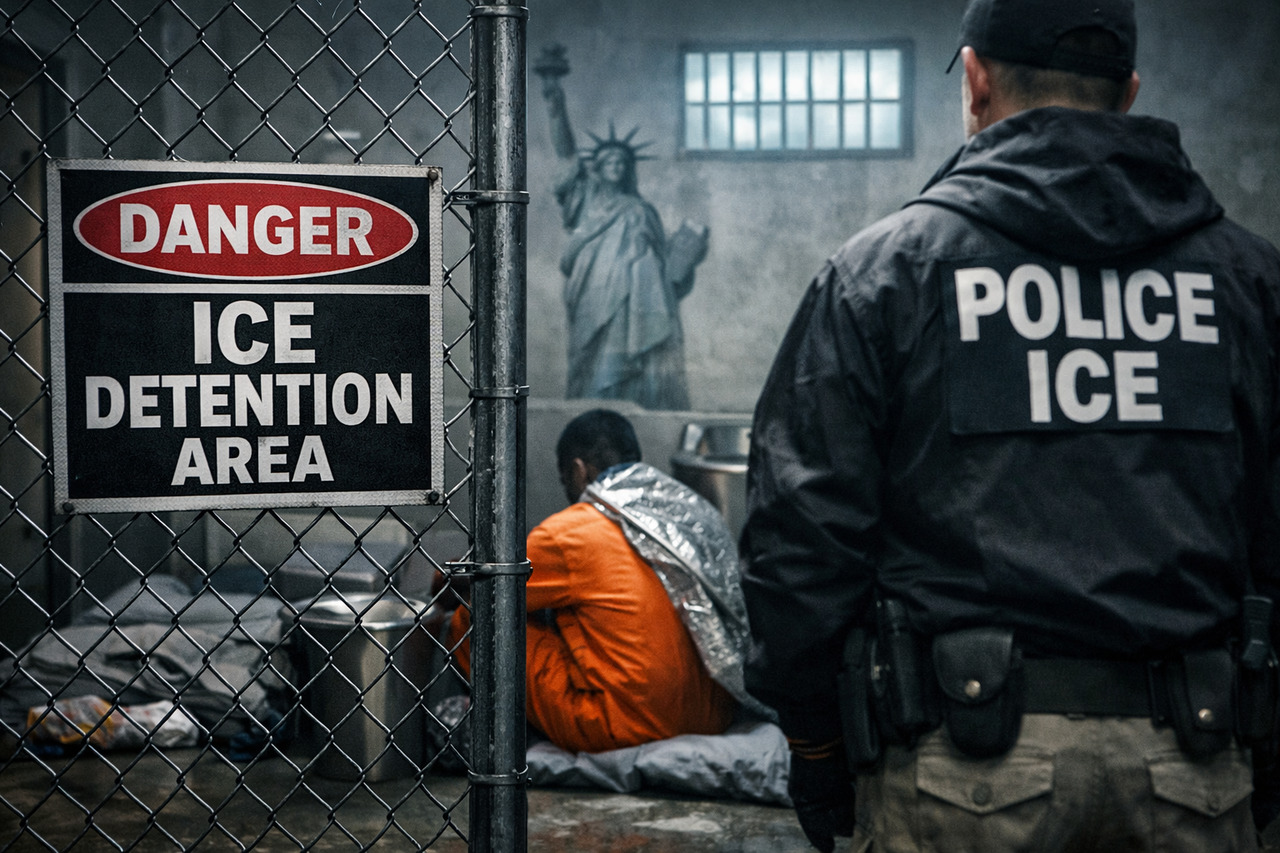
A federal judge in New York has sharply criticized U.S. Immigration and Customs Enforcement (ICE) after Erron Anthony Clarke was detained for days in what was described in court filings as “putrid,” horrific conditions at an ICE detention center in New York.
The December ruling, issued in the Eastern District of New York, highlighted serious concerns about how short-term holding cells are being used by ICE, pushing judges and advocates to question whether current practices violate constitutional and statutory protections for immigrants.
The case centers on Erron Anthony Clarke, a Jamaican national who entered the United States legally years ago on a temporary work visa and later married a U.S. citizen. In early December, Clarke was taken into ICE custody while pursuing an application for permanent residency.
What followed raised alarm from the bench and human rights observers. Instead of being immediately transferred to a proper detention facility, Clarke was held in a makeshift holding room inside a federal courthouse in Central Islip, Long Island, for days longer than even ICE’s own internal guidelines permit.
According to U.S. District Judge Gary Brown’s detailed order, multiple detainees —nine including Clarke — were confined in a space meant for short stays, designed to temporarily hold a single individual.
The room, described as cramped and “putrid,” lacked basic bedding, hygiene supplies, showers, or adequate heat. The temperature dropped into the 20’s, bright lights stayed on continuously, and detainees were forced to sleep on the floor around a hole used as a toilet.
U.S. District Judge Gary R. Brown, appointed to the bench during the Trump administration, did not mince words. In a sweeping 24-page memorandum and order, he wrote that the detentions “shock the conscience” and could well be unlawful, violating not only ICE’s own National Detention Standards but also fundamental due process rights.
Those standards specifically define how detention spaces should be used and capped the stay in a holding room at 12 hours — a limit eased internally by ICE memos to 72 hours amid swelling detention numbers.
Clarke’s legal team brought a habeas corpus petition, alleging that his confinement far exceeded what is legally and ethically permissible, particularly given his lack of criminal history. The court agreed, ordering Clarke released on bail during further proceedings.
Even after that order, though, the government held him overnight again before his eventual release on December 12 — a point the judge made with a comment about possible contempt proceedings.



Beyond the conditions themselves, the judge expressed deep concern over ICE’s responses to court inquiries. When ordered to provide basic documentation, including photographs of the Central Islip holding rooms and exact timelines of Clarke’s custody, ICE offered evasive responses or refused outright.

In some filings, the agency gave timeline details that the court found “demonstrably false,” such as claiming transfers between facilities in timeframes that were physically impossible given the distances traveled.

Brown warned that the apparent refusal to comply with judicial directives could prompt contempt proceedings against the Department of Homeland Security. Judge Brown gave DOJ lawyers until late December to justify why sanctions should not follow.
ICE Detention Center in New York
The case is one of several in recent months highlighting troubling conditions at an ICE detention center in New York, including makeshift holding rooms used beyond their intended purpose and facilities poorly equipped to handle prolonged incarceration.
Local advocates on Long Island have rallied against the court’s findings and pressured federal authorities to address what they describe as a pattern of neglect and inadequate oversight.
ICE has defended its practices in public statements, describing the Central Islip facility as a processing location rather than a detention center, and asserting that supplies, heating, bedding and food are provided as needed. Agency representatives have also pushed back against claims that detainees were held in dangerously cold conditions.
Still, the judge’s order and the detailed factual findings in the underlying legal filings paint a stark picture of how immigration enforcement practices can collide with constitutional obligations.
As debates continue in federal courts and on the broader national stage over how immigration detention should be conducted, this case underscores the urgent need for transparency, humane conditions, and adherence to both law and basic human dignity at the ICE detention center in New York and others across the nation.
Every member of Congress should inspect any ICE detention facilities in their district. This isn’t the first story about the terrible conditions in detention centers. Alligator Alcatraz was so bad that a judge ruled that it had to shut down.
Getting control over these human rights abuses now is increasingly important as they prepare to open ICE Mega Centers all over the country.