


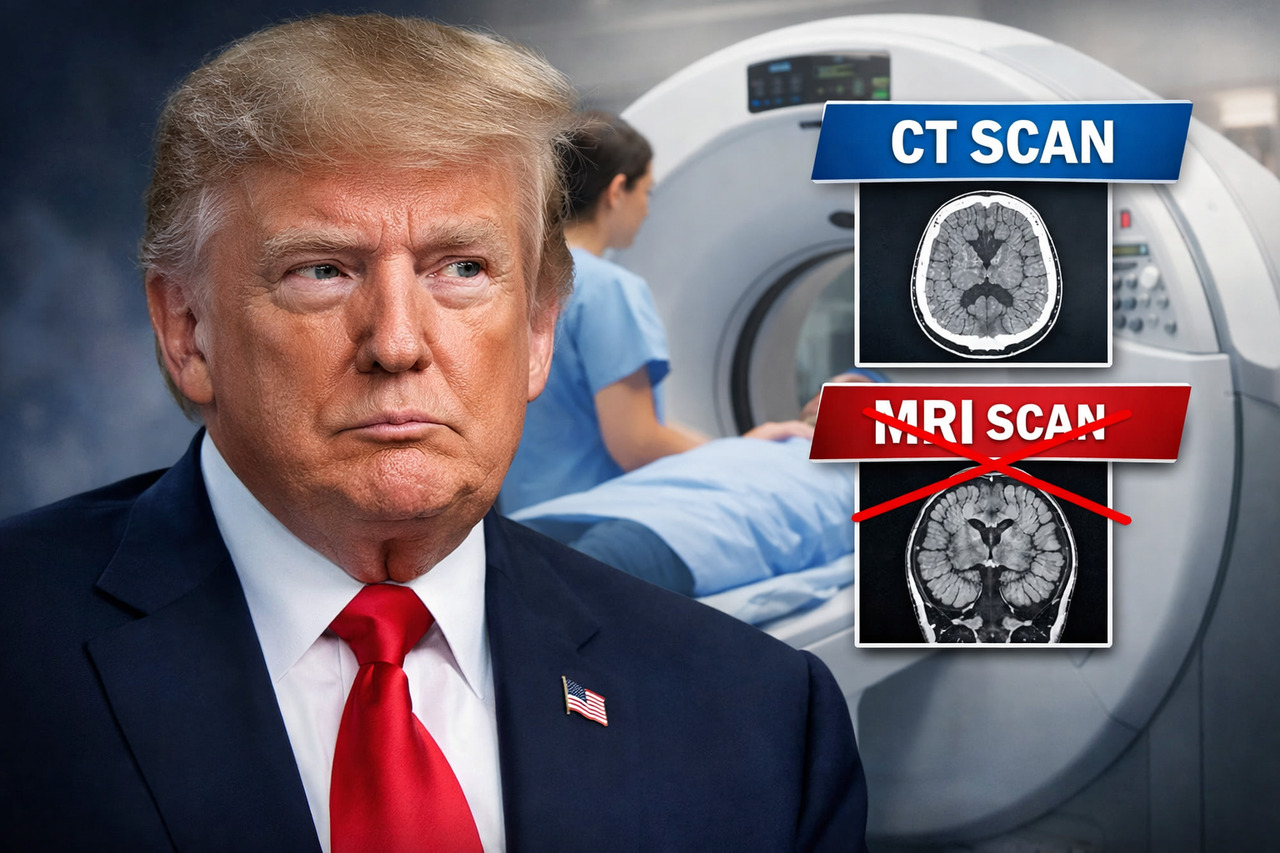
President Donald Trump has clarified the type of advanced imaging he received during a routine health exam in October, saying he underwent a CT scan — not an MRI, as he and White House officials had previously indicated.
The revelation came during a Wall Street Journal interview, where Trump also offered candid remarks about his health and the media attention surrounding the procedure.
MRI Claim vs. CT Scan Reality
In late October, Trump told reporters on Air Force One that he had an MRI scan during his visit to Walter Reed National Military Medical Center, describing the results as “perfect.”
Press Secretary Karoline Leavitt later referred to “advanced imaging” but did not specify the exact type of scan.
However, in a Sunday Wall Street Journal interview published January 1, 2026, Trump admitted the scan was a CT (computed tomography) scan, not an MRI (magnetic resonance imaging). His physician, Navy Capt. Sean Barbabella, confirmed this in a statement to CBS News Digital.
A CT scan uses X-rays to build a detailed 3D image of the body and is typically faster than an MRI, though it offers less detail of soft tissues. An MRI relies on magnetic fields and radio waves to produce more detailed images of organs.

Health Transparency and Public Scrutiny
Trump expressed mild regret about undergoing the scan, saying, “In retrospect, it’s too bad I took it because it gave them a little ammunition.” The president suggested that announcing the imaging fueled speculation about his health, though he maintains that nothing is wrong.
White House Press Secretary Karoline Leavitt reiterated that the administration always maintained Trump received advanced imaging and emphasized what she described as the president’s transparency about his health.
These health details are unfolding against a backdrop of public interest in Trump’s wellbeing as he serves his second term and nears his 80th birthday. Trump is currently the oldest person to serve as U.S. president.
What the CT Scan Showed
Capt. Barbabella explained that the CT scan was performed to “definitively rule out any cardiovascular issues.” The imaging — which Trump agreed to undergo while at Walter Reed to meet with staff and military personnel — reportedly showed no abnormalities.


This scan was precautionary in nature and separate from Trump’s annual physical, which took place earlier in the year. The White House said that advanced imaging is part of comprehensive care for someone in Trump’s age group.
Broader Health Comments from Trump
Beyond the imaging mix-up, Trump also talked about his health habits and lifestyle during the interview:
- Aspirin Use: Trump said he takes a 325 mg dose of aspirin daily, higher than what many doctors recommend (81 mg), because he believes it helps keep his blood thin. He acknowledged that this may contribute to easy bruising, especially on his hands, but said he is “a little superstitious” about lowering the dose.
- Exercise Preferences: The president reaffirmed that he does not enjoy traditional exercise routines such as treadmills, preferring activities like golf. Trump has previously suggested that the human body has a finite amount of energy, “like a battery,” and exercising causes “the battery” to die faster.
- Visible Bruising and Swelling: Some observers have noticed bruising on Trump’s hands and swelling around his ankles. The White House attributed the bruises to frequent handshaking and aspirin use, while swelling has previously been linked to a benign condition called chronic venous insufficiency.
What Experts Say
Medical professionals note that both CT scans and MRIs are standard procedures for evaluating cardiovascular and abdominal health. CT scans are often used as a first-line tool because they are quick and effective for detecting blocks, clots, and other structural issues. MRI is generally more detailed but takes longer and may not always be necessary for routine screening, which is why people didn’t believe he had a “routine” MRI.
President Trump’s clarification that he had a CT scan instead of an MRI underscores the intense scrutiny faced by public figures regarding their health. While the imaging did not reveal any problems, the conversation reflects broader interest in presidential health transparency and how this administration has failed to communicate Trump’s medical information to the public.