

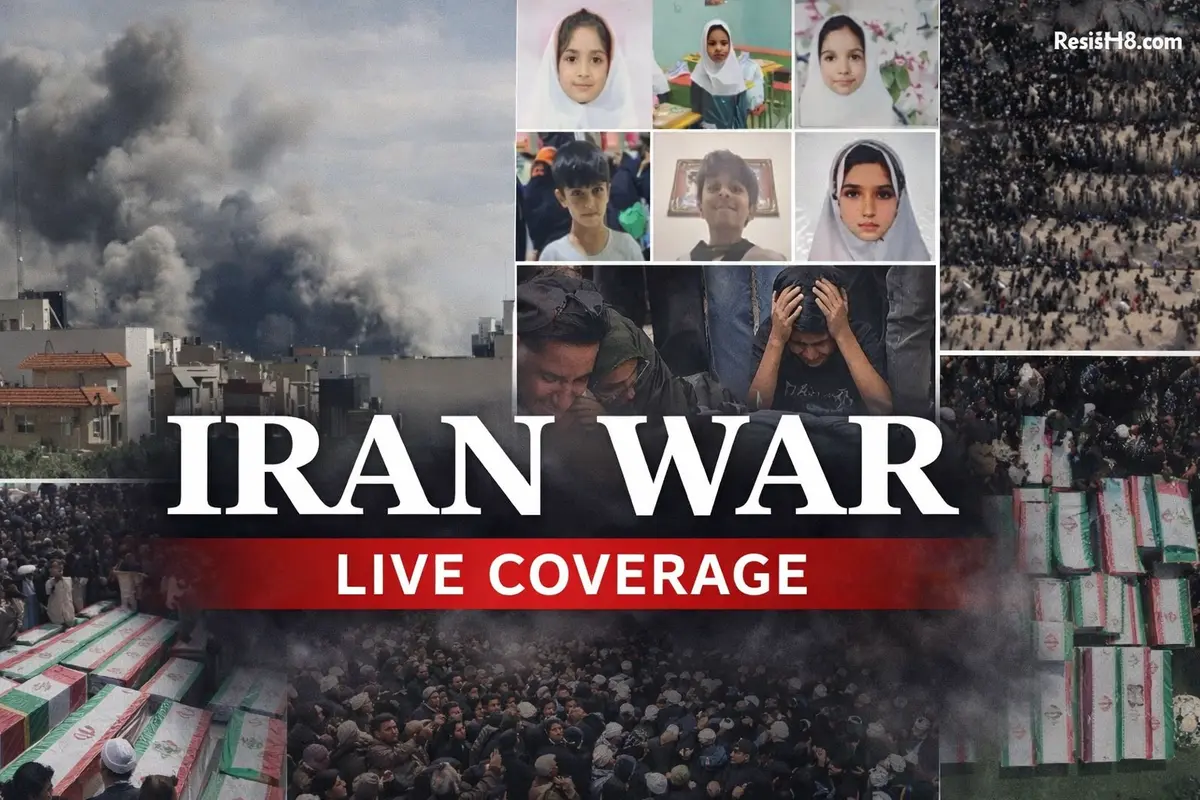
Three weeks into the U.S.-Israeli war on Iran, Saturday’s events made one thing brutally clear: the conflict’s nuclear dimension is no longer theoretical. It is now the central front.
Iranian ballistic missiles tore into the southern Israeli cities of Dimona and Arad on Saturday evening, wounding more than 100 people in what emergency services declared a mass casualty event.
The strikes targeted the area surrounding Israel’s Shimon Peres Negev Nuclear Research Center — the secretive desert facility where Israel is believed to have built its undeclared nuclear arsenal.

It was the first time the area had been directly targeted since the war began on February 28.
Iran said the attacks were direct retaliation for a strike earlier that day on its own Natanz uranium enrichment complex, the country’s most important nuclear site.
The Israeli military denied responsibility for the Natanz strike, saying it was “not aware” of such an attack — a claim that strains credulity given that Israeli aircraft have been operating continuously in Iranian airspace for three weeks and that destroying Iran’s nuclear capability is a stated objective of the campaign.
Children in the Blast Zone
The human cost arrived in fragments — of glass, of shrapnel, of concrete blown from apartment walls.
In Dimona, an Iranian missile struck a residential building, injuring at least 39 people. Among them was a 10-year-old boy in serious condition with shrapnel wounds.
Emergency paramedics described “extensive damage and chaos at the scene.” The Israeli military confirmed it failed to intercept the missile before impact.
Two hours later, a second missile — reportedly a Khorramshahr-4 carrying a 1.5-ton conventional warhead — slammed into a residential neighborhood in Arad, roughly 35 kilometers north of the nuclear research center.

The results were devastating: at least nine buildings sustained significant structural damage, some partially collapsed, and fires broke out in the wreckage.
At least 71 people were physically injured, including a 5-year-old girl listed in serious condition.
Emergency responders deployed helicopters, dozens of ambulances, and search teams to comb through rubble for survivors.
Soroka University Medical Center declared a mass casualty incident. The Israeli Health Ministry activated full emergency operations, and schools across the country were ordered closed through Monday.

Israel’s military acknowledged a critical failure: its air defense systems failed to intercept the missiles targeting both Dimona and Arad, despite those systems having successfully stopped similar projectiles in the past. The Israeli Air Force launched an investigation into the defense breakdown.
The Natanz Question
The trigger for Saturday’s escalation was an earlier strike on Iran’s Natanz enrichment complex — a facility that hosts underground centrifuges used to enrich uranium and that had already been damaged in last year’s 12-day war between Iran and Israel.
Iran’s Atomic Energy Organization confirmed the attack, calling it a violation of international law and nuclear agreements, but reported no radioactive leakage.
The International Atomic Energy Agency confirmed it had been informed of the strike and reported no increase in off-site radiation levels. IAEA chief Rafael Grossi renewed his call for military restraint to prevent a nuclear accident — a plea that both sides appear determined to ignore.
Iran’s parliament speaker framed the successful strikes on Dimona as proof of a shifted balance. If Israel cannot defend its most heavily protected nuclear zone, he argued, the war has entered a new operational phase.
Iranian military sources told state-aligned media that Tehran intends to raise the cost of any further attacks on its nuclear sites, warning that future responses will be broader and more damaging.
Diego Garcia and the Range Revelation
As if the nuclear escalation weren’t alarming enough, Iran on Friday launched two intermediate-range ballistic missiles at Diego Garcia, the joint U.S.-U.K. military base in the Indian Ocean — roughly 4,000 kilometers from Iranian territory.
Neither missile hit the base. One was intercepted by a U.S. warship; the other malfunctioned in flight. But the attempt itself sent shockwaves through Western defense establishments.
Iran’s foreign minister had claimed just last month that Tehran’s ballistic missiles had a maximum range of about 2,000 kilometers. Diego Garcia is double that distance — and roughly the same distance from Iran as much of central Europe.
The U.K. condemned what it called Iran’s “reckless attacks” and confirmed it had authorized the United States to use British bases, including Diego Garcia and RAF Fairford in England, for “defensive operations” targeting Iranian assets near the Strait of Hormuz.
London drew the line at allowing use of RAF Akrotiri in Cyprus for offensive strikes, an effort to limit its exposure to a conflict that most European nations have tried to stay out of.
Trump’s 48-Hour Ultimatum
Against this backdrop of escalating nuclear brinkmanship, President Trump took to Truth Social on Saturday night to issue what may be the war’s most dangerous threat yet. He gave Iran 48 hours to fully reopen the Strait of Hormuz — the critical waterway through which roughly a fifth of global crude oil passes during peacetime — or face the destruction of its power plants.
“If Iran doesn’t FULLY OPEN, WITHOUT THREAT, the Strait of Hormuz, within 48 HOURS from this exact point in time, the United States of America will hit and obliterate their various POWER PLANTS, STARTING WITH THE BIGGEST ONE FIRST!” Trump wrote.
The U.S. has so far avoided targeting Iranian energy infrastructure out of concern for global economic fallout.
Striking power plants would represent a dramatic escalation aimed at Iran’s civilian population — one that would almost certainly deepen humanitarian suffering in a country already under three weeks of sustained bombardment that has killed at least 1,444 people.
A War With No Off-Ramp
The day’s events laid bare a conflict that is accelerating rather than winding down, despite Trump’s suggestion just 24 hours earlier that the U.S. was considering scaling back military operations.
Israeli Defense Minister Israel Katz announced that strikes against Iran would “increase significantly” in the coming week. Israel’s chief of staff approved new attack plans “across all fronts.”
Meanwhile, the broader regional picture grew darker: the UAE reported intercepting yet another wave of Iranian missiles and drones, bringing its wartime total to 341 ballistic missiles, 15 cruise missiles, and 1,748 drones. Saudi Arabia expelled Iranian diplomatic staff. Schools across Israel moved to remote learning.
Three weeks in, the U.S.-Israeli campaign has struck more than 7,000 targets in Iran.
Iran’s navy is grounded, its tactical aircraft aren’t flying, and its missile launch rate has reportedly decreased from the war’s opening days. But Saturday proved that Iran retains the capacity to strike where it hurts most — and that it is willing to target the nuclear dimension of this conflict head-on.
For the children of Dimona and Arad — a 10-year-old boy wrapped in bandages, a 5-year-old girl fighting for her life — the strategic calculations of generals and presidents are meaningless.
They are living through the consequences of a war that neither side seems capable of stopping and no outside power appears willing to halt.
The IAEA can call for restraint. The U.N. can issue statements. But when both sides are striking each other’s nuclear infrastructure while children sleep in nearby apartment buildings, the word “restraint” has lost all meaning.
Later tonight: The WHO is preparing for nuclear war.
This is a developing story. Resist Hate will continue to update coverage as new information becomes available.