

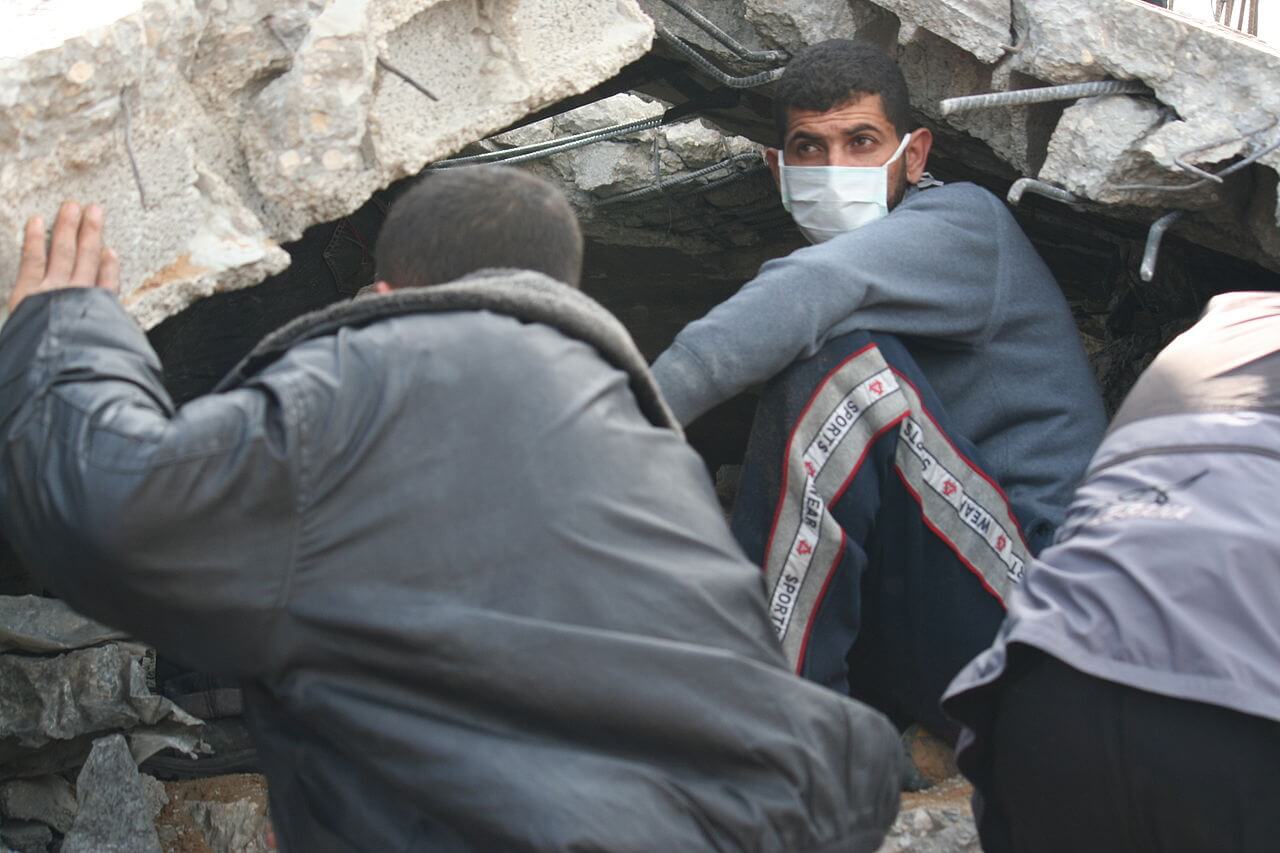
The mission that haunts Nooh al-Shaghnobi most took place on September 17, near the al-Saha area of eastern Gaza City. Israeli forces had bombed a home, killing more than 30 members of one extended family. Most of their bodies were trapped under the rubble.
Al-Shaghnobi’s Gaza Civil Defense force team pulled two dead young girls from the bombed house and kept digging, crawling under collapsed floors. “We don’t go under unless someone is alive,” he told The Intercept.
“Otherwise, we dig from above — ceiling by ceiling.” What followed was a descent into something dreamlike and horrifying.
“We walked 12 meters under the rubble,” he said. “Every meter, the air grew less. I crawled past legs, arms, the body of a child hugging his dead mother. I felt the ground shake from bombings above.”
From deep inside the wreckage, the team heard a young girl calling, “I’m here. I’m here.”
The Civil Defense force is an emergency and rescue operations group administered by the Palestinian Minister of Interior. After two years of Israeli genocide, it has an estimated 900 personnel and has lost roughly 90% of its operating capacity, Civil Defense workers told The Intercept.
In the absence of heavy equipment, the civil defense teams use simple tools like hammers, axes, and shovels. Without excavators or heavy equipment, a single recovery can take days.
Local civil defense workers estimate there are still 10,000 bodies buried under the rubble.
“When you hear a voice, you know there is life. That’s enough to make you risk your life to recover this soul.”
By the time al-Shaghnobi finally reached Malak, she was unconscious with no pulse. Her eyes open, her legs blue, she had passed away.
“I tried to wake her up, but it was too late,” al-Shaghnobi said. “I was in a moment of utter stillness, and I could hear nothing but my own breath.”