

Editor’s Note: Before I start using my “news reporter voice,” I want to say something: If you’ve known Kurt Cobain was murdered since 1994, leave a comment. 👋
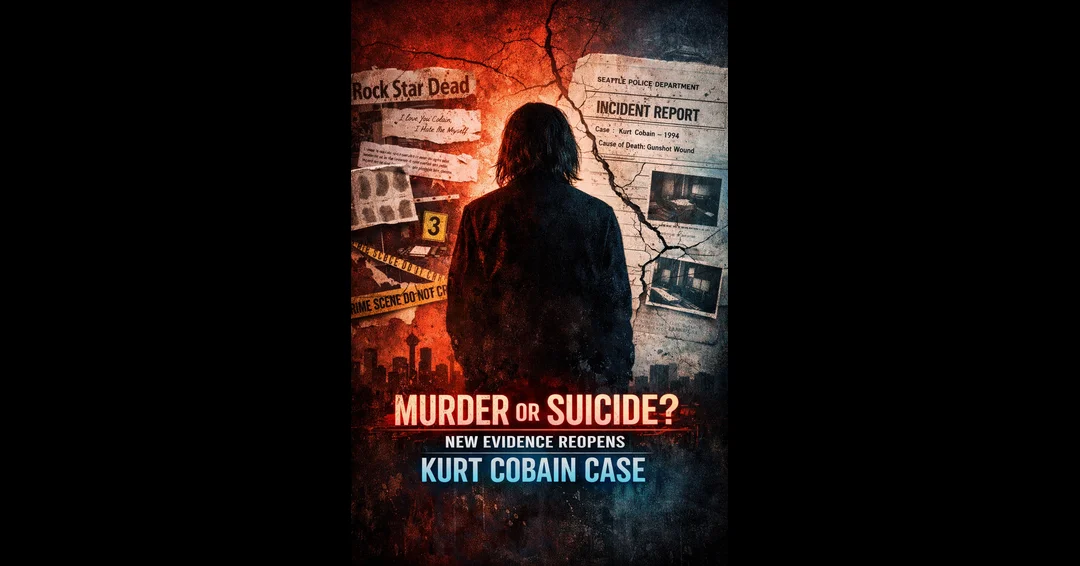
Nearly 32 years after Kurt Cobain was found dead in his Seattle home, a new forensic report is raising serious questions about how the Nirvana frontman actually died. A team of independent forensic experts now claims that Cobain’s 1994 death was not a suicide — it was a homicide.
What Does the New Report Say?

The findings come from a peer-reviewed paper led by forensic specialist Brian Burnett and independent researcher Michelle Wilkins. After reviewing the original autopsy and crime scene evidence, the team concluded that Cobain may have been attacked by one or more people, forcibly injected with a massive heroin overdose to knock him unconscious, and then shot in the head. They also believe the shotgun was placed in his hands afterward to make it look like he did it himself.
Burnett was blunt in his assessment, telling the Daily Mail: “This is a homicide.”
Kurt Cobain Was Murdered: The Key Evidence
Several findings in the report stand out.
First, there’s the heroin. Cobain reportedly had roughly ten times the lethal dose for an experienced user in his system. The researchers argue it would have been physically impossible for someone that heavily drugged to cap their syringes, neatly pack away their heroin kit, and then lift a shotgun to pull the trigger.
“We’re supposed to believe he capped the needles and put everything back in order after shooting up three times, because that’s what someone does while they’re dying,” Wilkins told Newsweek.
Then there’s the autopsy itself. The report found organ damage — specifically necrosis of the brain and liver — that is consistent with oxygen deprivation from an overdose, not from a quick death by gunshot. Wilkins explained that this type of tissue damage simply doesn’t occur in an instant gunshot death.
The crime scene also raised red flags. The area around Cobain’s body was described as “eerily clean.” His hand was found gripping the shotgun barrel, but there was no blood spatter on it. Shotgun shells were lined up at his feet, and a receipt for the gun and ammunition was found in his pocket. Wilkins said the whole scene looked deliberately arranged.
“To me, it looks like someone staged a movie and wanted you to be absolutely certain this was a suicide,” she said.
The report also questions Cobain’s famous suicide note. Handwriting experts involved in the analysis claim the top portion of the note reads more like a letter about retiring from the music industry.



The final lines — the ones that reference suicide and family — appear to be written in a different style, suggesting someone may have added them later.

What Happens Now?
The team has formally asked authorities to reopen the case. So far, the answer has been no. The Seattle Police Department said their original detective concluded Cobain died by suicide, and that remains their position. The King County Medical Examiner’s Office said they are open to revisiting conclusions if new evidence emerges, but they have seen nothing that warrants reopening the case.
“If we’re wrong, just prove it to us,” Wilkins responded. “That’s all we asked them to do.”
Why This Matters
As of February 2026, Kurt Cobain’s death is still officially classified as a suicide. But this new forensic analysis represents the most structured, science-based challenge to that ruling in three decades. Whether or not authorities ever act on it, the report has reignited a conversation that millions of fans and skeptics have been having since 1994.
For those who loved Cobain’s music and mourned his loss, the question remains painfully open: What really happened in that Seattle greenhouse?
If you or someone you know is struggling with thoughts of self-harm, please reach out to the 988 Suicide and Crisis Lifeline by calling or texting 988.