

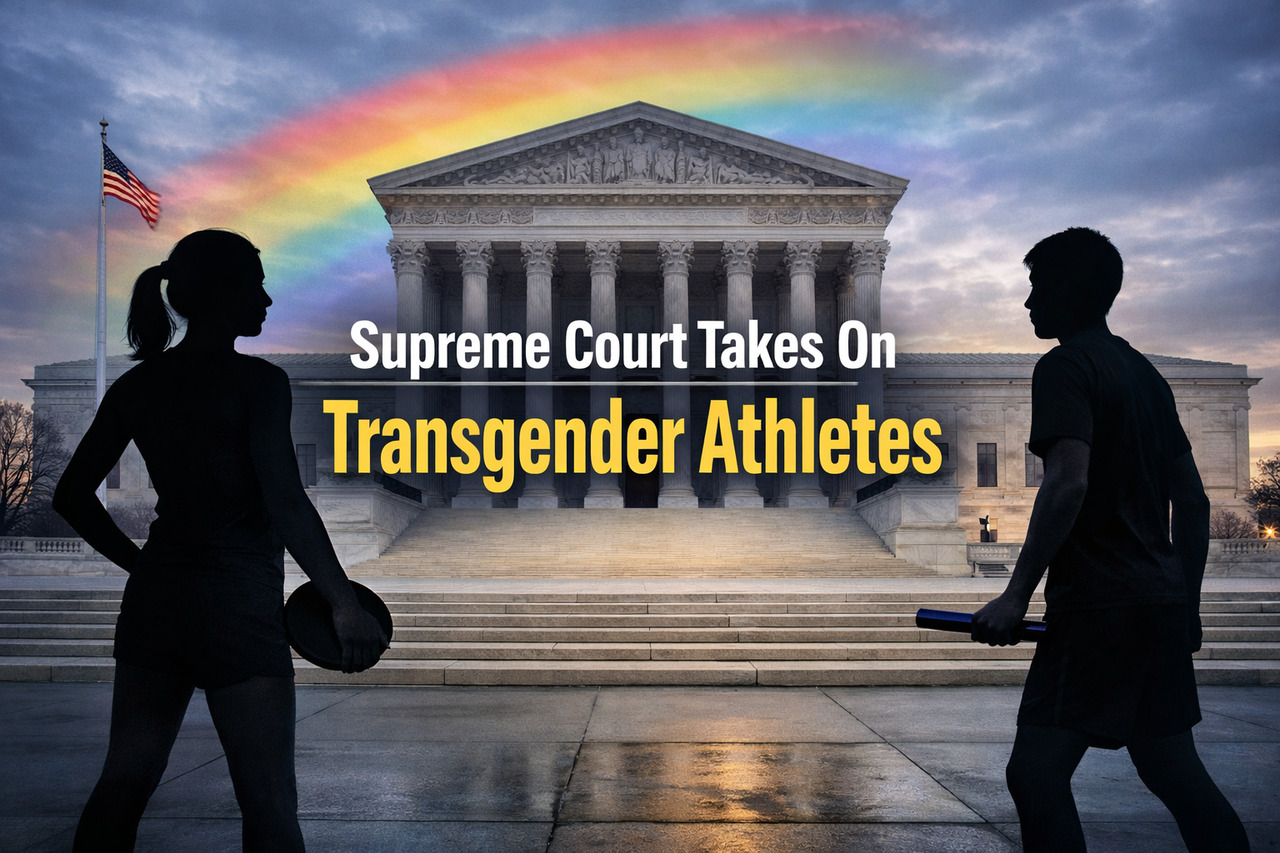
As the U.S. Supreme Court begins a watershed legal confrontation this week, the future of transgender athletes in girls’ and women’s sports hangs in the balance.
Two high-profile cases from Idaho and West Virginia are now before the nation’s highest court, setting the stage for an unprecedented ruling with far-reaching legal and cultural implications.
The cases, Little v. Hecox and West Virginia v. B.P.J., challenge state laws that ban transgender girls and women from participating in female-designated athletic programs.
At stake is the broad interpretation of Title IX — the landmark 1972 federal civil rights law that prohibits sex-based discrimination in education — and whether its protections extend to transgender students in sports.
At the center of the West Virginia case is 15-year-old athlete Becky Pepper-Jackson, who has been living as a girl since early childhood and placed third in the girls’ discus throw during last season’s high school competition.
Her ability to compete this year is now uncertain because of the state’s “Save Women’s Sports Act,” a 2021 law that bars transgender girls from girls’ sports teams. Her family’s lawsuit successfully blocked enforcement of the ban in lower courts, but the Supreme Court’s decision on Tuesday will determine the continuation of that protection.
My Opinion
Just as I’ve said in the past in regards to abortion bans, politicians should not ban something without first consulting a knowledgable expert or professional on the subject. I argued that state legislatures and Congress should first consult an OBGYN to answer questions and educate legislators on things like; when an actual heartbeat exists, medical risks, and what emergencies should be included in some form of “exceptions clause” of legislation, etc.
People who are willfully ignorant, or simply uneducated, when it comes to gender-affirming care should learn about hormones and puberty before making decisions on laws involving transgender youth. If a trans girl began taking puberty blockers at a young age, the “strength” and other biological male characteristics used in the argument against trans girls playing in girls sports (biological males are stronger, etc.) usually haven’t developed without the hormonal changes that occur during puberty.
Whether intentional or not, passing legislation that bans something you don’t even understand is wrong. Just my 2 cents…
ACLU Video Featuring Becky Pepper Jackson

In Idaho, the Little v. Hecox case focuses on the Fairness in Women’s Sports Act, enacted in 2020. Named after then-Governor Brad Little, this law prevented transgender women and girls from competing on girls’ school sports teams.
Isolated in scope, the original challenge initially secured a favorable ruling for transgender rights lower down, but Idaho’s appeal has pushed it to the Supreme Court for a definitive decision.
Transgender Athletes Cases
The legal debates are intensely complex and polarized. Supporters of the bans argue that they protect fair play and physical safety in women’s sports by linking eligibility strictly to biological sex assigned at birth. Opponents, including civil rights groups like the ACLU, contend these laws discriminate against transgender athletes and violate constitutional equal protection guarantees.
These Supreme Court cases arrive at a moment of heated national conflict over sports, culture, and civil liberties. Nearly 30 states have passed laws restricting transgender participation in girls’ sports to varying degrees.

Some initiatives, like in Washington state, even propose invasive verification methods for student athletes’ sex at birth, such as genital inspections or blood tests — measures that rights advocates have denounced as discriminatory and harmful.
Political responses are likewise split. Over 130 Democratic members of Congress signed a brief urging the Supreme Court to rule in favor of inclusive policies for transgender athletes, framing the legal battle within broader civil rights protections.
But the narrative is not one dimensional. Some news outlets have highlighted unverified allegations of harassment involving a trans athlete central to one of the cases, which complicates public perception and has drawn scrutiny over the details — though major court arguments remain focused on constitutional and statutory law rather than individual conduct.
Public opinion surveys show that a majority of Americans favor categorizing athletic participation by sex assigned at birth, revealing deep divisions between cultural attitudes and evolving civil liberties interpretations.

The Supreme Court’s conservative majority adds another layer to the uncertainty, especially after recent rulings that have been viewed as less favorable to transgender rights in other contexts.
One key justice’s prior support for broad LGBTQ workplace protections contrasts with more recent votes that have sided with restrictions on gender-affirming care, making his vote a focal point of advocacy and legal strategy alike.
Whatever the outcome, the Supreme Court’s ruling — expected by early summer 2026 — will set a legal precedent that could redefine how transgender athletes are treated nationwide and potentially influence a wide range of civil rights questions beyond sports.
For families, athletes, lawmakers, and rights advocates, this is more than a sports story — it’s a pivotal moment on the intersections of law, identity, and equal opportunity.