


A federal judge just slammed the brakes on Trump’s $400 million White House ballroom project, ruling that no president has the authority to demolish parts of the White House and build whatever he wants without Congress signing off.
What Just Happened
U.S. District Judge Richard Leon — a George W. Bush appointee, not exactly a liberal activist — issued a preliminary injunction on Tuesday ordering all construction on Trump’s massive ballroom to halt.
The ruling came after the National Trust for Historic Preservation sued the administration, arguing that Trump blew past every legal requirement when he demolished the 120-year-old East Wing last October and started building a 90,000-square-foot entertainment complex in its place.
The judge didn’t mince words. He wrote that the president is the “steward” of the White House, not its owner, and that construction “must stop until Congress authorizes its completion.”
He found that no existing law “comes close” to giving Trump the authority he’s claimed to unilaterally tear down and rebuild parts of the most iconic building in American democracy.
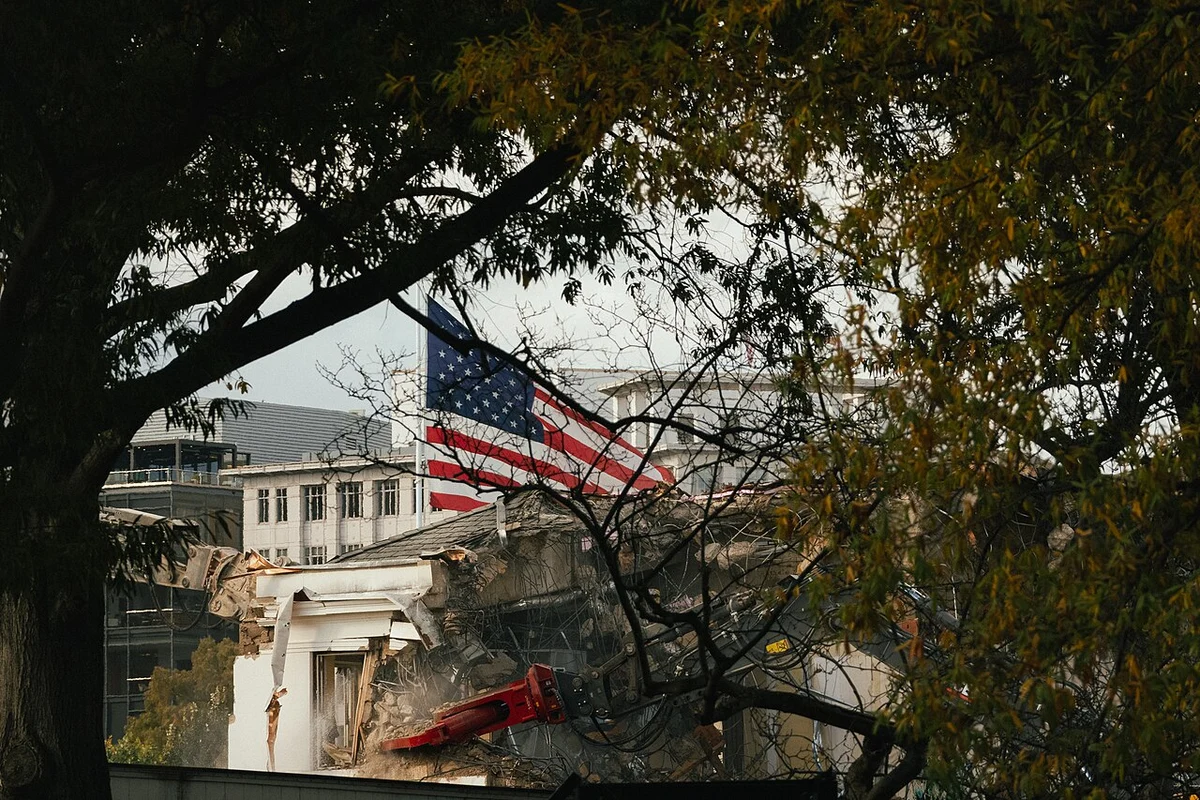
Leon gave the administration 14 days before the injunction takes effect. The Justice Department filed an appeal within hours.
How We Got Here
Trump demolished the East Wing — which housed the First Lady’s offices, the White House Family Theater, and the historic Jacqueline Kennedy Garden — in late October 2025.
He did this without submitting plans to either of the two federal commissions that are supposed to review construction on federal property.
He didn’t seek congressional authorization. He didn’t open a public comment period. He just started tearing it down.
The ballroom project has ballooned from an initial $250 million estimate to $400 million, funded entirely by private donations — including from tech giant Alphabet, which donated $22 million as part of a legal settlement with Trump.
The proposed structure would be roughly 89,000 square feet, significantly larger than the 55,000-square-foot White House itself.
Trump has been deeply personally involved, from selecting marble to reviewing floor plans. He told reporters aboard Air Force One on Sunday that the ballroom would feature bulletproof glass and a “drone-proof roof,” and that a “massive” military complex is being built underneath it. He’s promised to have it finished by summer 2028.
The Public Doesn’t Want it
The overwhelming public response to this project has been opposition — and it hasn’t been close. More than 32,000 public comments were submitted to the National Capital Planning Commission, and roughly 98% were critical.
The Commission of Fine Arts received 2,000 comments, with 99% opposed. People called the design “appalling,” “shameful,” and “hideous.”
Architecture professionals flagged serious design problems including an exterior staircase leading to a wall with no door, columns that would block views, fake windows, and disruptions to the historic symmetry of the White House grounds.
Even Republican Rep. Michael Turner of Ohio called images of the bulldozed White House grounds “deeply disturbing.”
None of this stopped Trump from stacking both review commissions with loyalists and fast-tracking approval.
What This Is Really About
This isn’t a story about architecture. It’s about a president who believes the rules don’t apply to him.
Trump bypassed Congress. He bypassed federal review boards. He demolished a historic building before anyone could stop him. He replaced the original architect after the designer pushed back on the project’s expanding scope.
And when asked about his motivations, Trump said plainly: “It’s a monument. I’m building a monument to myself — because no one else will.”
That quote should tell you everything you need to know.
Judge Leon, to his credit, recognized what’s at stake here. He emphasized that Congress has a constitutionally prescribed role in authorizing construction on federal property and spending oversight.
The law Trump cited to justify the project — which gives presidents authority for “care, maintenance, repair” and “alteration” of the White House — doesn’t cover demolishing entire buildings and constructing new ones.
As the judge put it, calling the East Wing demolition an “alteration” would require “some brazen interpretation of the laws of vocabulary.”
What Happens Next
Trump’s response to the ruling was predictable. He called the National Trust for Historic Preservation a “Radical Left Group of Lunatics” on social media — even though Attorney General Pam Bondi sits on the Trust’s board.
He complained that people don’t appreciate his efforts at “sprucing up” Washington’s buildings.
The Justice Department has already filed an appeal. The NCPC is still scheduled to vote on the ballroom design on April 2, though the legal significance of that vote is now questionable.
Meanwhile, the East Wing is already gone. The Jacqueline Kennedy Garden is destroyed. The damage to a piece of American history can’t be undone regardless of what happens in court.
That was always the strategy — move so fast that by the time anyone can stop you, the demolition is already done and the only question left is what to build on the rubble.
The court said no. Whether that no sticks is the next fight.