

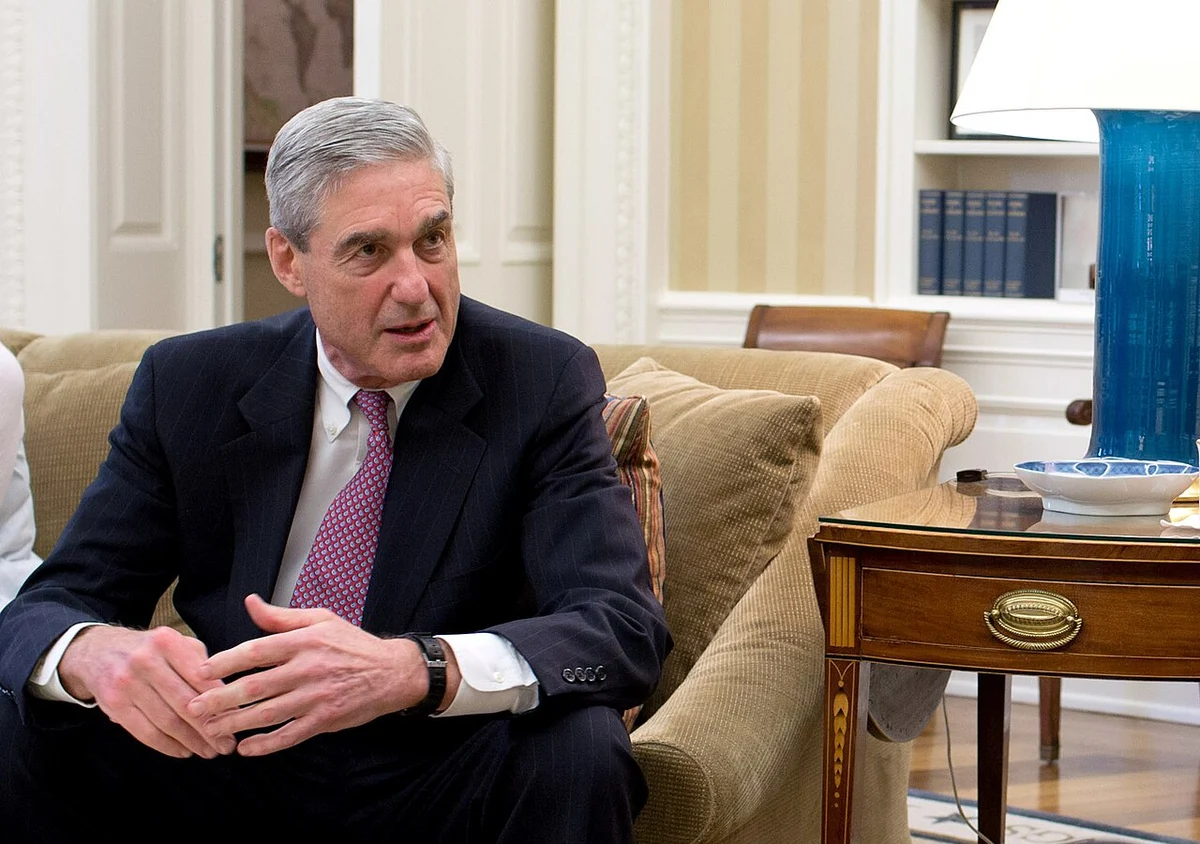
Former special counsel and decorated Marine combat veteran Robert Mueller has died at 81. The sitting president responded by saying he is “glad” Mueller is dead.
Robert Mueller, the former FBI director and special counsel who led the investigation into Russian interference in the 2016 presidential election, died Friday night at the age of 81.
His family confirmed the news in a brief statement Saturday morning, asking that their privacy be respected.
Mueller had been living with Parkinson’s disease since 2021, a diagnosis his family made public last August. He had stepped back from his law practice and teaching in recent years as the disease progressed.
Within hours of the news breaking, President Donald Trump took to Truth Social to broadcast his reaction:
“Robert Mueller just died. Good, I’m glad he’s dead. He can no longer hurt innocent people!”
President Donald Trump
It was a statement that managed to be shocking even by Trump’s well-established standards for cruelty — a sitting president of the United States publicly celebrating the death of a decorated combat veteran, a man who spent decades in bipartisan public service, and who was mourned Saturday by figures across the political spectrum.
The Life Trump Mocked
The contrast between the two men — born just two years apart, both raised in New York City, both Ivy League educated — could not be more stark.
Related News
After graduating from Princeton in 1966, Robert Mueller volunteered for the United States Marine Corps.
He trained at Parris Island, completed Officer Candidate School, Army Ranger School, and Army jump school, then shipped out to Vietnam as a rifle platoon leader with the 2nd Battalion, 4th Marines, 3rd Marine Division.
In December 1968, just weeks after arriving in-country, Mueller’s platoon came under heavy fire in Quang Tri Province.
He rescued a wounded Marine under enemy fire, personally leading a fire team across open, fire-swept terrain. For that action, he received the Bronze Star with “V” for valor. His citation praised his “courage, aggressive initiative, and unwavering devotion to duty.”
In April 1969, Mueller was shot through the thigh by an AK-47 round during an ambush.
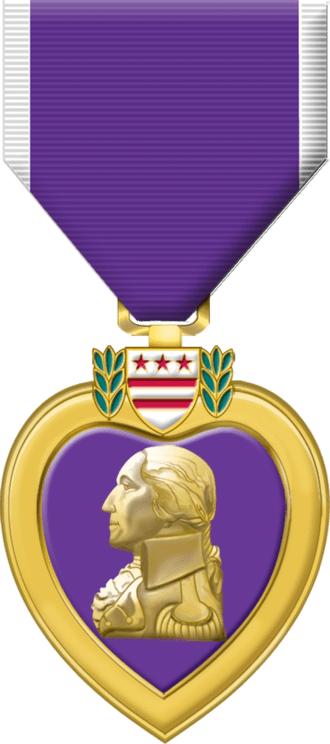
He kept fighting, maintained fire superiority over the enemy, and ensured the evacuation of his wounded. He received the Purple Heart. After recovering at a field hospital near Da Nang, he went back to his platoon.
By the time Mueller left Vietnam, his decorations included the Bronze Star, the Purple Heart, two Navy Commendation Medals, and the Vietnamese Cross of Gallantry.
“I consider myself exceptionally lucky to have made it out of Vietnam,” Mueller said years later.
“There were many — many — who did not. And perhaps because I did survive Vietnam, I have always felt compelled to contribute.”
Donald Trump, during that same war, received five draft deferments — four for college and one for bone spurs in his heels, a diagnosis arranged by a podiatrist who rented office space from Trump’s father.

Story of “bone spurs” diagnosis as a favor to Fred Trump
A Career of Bipartisan Service
Mueller went on to earn his law degree from the University of Virginia and spent over a decade as a federal prosecutor. He held Senate-confirmed positions under four different administrations — two Republican, two Democratic.
In 2001, President George W. Bush nominated Mueller as the sixth director of the FBI. He was confirmed unanimously by the Senate and took office on September 4th — exactly one week before the September 11 attacks transformed the role into something no one could have anticipated.
Mueller oversaw the Bureau’s transformation from a domestic law enforcement agency into a global counterterrorism force.
President Barack Obama later asked Mueller to stay beyond the standard 10-year term, making him the longest-serving FBI director since J. Edgar Hoover, with 12 years at the helm.
Former Deputy Attorney General Sally Yates, writing about Mueller for TIME in 2019, captured the man’s character: his work was governed not by entitlement, but by duty.
While the country held its breath during his nearly two-year special counsel investigation, Mueller didn’t utter a single public word.
The Investigation That Made Him a Target
In May 2017, following Trump’s firing of FBI Director James Comey, the Justice Department appointed Mueller as special counsel to investigate Russian interference in the 2016 election and any coordination between Moscow and the Trump campaign.
Over 22 months, Mueller’s team issued more than 2,800 subpoenas, executed nearly 500 search warrants, and interviewed approximately 500 witnesses.
The investigation produced 34 indictments and secured seven guilty pleas or convictions, including six Trump campaign associates — among them campaign chairman Paul Manafort, national security adviser Michael Flynn, personal attorney Michael Cohen, and longtime adviser Roger Stone.
The Mueller Report, all 448 pages of it, documented sweeping and systematic Russian interference in the election.
It uncovered dozens of secret contacts between the Trump campaign and Russian government officials — contacts both sides had denied.
The report detailed how Trump’s campaign “expected it would benefit electorally from information stolen and released through Russian efforts.”
Mueller did not establish that the campaign conspired with Russia. He also did not charge Trump with obstruction of justice — not because the evidence wasn’t there, but because longstanding Justice Department policy held that a sitting president could not be indicted.
Mueller made this explicit in a rare public statement: “If we had confidence that the president clearly did not commit a crime, we would have said so.”
Trump, of course, branded the entire investigation a “witch hunt” — a phrase he repeated hundreds of times during and after the probe.
He pardoned or commuted the sentences of associates convicted in the investigation, including Flynn, Manafort, and Stone. And on the day Mueller died, Trump made clear that his hatred outlasted the man himself.
The Reactions That Followed
The response to Trump’s post was immediate and divided along predictable lines.
Senator Adam Schiff called it a display of “basic indecency and unfitness for office.” Senator Richard Blumenthal described Mueller as “a dedicated, courageous patriot” and skilled prosecutor.
Senator Mark Warner praised his “integrity, duty, and strength of character.”
Former President George W. Bush, who nominated Mueller to lead the FBI, said he and Laura Bush were “deeply saddened,” noting that Mueller took office just one week before September 11 and “led the agency effectively, helping prevent another terrorist attack on U.S. soil.”
Andrew McCabe, a former FBI deputy director who was similarly targeted by Trump, called Mueller “an absolute American hero and an American patriot.”
Mueller’s former law firm, WilmerHale, mourned him as “an extraordinary leader and public servant and a person of the greatest integrity.”
The FBI Agents Association honored Mueller’s “commitment to public service and to the FBI’s mission.”
Some Republicans struck a more measured but still telling tone. Senator John Kennedy said Mueller served honorably “in his earlier days” but was “used by some of his colleagues” in his final public role.
Representative Mike Turner acknowledged Mueller’s “extremely strong reputation and career” before the special counsel appointment — a framing that accepts Trump’s premise that the investigation itself was the problem, rather than the conduct it uncovered.
What It Tells Us
There is no mystery here. A man who volunteered for combat in Vietnam, who was shot and went back to his platoon, who served his country under four presidents from both parties, who was unanimously confirmed by the Senate, and who spent his final years battling Parkinson’s disease — that man was mocked in death by a president who dodged the draft five times and has never shown the faintest understanding of duty or sacrifice.
Robert Mueller did not seek attention. He let his work speak for itself — perhaps too much so, as the investigation’s findings were drowned out by years of lies and conspiracy theories.
But the record is there for anyone willing to read it: 34 indictments, seven convictions, and a documented pattern of obstruction by a president who then pardoned the people convicted of covering for him.
Mueller once told an interviewer that he was still “most proud the Marine Corps deemed me worthy of leading other Marines.”
He lived and died as a man whose sense of duty was forged in the worst conditions imaginable and never wavered.
Trump’s reaction to Mueller’s death is not surprising. But it should still be remembered for what it is: a confession.
Not of guilt over the investigation — though the evidence speaks to that on its own — but of a character so hollow that it cannot comprehend service, sacrifice, or basic human decency. Even in death.
Robert Mueller is survived by his wife, Ann Cabell Standish, whom he married in 1966, and their two daughters.