

This article originally appeared on Minnesota Reformer
Diabetics rationing insulin. Jaundiced babies missing appointments. Appendicitis festering untreated for days. Expectant mothers laboring in hiding.
These were just some of the anecdotes shared by five Minnesota physicians Tuesday at a hastily scheduled Capitol press conference on the health care impacts of the federal law enforcement surge across the state.
They were flanked by Democratic-Farmer-Labor Sens. Alice Mann and Matt Klein, both physicians. The group evoked a climate of fear keeping patients and their loved ones out of Minnesota clinics and hospitals.
“The only other time in history I can remember having a group of physicians standing in front of you (like this) was during COVID…this is a moment of crisis in our state,” Mann said to an audience of several dozen press, legislative staff and medical workers.
The gathering came after the U.S. Department of Homeland Security recently subpoenaed Hennepin Healthcare for the I-9 forms it uses to confirm its workers’ identities and employment eligibility. Those forms include workers’ home addresses, Social Security numbers and other sensitive personal information.
Hennepin Healthcare operates Hennepin County Medical Center, a major safety net hospital in downtown Minneapolis that serves a relatively high proportion of uninsured and underinsured patients. Earlier this month, elected officials and HCMC staff called on hospital administrators to do more to protect patients after reports emerged that federal agents stood watch by a shackled detainee’s bedside and prevented family members from visiting him for more than a day over the New Year holiday.
Another detainee, Alberto Castaneda Mondragon, reportedly remains hospitalized at HCMC under U.S. Immigration and Customs Enforcement supervision after sustaining a “catastrophic” and “life-threatening” head injury in the hours after his Jan. 8 arrest, according to a lawsuit reviewed by Sahan Journal. It’s unclear exactly how the injury occurred, but the lawsuit alleges Castaneda Mondragon told hospital staff that he was roughed up by federal agents.
In a statement about the New Year detention, HCMC said “any federal agents arriving with a patient presented appropriate identification, adhered to our established processes, and left after (hospital security) asked for documentation to support their continued presence.”
U.S. Immigration and Customs Enforcement did not respond to an email seeking comment.
The doctors assembled at the Capitol on Tuesday made clear that those assurances don’t go far enough.
Klein, a former Hennepin Healthcare physician running for U.S. Congress in Minnesota’s 2nd District, said he’d cared for “numerous patients” at HCMC in the midst of “formal interactions with the law…but I’ve never heard a concern over 35 years of practice that patients’ rights were violated.”
Klein tied what he said were federal agents’ disregard for patient privacy and well-being with the killing earlier this month of Renee Nicole Good, a U.S. citizen and mother of three. According to media and witness reports, agents rebuffed a physician who arrived at the scene shortly after ICE agent Jonathan Ross shot Good at least three times.
Klein said Good still had a pulse “eight minutes” after the shooting.
“I can’t say how much that stirs the blood of those behind me…and I believe it stirs the blood of every patriotic Minnesotan,” he said.
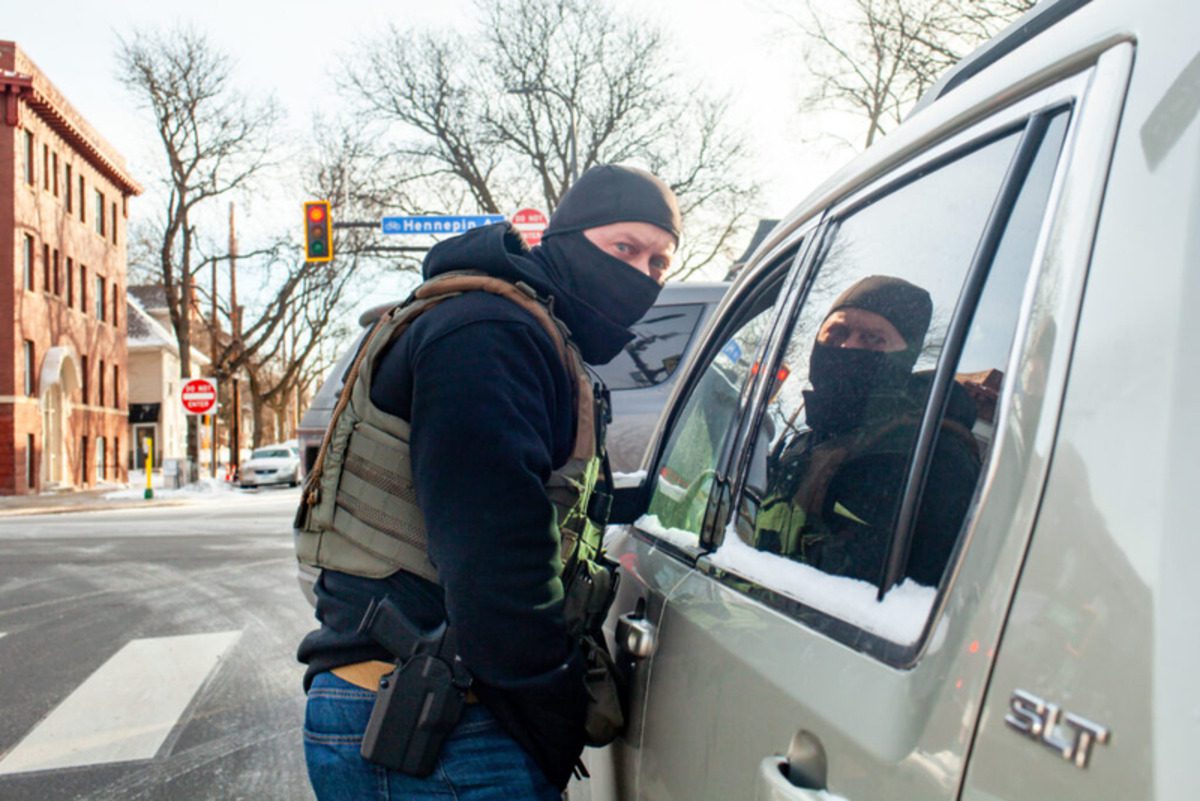
One by one, working physicians stepped up to the mic to describe the toll of a federal immigration and “anti-fraud” operation that has mushroomed into something more. Gov. Tim Walz last week described the roughly 3,000-agent force as an “occupation.”
Erin Stevens, chair of the legislative committee for the Minnesota chapter of the American College of Obstetrics and Gynecology, said ICE agents have waited in vehicles outside hospitals, routinely entered medical buildings and even followed patients into emergency rooms.
Fewer patients are presenting at metro-area labor and delivery triage units amid a spike in requests for home births among patients who had previously intended to deliver in hospital and for whom home birth “is not a safe option,” Stevens added.
Janna Gewirtz O’Brien, a member of the executive board of the Minnesota chapter of the American Academy of Pediatrics, said trauma stemming from “violence and the threat of family separation” could affect her young patients for many years to come.
In the here and now, new mothers are laying low and deferring checkups for their babies as they weigh the benefits of health care against the risk of indefinite detention, Gewirtz O’Brien said.
Families that feel safe enough to venture outdoors face health risks through no fault of their own, Gewirtz O’Brien added, noting the apparently incidental tear-gassing of a family vehicle in north Minneapolis during a chaotic ICE operationlast week. A six-month-old riding in the vehicle was admitted to a nearby hospital with breathing problems.
“Chemical weapons have no place in our neighborhoods or schools. They can have life-threatening effects on children,” she said. “It’s only a matter of time before a child dies.”
Minnesota Reformer is part of States Newsroom, a nonprofit news network supported by grants and a coalition of donors as a 501c(3) public charity. Minnesota Reformer maintains editorial independence. Contact Editor J. Patrick Coolican for questions: info@minnesotareformer.com.