

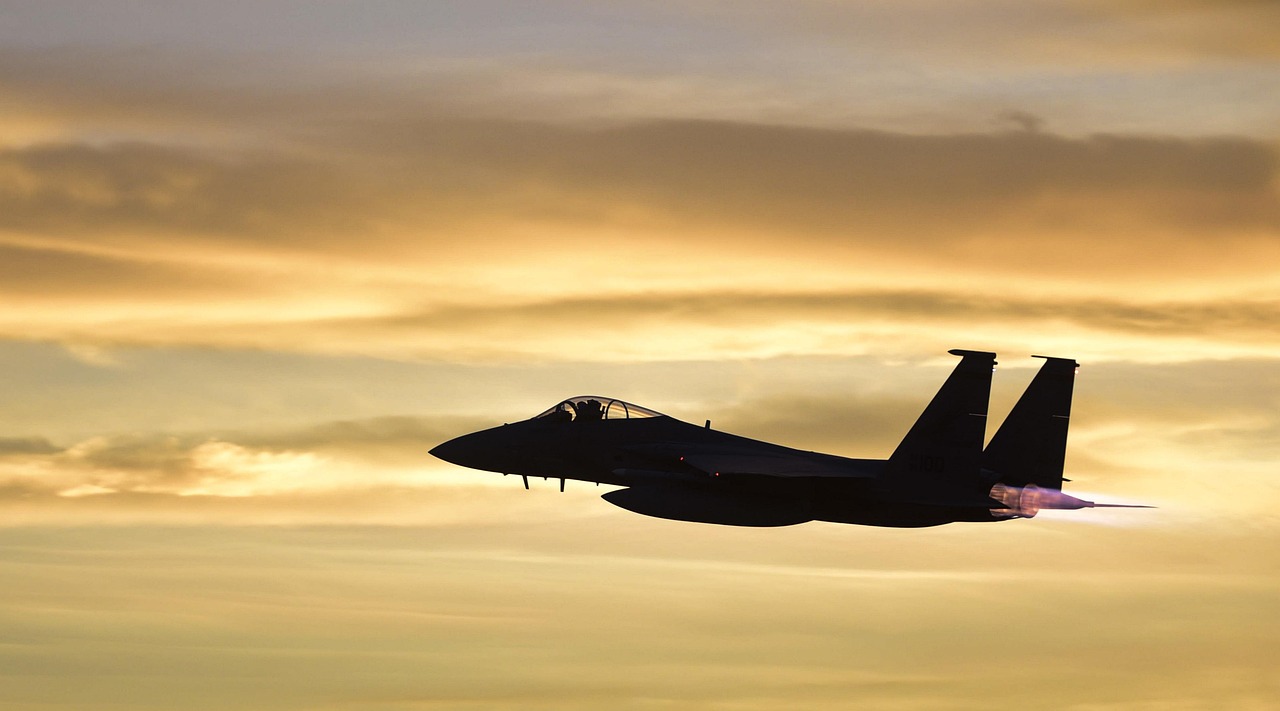
In a dramatic escalation of U.S. military involvement in West Africa, American forces carried out strikes against ISIS-linked militants in northwest Nigeria on Christmas Eve and Christmas Day, marking one of the most significant U.S. counterterrorism actions on the continent in years.
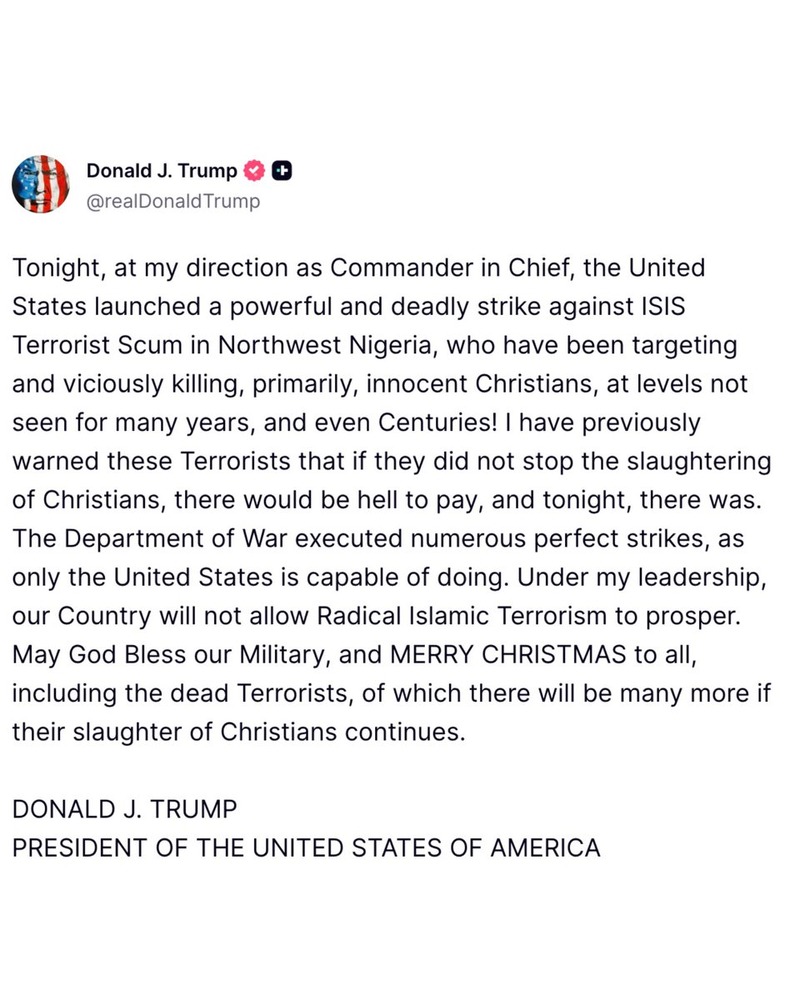
President Donald Trump announced the operation on social media, framing it as a response to what he described as ongoing attacks on Christian communities, a claim that has sparked debate among Nigerian officials, analysts, and global observers.
President Trump posted on his platform that “tonight, at my direction as Commander in Chief, the United States launched a powerful and deadly strike against ISIS Terrorist Scum in Northwest Nigeria, who have been targeting and viciously killing, primarily, innocent Christians.” He added that “there will be many more [dead terrorists] if their slaughter of Christians continues.”
The U.S. military’s Africa Command (AFRICOM) confirmed that precision strikes targeted militants in Sokoto state, a region in northwest Nigeria that borders Niger and has been a hotspot for violent extremist activity.
According to official statements, the operation was conducted in coordination with the Nigerian government, with approval and intelligence support from Abuja. U.S. officials reported that multiple Islamic State fighters were killed, though specific casualty figures and the full extent of the operation remain undisclosed.
A Shift in U.S. Africa Policy
The strikes come after weeks of mounting pressure from Republican lawmakers and influential conservative voices in the U.S., who have amplified reports of violence against Christians in Nigeria’s volatile Middle Belt and north.
Trump and allies have repeatedly criticized Nigerian authorities for failing to curb these attacks, culminating in the administration designating Nigeria as a “country of particular concern” under the International Religious Freedom Act.
Last month, Trump directed the Pentagon to plan possible military action in Nigeria, a rare step given his campaign rhetoric emphasizing a withdrawal from “endless wars,” referring to himself as the “anti-war President.”
This recent move — coupled with expanded drone and surveillance flights out of bases in West Africa — signals a willingness by the U.S. to reengage militarily in the region, particularly against Islamic State of West Africa Province and associated groups like the lesser-known Lakurawa faction.
Defense Secretary Pete Hegseth also publicly lauded the operation, asserting that the United States will not allow “radical Islamic terrorism to prosper.” Hegseth’s remarks, made on social media following the strikes, hinted that further operations could follow if extremist threats persist.
Nigerian Government Pushback
Despite the official narrative in Washington, Nigerian authorities have pushed back against the framing that the violence is primarily or solely religious in nature.
Nigerian Foreign Minister Yusuf Tuggar described the military action as part of broader counterterrorism cooperation aimed at protecting all civilians and dismantling violent networks, not a mission focused exclusively on one faith group.
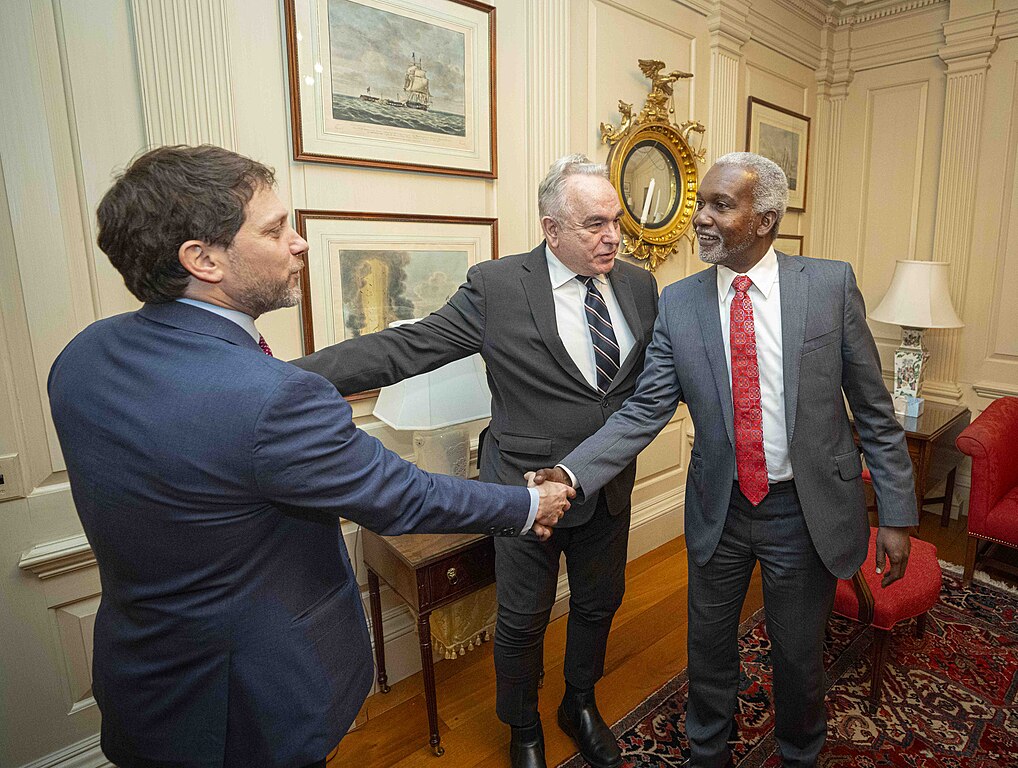
“When you try to reduce it to just say, ‘Oh, no, it’s Muslims killing Christians in Nigeria,’ you can get it completely wrong,” he said.
Nigeria’s security landscape is notoriously complex. The country grapples not only with Islamist extremist groups like ISIS affiliates and Boko Haram in the northeast, but also with intercommunal violence, disputes over land and water resources, and banditry, all of which cut across religious lines.
Analysts have emphasized that many victims of extremist violence in Nigeria include both Christians and Muslims, and that oversimplified narratives risk obscuring the true drivers of conflict.
Local voices from villages near the strike zone reported fear and disorientation after the nighttime explosions, with residents describing bright flashes and shaking homes as Tomahawk cruise missiles reportedly struck targets. Some villagers expressed concern over possible civilian harm or unexploded ordnance, highlighting the human toll and unpredictability of remote strikes.
Reactions
The U.S. military action has drawn mixed reactions globally. Supporters argue that decisive action against ISIS in Nigeria is necessary to protect vulnerable communities and disrupt extremist networks that also pose a threat to regional stability.
Critics caution that measures framed through a narrowly religious lens could exacerbate tensions, fuel recruitment by extremist groups, and sideline long-term political solutions Nigeria desperately needs.
For President Trump, the operation delivers on a campaign promise to combat global terrorism, while also appealing to his evangelical base. Yet it raises questions about the future of U.S. involvement in Africa and whether strikes like this will become a broader strategic pattern.
With AFRICOM forces now more visibly engaged and intelligence cooperation with African partners deepening, policymakers will need to balance military action with diplomacy, development, and nuanced understanding of local dynamics.
As Nigeria continues to face multiple threats, the U.S. action may mark a turning point in Washington’s approach to African security. Whether these strikes diminish extremist capabilities or contribute to a cycle of violence remains to be seen.
For now, stakeholders on both sides of the Atlantic will be watching closely, weighing the costs and consequences of a bold and controversial military intervention.