

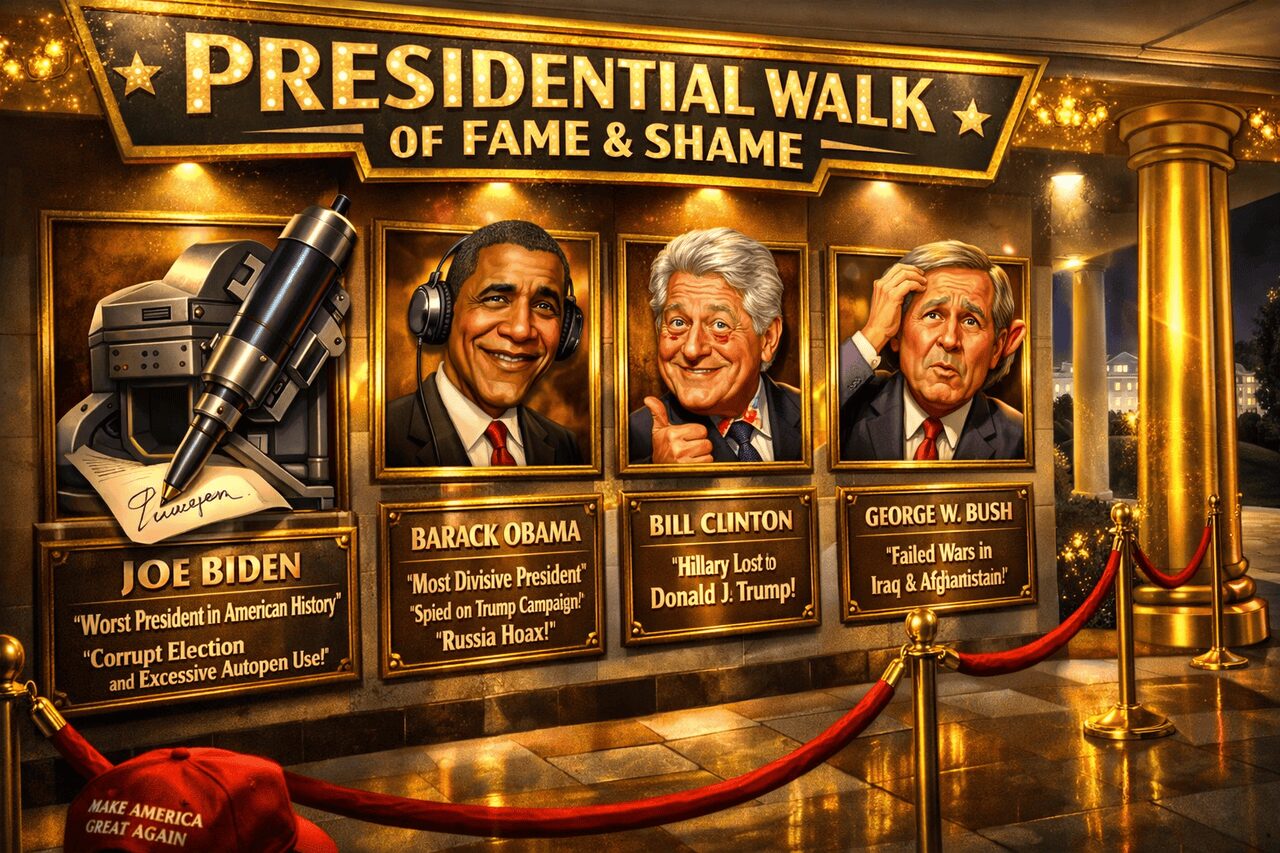
WASHINGTON, D.C. — Move over Smithsonian. Make way for the newest must-see tour on Pennsylvania Avenue — the White House Presidential Walk of Fame and Shame, where history is rewritten with the finesse of a late-night tweet and the aesthetic gusto of a gold-plated elevator in Trump Tower.
The new plaques, freshly installed by President Donald Trump, offer what the administration calls “eloquent descriptions of presidential legacy” and critics call “a roast session in bronze.”
Once upon a time, the White House was a place of unity, gravitas, and at least aspiring to a sense of national purpose. Not anymore. Under the gleaming sheen of an expanded golden interior vision, Trump’s new plaques beneath portraits of past presidents bring a curated narrative (some might say a “narrative buffet”) to the West Colonnade — a space now part art gallery, part roast chamber.
Section One: Biden’s Statue of Privatized Ink
The first stop on this historical joyride is Joe Biden’s spot. But wait — there’s no official portrait. Instead, in a stroke of bureaucratic theater, an image of an autopen proudly stands in for the 46th president — a mechanical friend best known for faithfully wielding Biden’s signature.
Beneath it: a plaque accusing him of being “by far the worst President in American history,” overseeing a “corrupt election” and perpetrating unthinkable atrocities like using an autopen too much.
If ever there were a presidential device whose destiny was to become political satire, this was it. Future historians will surely debate whether the autopen was glorified, harassed, or simply relieved not to have to run for office. Irony is served in bronze.
Section Two: Obama — The Divisive Community Organizer (That Time Machine’s Fault)
Next up is Barack Hussein Obama. His plaque highlights his historic barrier-breaking status as the first Black president and — in a decision that is sure to invite hours of podcast debate — calls him “one of the most divisive political figures in American history.”
The plaque also dredges up claims about Obama “spying” on Trump’s campaign and nurturing the “Russia, Russia, Russia hoax,” as though classified documents were included on the list of infamous dinner recipes from the Obama White House kitchen.
History buffs, brace yourselves. This commemorative text seems to blend actual achievements with what can only be described as selective creative editing. It’s like Wikipedia got access to a creative writing prompt titled: “What if History Were a Roast Battle?”
Section Three: Clinton — From Oval Office to Footnote
Bill Clinton’s plaque is a masterpiece of minimalist rhetoric: “President Clinton’s wife, Hillary Clinton, lost the 2016 election to President Donald J. Trump!”
Genius in its simplicity, it manages to rewrite the historical record while also pivoting the topic squarely to 2016. Whether this is historical interpretation or performance art depends on your point of view.
Section Four: Bush — The Republican Who Did Something Wrong (According to Trump)
Even Republican George W. Bush isn’t spared Trump’s editorial pen. His plaque chastises him for wars in Afghanistan and Iraq — “both of which should not have happened” — a rare moment of bipartisan agreement if we forget the fact that warriors of political discourse have been debating Iraq for two decades.
Public Reaction: Comedy, Controversy, and Cultural Chaos
Critics across the political spectrum have responded with a mix of stunned brows, raised eyebrows, and late-night monologue material. Comedian Jimmy Kimmel joked that the plaques resemble entries from a satirical site called “Dickipedia.” (We’re not sure that’s real, but now everyone’s hoping it exists.)
On the press side, White House spokesperson Karoline Leavitt insists these plaques reflect Trump’s historical perspective, and yes — many were reportedly authored by Trump himself. “They are eloquently written,” she said, which is one way to describe definitive historical revisionism embraced with the enthusiasm of a teenager at a sci-fi convention.
A Walk to Remember (or Debate, or Roast)
In the end, this “Presidential Walk of Fame” feels less like a gallery and more like a cultural artifact of 2025 — part museum, part slam poetry, part political carnival attraction. Future schoolchildren might visit and wonder, “Did presidents really have autobiographies written by comedians?” The answer may depend on which plaque you stop in front of first.