

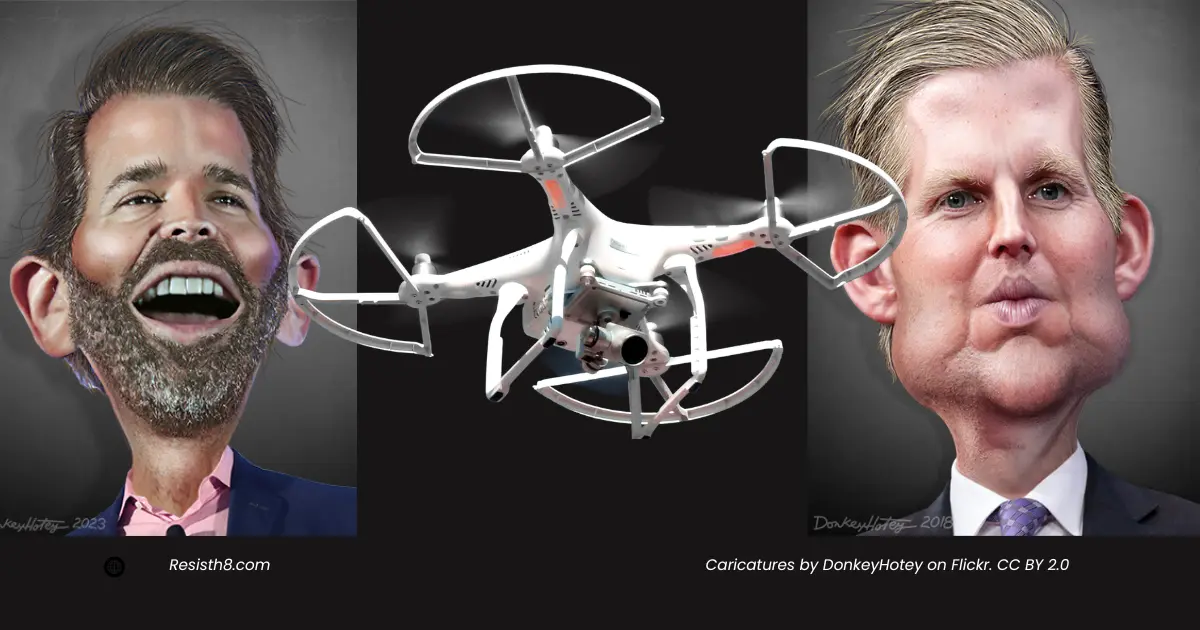
Eric Trump and Donald Trump Jr. are rapidly expanding their investments in the military drone industry — the same industry that stands to make billions from their father’s administration, his Pentagon spending surge, and the war he launched against Iran.
On Monday, a newly formed drone company called Powerus Corporation named both brothers as “notable investors.”
This is the president’s family building a financial empire on the back of American defense spending and the ongoing war their father started.
The company, co-founded by former U.S. Army Special Operations veterans, plans to merge with Aureus Greenway Holdings, a Florida-based golf course operator, in a reverse merger that would take the drone maker public on the Nasdaq under the ticker symbol “PUSA.”
Powerus says it is focused on “American drone industry dominance through domestic manufacturing, autonomous systems innovation, and strategic defense partnerships.”
The deal is being financed in part through Dominari Securities, an investment bank in which both Trump brothers hold approximately 6% stakes.
Unusual Machines, a drone parts manufacturer where Donald Trump Jr. has served on the advisory board since November 2024, is also investing in the transaction.

The Korea Corporate Governance Improvement Fund has committed to purchasing $50 million worth of Powerus stock.
Put plainly: The president’s sons have financial interests in the companies raising money, the companies doing the investing, and the companies building the drones.
And the man making policy decisions that determine how many billions flow into the drone sector is their father.
A Pattern, Not an Incident
This is not the first Trump family drone deal, and it’s not a small one. It’s part of a rapidly growing portfolio of defense investments that directly intersect with administration priorities.
Eric Trump is also an investor in Xtend, an Israeli drone manufacturer that recently announced a $1.5 billion deal to go public through a merger with JFB Construction Holdings on the Nasdaq.

Xtend’s drones have been used extensively in Israeli military operations in Gaza, where the company says its systems have been deployed for building reconnaissance, booby-trap neutralization, and targeted strikes.
Some of its products are marketed as “low cost-per-kill” munitions. Xtend has already secured multimillion-dollar Pentagon contracts, including for AI-enabled one-way attack drone kits built for special operations forces.
Donald Trump Jr.‘s investment firm, 1789 Capital, holds a major stake in Anduril Industries, a defense technology giant valued at roughly $60 billion that specializes in autonomous combat systems.
Anduril has secured billions in government contracts, including $3.5 billion for missile-tracking satellites and a $14.3 million Defense Production Act award to boost solid rocket motor capacity.
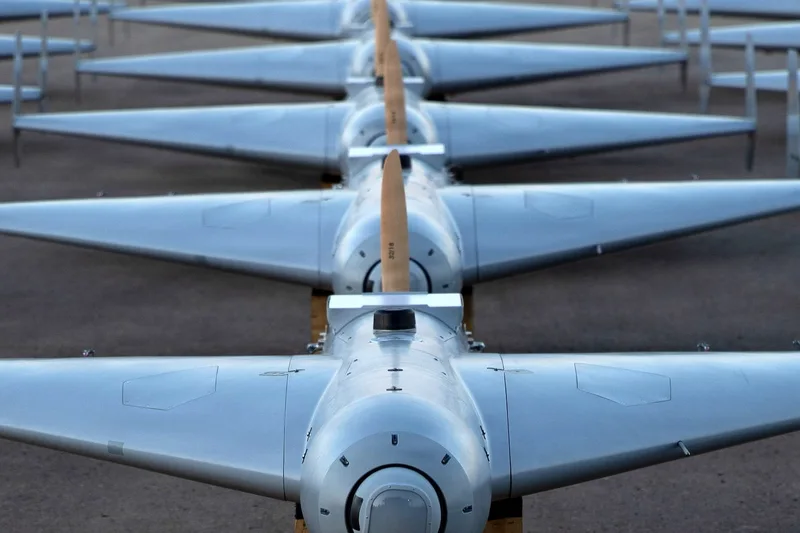
U.S. Central Command Public Affairs
Both Anduril and SpaceX, in which 1789 Capital also holds investments, are competing for contracts under the administration’s “Golden Dome” missile defense initiative — a program that could cost taxpayers trillions of dollars.
The Administration Made This Market
The Trump brothers’ investments are not happening in a vacuum. They are happening inside a market their father’s administration has actively created.
In December, the FCC banned the import and sale of all new foreign-made drone models, a sweeping action that went well beyond the originally expected restrictions on Chinese manufacturers DJI and Autel.
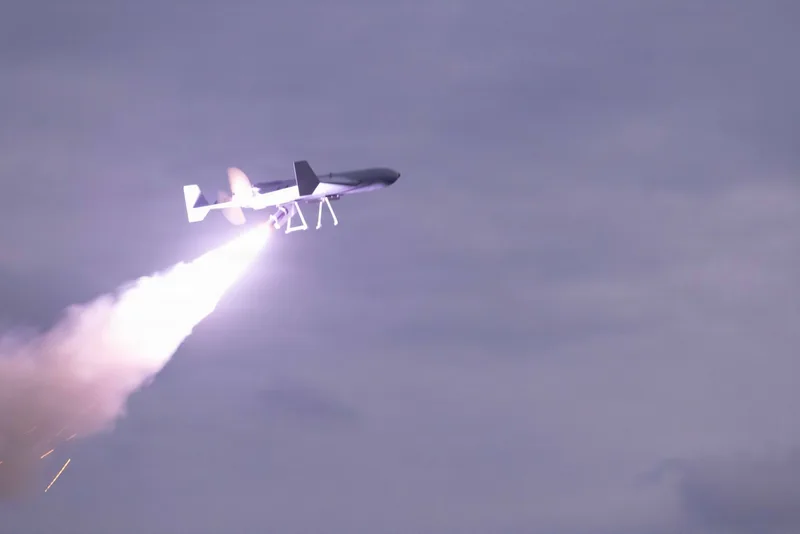
Michael Smith/Naval Air Warfare Center Weapons Division
The ban created an enormous gap in the U.S. drone market — DJI alone had controlled roughly 70% of the American commercial drone market — and opened the door for domestic manufacturers to compete for Pentagon contracts worth billions.
The Pentagon is now ramping up drone procurement dramatically under its “Drone Dominance” initiative, which targets the purchase of hundreds of thousands of unmanned systems.
The administration has announced plans to increase defense spending to $1.5 trillion by 2027, up from $900 billion in 2026.
The ongoing war against Iran — the first conflict in which the Pentagon has deployed one-way attack drones in combat — has only accelerated the demand.

The Trump sons are invested in companies positioned on every side of this boom.
They profit from the companies that build drones, the companies that supply drone parts, the investment banks that finance drone deals, and the defense firms that win the contracts their father’s Pentagon hands out.
Ethics Experts Say the Conflicts Are Obvious
Government ethics watchdogs are not mincing words about what this looks like.
Dylan Hedtler-Gaudette, director of government affairs at the nonpartisan Project on Government Oversight, told ABC News that these deals “at a minimum present the appearance of impropriety.”
He noted that while President Trump may not be personally approving specific Pentagon contracts, the people who do make those decisions are well aware of which companies the president’s sons are involved in.
“Are contracts going to the best competitors offering up bids?” Hedtler-Gaudette asked. “Or are they handing out bids based on family connections to the White House?”
Kedric Payne, senior director of ethics at the Campaign Legal Center, was equally direct.
“The first thing that comes to mind is another example of the president’s family appearing to profit from the presidency,” he said, adding that past presidents made efforts to avoid even the appearance that their families benefited from the office.
The Trump family has maintained that the president is not involved in his sons’ business decisions.
Trump’s assets are held in a trust — but it is not a traditional blind trust. It is managed by his own children, the same people making these investments.
The Bigger Picture
When you pull back and look at the full scope of what is happening here, the pattern is impossible to ignore.
The president launches a war.
The Pentagon needs drones.
The administration bans foreign competitors.
The president’s sons invest in the companies that fill the gap.
The investment bank they co-own helps finance the deals.
The companies they back win government contracts.
And the trust that supposedly insulates the president from all of this is run by the very people doing the investing.
This is not a gray area.
This is the president’s family building a financial empire on the back of American defense spending and the ongoing war their father started.
No amount of press releases about “American leadership” and “domestic manufacturing” changes what this fundamentally is: the kind of conflict of interest that, in a functioning democracy, would trigger immediate congressional investigation.
Yet, the story barely makes the front page. Tell me again, how much money did Hunter Biden make on the board of a Ukrainian company?