

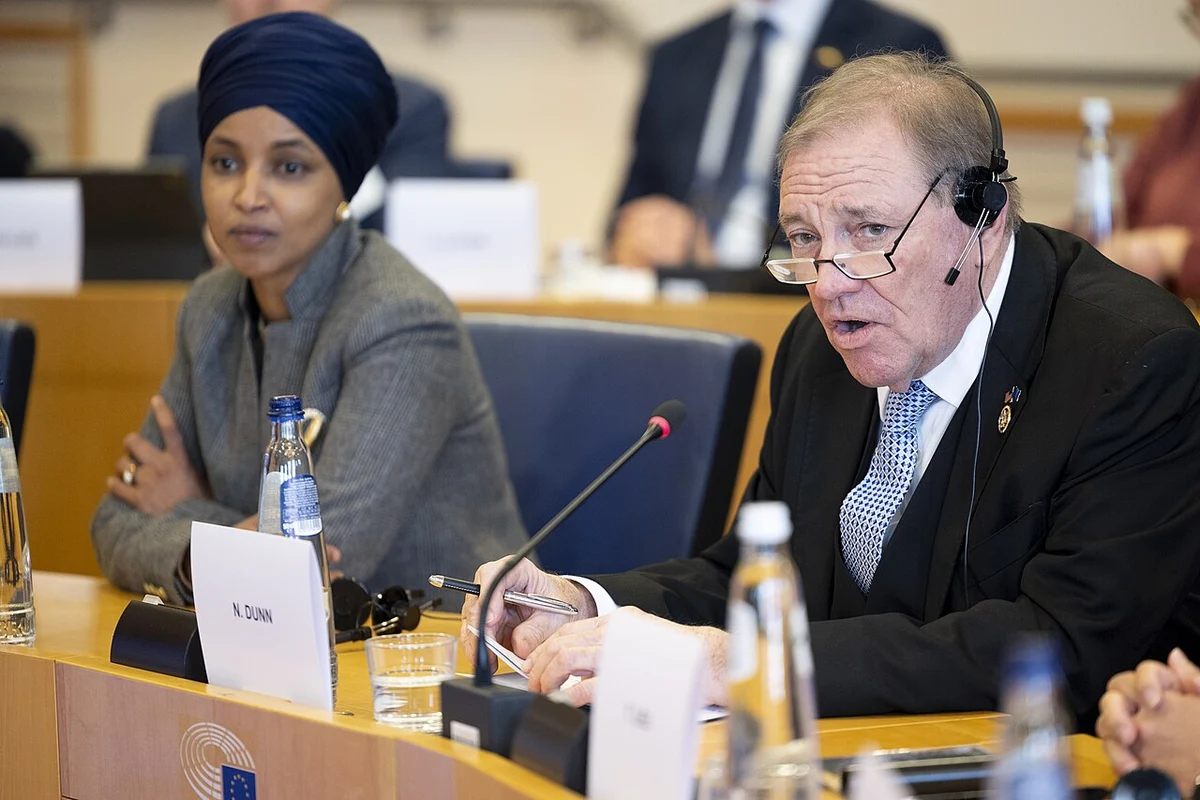
During a press conference at the White House on Monday, Donald Trump disclosed that Republican Rep. Neal Dunn of Florida had received a terminal heart diagnosis and would have been dead by June — information that had never been made public.
Seated beside Trump, House Speaker Mike Johnson appeared visibly caught off guard, telling the president on camera that the diagnosis had not been shared publicly.
Minutes later, Trump shifted attention to his chief of staff, Susie Wiles, seated next to him at the same event, and referenced her own recent breast cancer diagnosis, which he had announced earlier that morning via Truth Social.
The back-to-back disclosures turned what was supposed to be a routine Kennedy Center board luncheon into a spectacle of private medical information broadcast live to the nation — raising immediate questions about consent, boundaries, and why the president treats other people’s health crises as props for his own narrative.
“Number one, I liked him. Number 2, I needed his vote.”
Trump brought up Dunn’s condition while praising Johnson for managing the House GOP’s razor-thin majority. Republicans currently hold a 218-214 advantage with three vacancies, meaning they can lose no more than one vote on any party-line issue.
Trump referenced “one man who was very ill” and turned to Johnson to fill in the details. Johnson, choosing his words carefully, said Dunn had faced “real health challenges” and a “pretty grim diagnosis,” calling the congressman a “real champion” for continuing to show up and vote. Trump pressed Johnson further. The Speaker said he believed it was a terminal diagnosis. Trump then blurted out that Dunn “would be dead by June.”
Johnson’s immediate reaction told the story. He replied, on camera, that the information had not been public.
Trump went on to describe the private conversation in which Johnson first told him about Dunn’s condition. His framing was striking in its honesty about priorities.

He said the news was bad for two reasons — first, because he liked Dunn, and second, because he needed Dunn’s vote.
He later tried to clean that up, adding that he helped Dunn “for him first and for the vote second,” but then admitted, “it was a close second, actually.”
The Walter Reed Intervention
Both Trump and Johnson described how the president connected Dunn with White House physicians who arranged emergency heart surgery at Walter Reed National Military Medical Center.
Trump said Dunn was on the operating table within roughly two hours of the doctors seeing him. The surgery involved stents and other cardiac procedures.
Johnson said the surgery gave Dunn “a new lease on life” and that the 73-year-old congressman now “acts like he’s 30 years younger.” Trump called the White House doctors “miracle workers.”
Dunn, a physician himself and a former Army surgeon, represents Florida’s 2nd Congressional District and announced in January that he would not seek reelection after five terms.
Rumors circulated in February that he might resign mid-session, which would have further strained the GOP majority. His office later confirmed he would serve out the remainder of his term.
His office did not immediately respond to requests for comment about Trump’s public disclosure of his diagnosis.
Johnson had previously told donors at a retreat in late February that Dunn had a terminal diagnosis, but those remarks were not made in a public forum with television cameras rolling.
Susie Wiles’ Diagnosis Announced the Same Day
Earlier Monday morning, Trump posted on Truth Social that Wiles, 68, had been diagnosed with early-stage breast cancer. He said her prognosis was “excellent” and that she would remain at the White House “virtually full time” during treatment.
At the Kennedy Center event, Trump called her “an amazing person, an amazing fighter” and described her diagnosis as “a minor difficulty.”
Wiles, in her own statement, said she had received the diagnosis the previous week and planned to begin treatment soon. She said she was grateful for her medical team and encouraged by a strong prognosis.
Wiles is the first woman to serve as White House chief of staff. She managed Trump’s 2024 campaign and is considered one of his closest advisors.
The president has referred to her as “the most powerful woman in the world” and once called her “Susie Trump.”
A Pattern of Disclosure Without Consent
Trump has a long record of sharing information others expected to remain private. He has publicly discussed sensitive intelligence with foreign officials, stored classified documents at his Mar-a-Lago estate, and repeatedly made off-the-cuff disclosures that revealed details aides had not planned to make public.

Monday’s press conference fit the pattern. Whether Dunn consented to having his terminal diagnosis broadcast on live television remains unclear.
What is clear is that Johnson did not expect the disclosure, that Dunn’s office had never publicly confirmed it, and that the president framed the story primarily as a tale of his own intervention — one in which the vote mattered almost as much as the man.
For Wiles, the situation was slightly different. She issued her own statement and appeared aware the news would be made public.
But even in her case, Trump controlled the timing, announcing her diagnosis on Truth Social before she could shape the narrative on her own terms.
The episode also underscored the fragility of the House GOP majority. With Dunn’s health uncertain, three seats vacant, and special elections approaching, Republicans are operating with almost no margin for absence.
The political reality is stark: every body matters, every vote is critical, and in Trump’s White House, even a terminal diagnosis becomes a story about the math.