
There was a time when Americans bonded over baseball, apple pie, and the shared delusion that politicians were public servants. That era is dead, buried, and probably accused of being a socialist or a fascist depending on which cable network you ask.
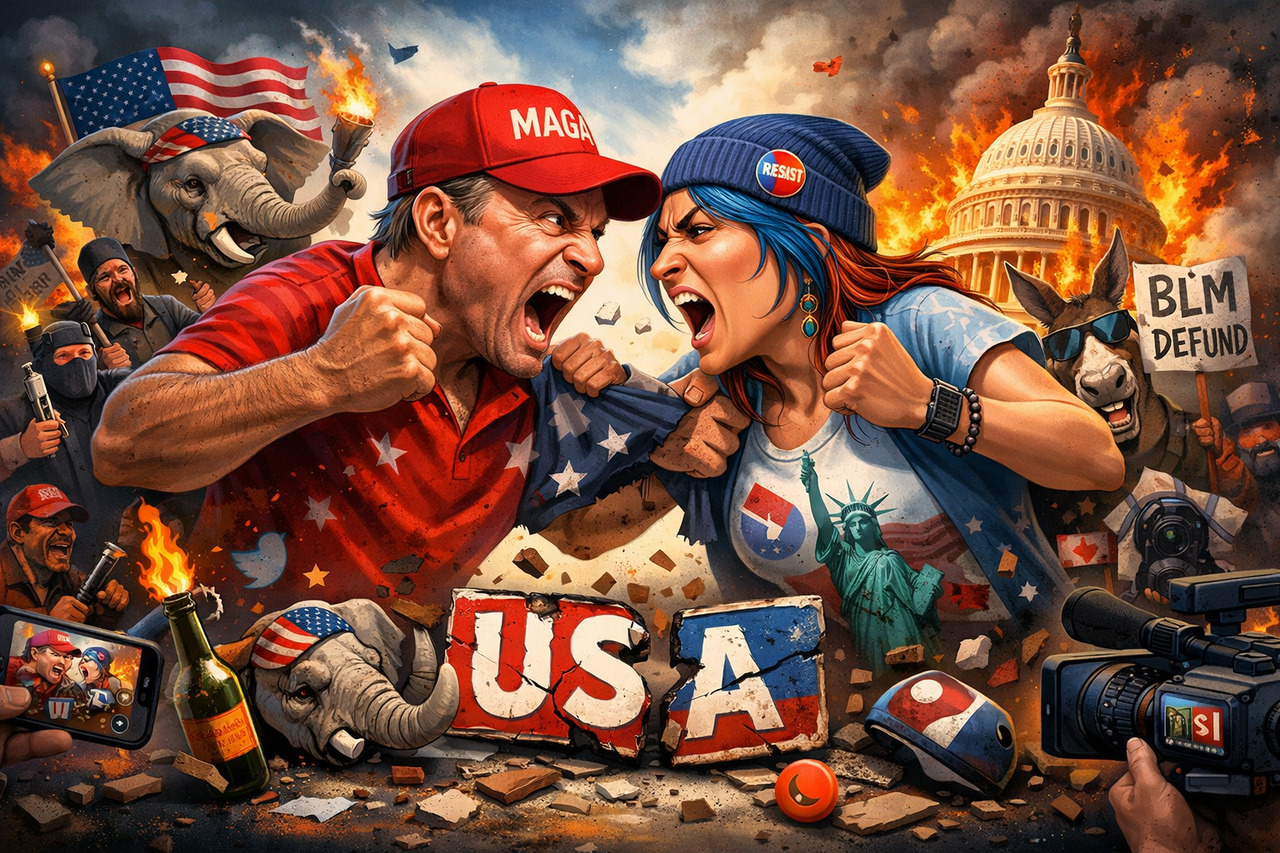
In its place, we now have the national pastime of political polarization—an all-consuming sport where Republican and Democratic voters scream at each other across social media, family dinner tables, and the occasional courthouse steps, all while insisting they alone are “defending democracy.”
This is not a disagreement over tax brackets or infrastructure funding. This is a full-blown cultural civil war, fought mostly with memes, misinformation, and the occasional assault rifle cameo.
And while both sides accuse the other of being brainwashed, corrupt, or evil, the real winner remains unchanged: chaos, served daily, with a side of outrage.
Political Polarization
Political polarization in the United States has become so intense that compromise is now treated like a moral failure. To reach across the aisle is to betray your tribe. To acknowledge nuance is to invite exile.
Somewhere along the way, politics stopped being about policy and turned into identity—complete with merch, slogans, and enemies who must be crushed, not persuaded.
Republican voters are told that Democrats are Marxist radicals plotting to destroy America from within, replacing freedom with government dependency and forcing everyone to drive electric cars while confiscating hamburgers.
Democratic voters, meanwhile, are warned that Republicans are authoritarian extremists itching to dismantle democracy, criminalize dissent, and roll back civil rights until the Constitution is replaced with a Bible and a Twitter poll.
Both narratives are exaggerated. Both are profitable. Neither encourages anyone to calm the f**k down. That’s political polarization and it has some Americans calling for a “national divorce.” Who gets the new ballroom?
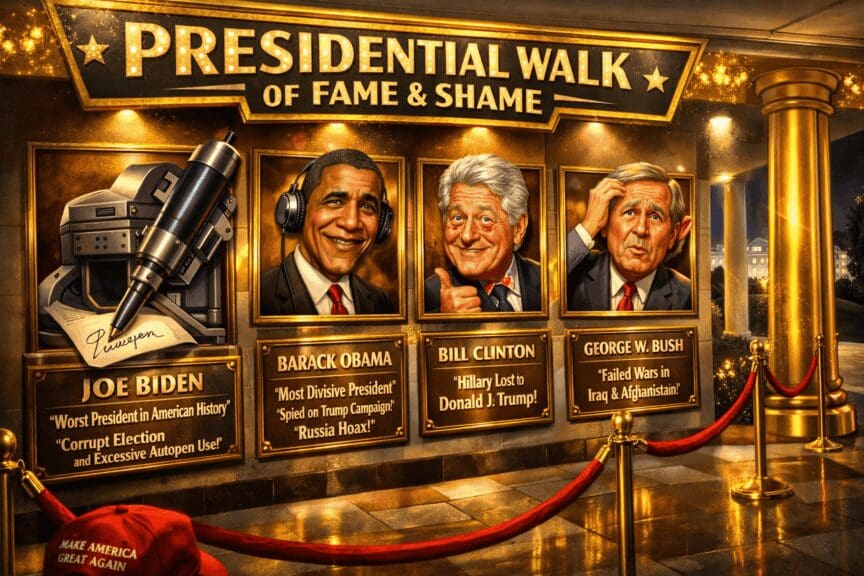
Nothing says political polarization like President Trump’s commentary under the portraits of former presidents in the White House.
Political Violence
The rise of political violence has been the logical next step in this slow-motion meltdown. When voters are convinced that the opposing party is an existential threat, aggression stops feeling immoral and starts feeling patriotic.
History shows that once politics is framed as survival, restraint becomes optional.
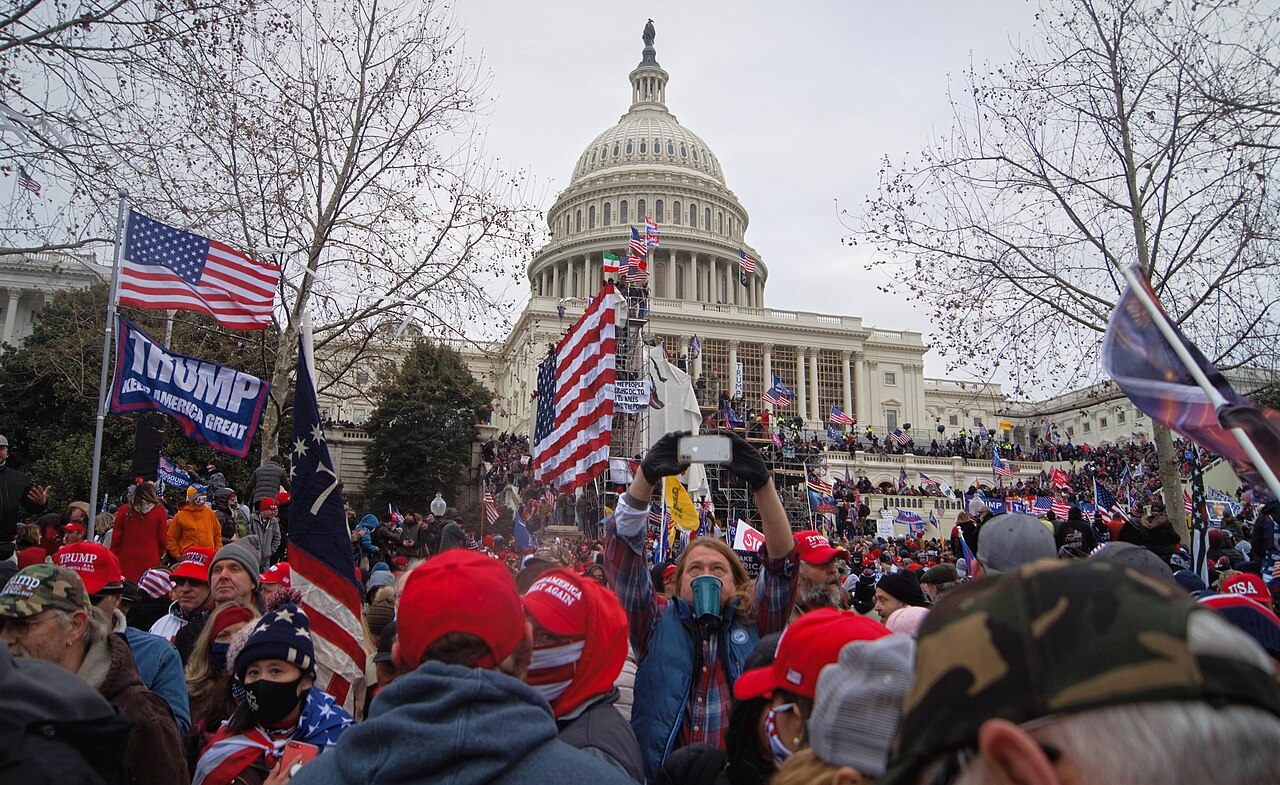
The most obvious recent example remains January 6, 2021, when a mob stormed the U.S. Capitol in a failed attempt to overturn a presidential election.
Many of the individuals involved were linked to far-right extremist groups such as the Proud Boys and the Oath Keepers, organizations that openly traffic in violent rhetoric, conspiracy theories, and fantasies of civil war.
Their members didn’t see themselves as criminals. They saw themselves as heroes, acting on what they believed was a stolen election.
This is the uncomfortable truth about far-right extremism in the United States: it doesn’t operate on the fringes anymore. It thrives in online ecosystems where outrage is currency and violence is reframed as resistance.
According to assessments by the Federal Bureau of Investigation, domestic violent extremism—particularly ideologically motivated violence from far-right actors—has become one of the most significant national security threats facing the country.
But pointing this out immediately triggers accusations of bias, censorship, or political persecution. Any attempt to address extremism is dismissed as a witch hunt, because acknowledging reality would require admitting that the movement has a problem with violence.
That’s a bridge too far in a political climate where loyalty matters more than facts.
Democrats, for their part, often respond to all of this with a mix of moral outrage and condescension, assuming that education alone will fix everything.
The idea that deeply rooted grievances, economic anxiety, cultural displacement, and algorithm-driven radicalization might require more than fact-checking is inconvenient. It’s easier to label millions of voters as irredeemable and move on.
And so the cycle continues. Republicans accuse Democrats of exaggerating extremism to silence opposition. Democrats accuse Republicans of enabling violence through rhetoric and inaction.
Social media platforms amplify the loudest voices because calm doesn’t drive engagement. Politicians fundraise off fear, warning their supporters that the next election is the last one that will ever matter.
Meanwhile, actual governance limps along like an afterthought.
What makes this moment especially bleak is how normalized political hostility has become. Threats against election workers, judges, journalists, and public officials are no longer shocking. They’re expected.
Violence is no longer a red line; it’s a background risk. The line between online radicalization and real-world harm keeps getting thinner, and everyone pretends not to notice until someone gets hurt.
The tragedy is not just that Americans disagree. Disagreement is healthy. The tragedy is that millions of people now believe their fellow citizens are enemies, not neighbors.
When politics becomes a moral apocalypse, every election feels like a countdown clock, and every loss feels illegitimate.
Satire almost struggles to keep up with reality here. The United States has somehow reached a point where calls for “national unity” are treated as suspicious, and suggesting that political opponents are still human beings is considered naïve.
We are a nation armed to the teeth, emotionally exhausted, and deeply convinced that the other side is the problem—full stop.
If there’s a punchline to all of this, it’s that the polarization voters claim to hate is the same polarization they reward. They click it, share it, donate to it, and vote for it. The fighting continues not because Americans are incapable of doing better, but because outrage has become easier than empathy and far more entertaining than compromise.
In the end, America isn’t breaking apart because Republicans and Democrats disagree. It’s breaking apart because too many people have decided that destroying the other side is more important than preserving the country they’re both claiming to save.