
A growing number of Republican lawmakers are posting explicitly anti-Muslim statements on social media, and House Speaker Mike Johnson’s response has been to defend the Islamophobia behind them while offering only the mildest pushback on tone.
The shift marks a stark departure from the party’s own recent precedent — and a calculated political strategy ahead of the 2026 midterms.
“Muslims Don’t Belong in American Society”
On Monday, March 9, Rep. Andy Ogles of Tennessee posted a blunt declaration on X: “Muslims don’t belong in American society. Pluralism is a lie.”

The statement was not a one-off. Ogles, who represents a safely red district, has previously called for banning immigration from Muslim-majority countries, pushed to deport New York’s first Muslim mayor, Zohran Mamdani, and said in a speech last year that “America is and must always be a Christian nation.”
He is also a member of the Sharia Free America Caucus and announced plans this week to introduce what he calls a “Muslim ban” bill. In a press release for the legislation, he made derogatory remarks about Islam’s Prophet Muhammad.
The backlash was swift — but almost entirely from Democrats. House Minority Leader Hakeem Jeffries called Ogles a “disgusting Islamophobe” who doesn’t belong in Congress. Rep. Katherine Clark of Massachusetts said Ogles’ rhetoric is what doesn’t belong in American society. Rep. Eric Swalwell of California questioned how many Muslims even live in Ogles’ district.
From Republican leadership? Near silence — or worse.
Johnson Defends the Sentiment, Questions Only the Tone
When reporters asked Speaker Johnson about Ogles’ comments at the House GOP retreat in Doral, Florida, he did not condemn them. Instead, he reframed the issue entirely.
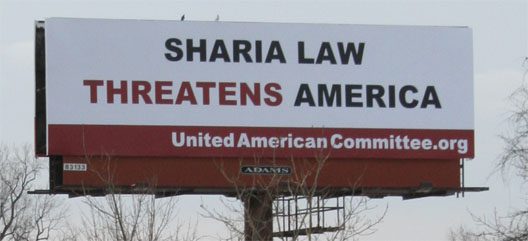
“There’s a lot of energy in the country and a lot of popular sentiment that the demand to impose Sharia law in America is a serious problem,” Johnson said.
“That’s what animates this.” He acknowledged that Ogles used “different language than I would use,” but emphasized that the underlying concern was legitimate. “Sharia law and the imposition of Sharia law is contrary to the U.S. Constitution,” he added.
When a reporter followed up by asking who, exactly, is imposing Sharia law in America, Johnson did not answer. He walked off the stage. His office declined to comment further.
This is the core of the dishonesty. There is no movement to impose Sharia law in the United States.
No city, no county, no state recognizes its authority. Sharia is a set of religious principles drawn from the Quran and the sayings of Muhammad, guiding personal practices like prayer, fasting, marriage, and finance. It has no standing over the Constitution or any federal or state law.
As Sabina Mohyuddin, executive director of the American Muslim Advisory Council in Tennessee, put it: “Because people don’t really know or have any idea what Sharia law is, it’s the boogeyman. You just throw the word out there and people get scared.”
That’s precisely the point. Johnson’s framing isn’t an explanation — it’s a strategy.
The Pile-On Continues
Ogles was not alone. In the days following his initial post, multiple Republican lawmakers doubled down.
Rep. Randy Fine of Florida, who previously drew criticism for writing that “the choice between dogs and Muslims is not a difficult one,” went further on Thursday: “We need more Islamophobia, not less. Fear of Islam is rational.” When Rep. Yassamin Ansari, the first Iranian American Democrat elected to Congress, challenged Fine’s statement, he responded by telling her to “get a brain” and insisted “Islam isn’t a race.”
Rep. Brandon Gill of Texas posted simply: “No more Muslims immigrating to America.” Rep. Andrew Clyde of Georgia wrote: “No more Islamic immigration. Denaturalize, deport, repeat.”
Sen. Tommy Tuberville of Alabama, who is running for governor, called Islam “a cult” and said Muslims are in the U.S. “to conquer,” adding: “We’ve got to SEND THEM HOME NOW.”
According to the Washington Post, close to 100 Republican members of Congress — more than 45 percent of the party’s caucus — have posted social media content about Islam or Muslims, with nearly all of it negative.
Republicans have also spent more than $10 million on political TV ads that mention “Sharia” or “Islam” in a negative way, roughly ten times the amount spent in each of the previous four election cycles, according to the ad-tracking firm AdImpact. Most of that spending has been concentrated in Texas ahead of its primaries.
“There’s this new energy on the right that kind of delights in provoking and offending and refuses to apologize.”
The “Sharia Free America” Caucus
The organizational backbone of this campaign is the Sharia Free America Caucus, launched in December 2025 by Reps. Chip Roy and Keith Self, both Texas Republicans, with the support of Tuberville. The caucus has grown to 50 members from 22 states.
It has introduced at least seven pieces of legislation, including bills that would prevent Muslims who observe Sharia from entering the country, bar courts from enforcing any decision that references Islamic law, and designate the Council on American-Islamic Relations (CAIR) as a terrorist organization (this is a perfect example of Islamophobia).
At its founding, the caucus framed itself as a constitutional defense project. Roy said “America is facing a threat that directly attacks our Constitution and our Western values.”
“Western values” = White Nationalism.
Self described “the American way of life” as “under siege by radicals from a culture waging war against our Constitution.” Tuberville called Islam “a death cult” that teaches “it is righteous to kill all infidels, and especially Christians.”
State-level legislation has followed. Florida, Kentucky, and New Hampshire have all introduced bills targeting Sharia. A nonbinding proposition on the Texas Republican primary ballot calling for a ban on Sharia law passed with 95 percent approval from GOP primary voters.
CAIR’s national deputy director, Edward Ahmed Mitchell, pointed to the double standard: “If any member of Congress had declared that ‘Jews do not belong in America,’ that politician would rightfully face condemnation and censure. Yet like Randy Fine and other anti-Muslim extremists in Congress, Mr. Ogles has faced no consequences for his dangerous rhetoric.”
2019 vs. 2026: A Party That Moved Its Own Red Line
What makes this moment especially telling is how dramatically it contrasts with the Republican Party’s own recent history.
In January 2019, Rep. Steve King of Iowa was stripped of all committee assignments by his own party’s leadership after questioning why the terms “white supremacist” and “white nationalist” were considered offensive.
Then-House Minority Leader Kevin McCarthy acted swiftly and decisively. Liz Cheney, then the third-ranking House Republican, said King “should find another line of work.” The party’s campaign arm disavowed him, and King was eventually defeated in a Republican primary.
Seven years later, Ogles declares that an entire religious group “doesn’t belong in American society” — and the Speaker of the House responds by validating the premise while quibbling about phrasing. No committee removals. No disavowal.
No consequences whatsoever. Rep. Shri Thanedar of Michigan has introduced a resolution to censure Ogles and remove him from the Homeland Security Committee, but without Republican support, it is unlikely to advance.
Gregg Nunziata, executive director of the Society for the Rule of Law and a former Republican policy adviser, captured the shift bluntly: “There’s this new energy on the right that kind of delights in provoking and offending and refuses to apologize.”
He called the failure to condemn Ogles “morally cowardly” and “politically shortsighted,” noting that the coalition that elected Donald Trump was itself pluralistic and that Republicans made gains in 2024 specifically because they expanded their support in minority communities.
The Strategic Logic
None of this is happening by accident. As MSNBC opinion writer Michael A. Cohen observed, when politicians from the same party start voicing the same talking points at the same time, it is not coincidence — it is coordination.
The Iran war has provided a backdrop. Recent violent attacks on U.S. soil by individuals with ties to ISIS have provided a pretext. But the timing, with midterm elections in November 2026, provides the motive.
Republicans are looking to energize a base that polls suggest may be less motivated than Democratic voters heading into November. Anti-Muslim rhetoric, however vile, has a track record of working with the GOP electorate. If it didn’t, elected officials wouldn’t keep doing it, and their leaders wouldn’t keep looking the other way.
The contrast with George W. Bush, who visited the Islamic Center of Washington, D.C., just days after September 11, 2001, and declared “Islam is peace,” is not just historical — it measures the distance the Republican Party has traveled.
Bush was speaking in the immediate aftermath of the worst terrorist attack in American history, when anti-Muslim sentiment was at its most understandable. He chose moral leadership. Johnson, operating without a fraction of that pressure, chose the opposite.
What’s at Stake
The First Amendment guarantees religious freedom to every American. There are approximately 3.5 million Muslims living in the United States, the vast majority of whom are citizens, taxpayers, neighbors, and community members.
When nearly half of one party’s congressional caucus is publicly posting hostile rhetoric about them, when a formal caucus exists to legislate against their religious practices, and when the Speaker of the House defends that rhetoric by invoking a fabricated threat, the problem is no longer fringe. It is institutional.
Rep. Nicole Malliotakis of New York, one of the few Republicans to push back, put it simply: “Freedom of religion is a pillar of our nation and broad brush statements like this are offensive and completely inappropriate.”
She’s right. The question is why so few of her colleagues agree — and what it says about the party they’ve become.