

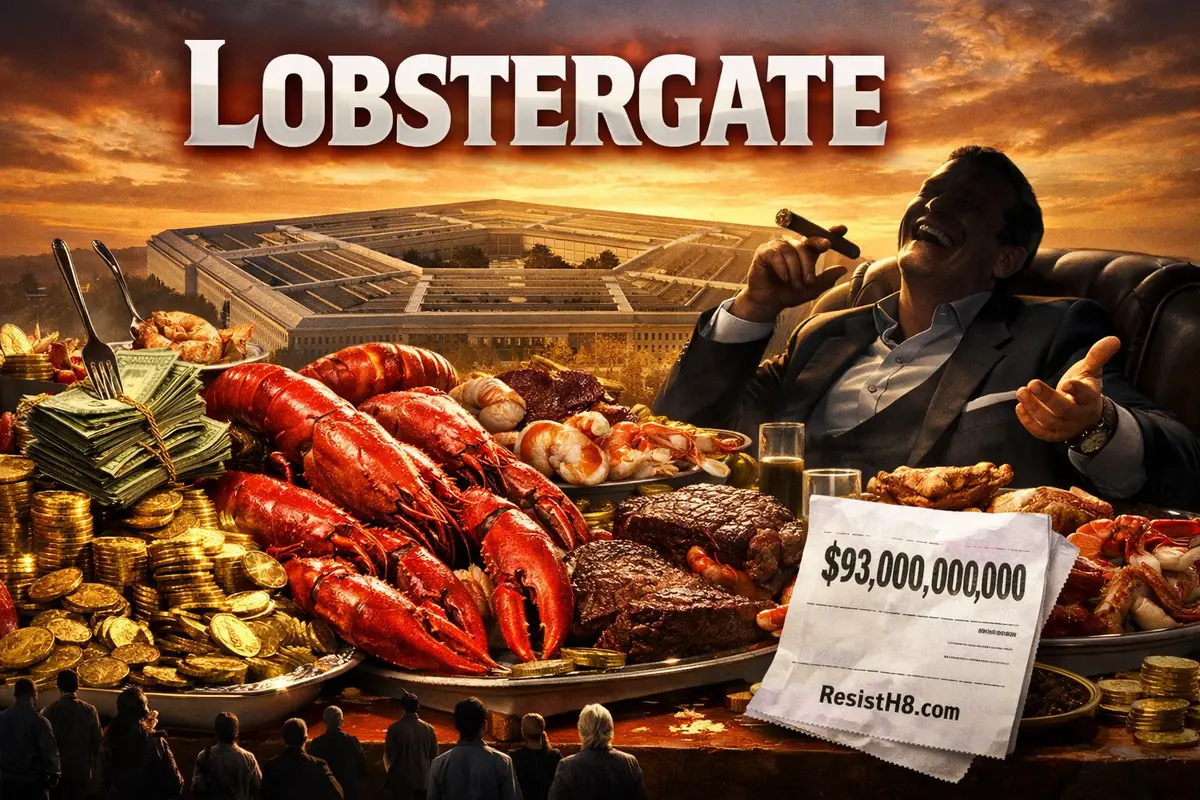
The same administration that created the Department of Government Efficiency, fired tens of thousands of federal workers, and gutted agencies from USAID to the EPA apparently has no problem with the Pentagon dropping $93.4 billion in a single month on Lobstergate — nearly $7 million on lobster tails, $2 million on Alaskan king crab, and $15.1 million on ribeye steak.
A newly published analysis by government watchdog Open the Books reveals that in September 2025 — the final month of the fiscal year — the Department of Defense went on the largest single-month spending spree by any federal agency in recorded history.
The numbers, verified against the U.S. Treasury’s own USASpending.gov database by Snopes, are staggering not just in scale but in what they reveal about the administration’s selective definition of “waste.”
The Menu
The Pentagon’s September 2025 shopping list reads less like a defense budget and more like a catering invoice for the world’s most expensive banquet.
According to Open the Books, the Department of Defense purchased $6.9 million in lobster tails, $2 million in Alaskan king crab, $15.1 million in ribeye steak, $1 million in salmon, nearly $140,000 in doughnuts, $124,000 in ice cream machines, and $26,000 in sushi preparation tables.
And that was just the food.
The non-food purchases were equally extravagant. The Air Force bought a $98,329 Steinway & Sons grand piano for the chief of staff’s residence. Musical instruments overall cost $1.8 million, including a $26,000 violin and a $21,750 custom handmade flute from the luxury Japanese brand Muramatsu.
The Pentagon spent over $225 million on furniture — the highest September total since 2014 — including chairs priced at nearly $1,900 each, premium Herman Miller office chairs totaling over $60,000, and $12,540 on fruit basket stands.
Another $5.3 million went to Apple devices, including 400 iPad Airs at $788 each — significantly more than the $499 retail price for the same model.
For good measure, the Department also spent $111,497 on footrests and $3,160 on stickers featuring Dora the Explorer, Frozen, and Paw Patrol.
The “Use It or Lose It” Game
None of this is accidental. It’s the predictable result of federal budgeting rules that punish agencies for not spending every dollar they’re allocated. Under “use-it-or-lose-it” rules, any money left unspent at the end of the fiscal year on September 30 gets returned to the Treasury — and the agency risks having its budget cut the following year. So every September, Pentagon officials go on a shopping spree to burn through whatever’s left.
This has happened under every administration. Open the Books has tracked the pattern for nearly a decade: since 2008, the Pentagon has averaged $62.4 billion in September spending on grants and contracts, compared to $28.9 billion in other months. Furniture spending alone spikes 564 percent above the monthly average every September.

But 2025 was different. The $93.4 billion total shattered previous records. In the last five business days of September alone, the Pentagon burned through $50.1 billion — more than the entire annual defense budgets of Israel and Italy.
The spending also included a record $6.6 billion in purchases from foreign governments and foreign-owned businesses, smashing the previous high by over $1 billion.
Part of the explanation is structural: the Pentagon operated under a continuing resolution — a Congressional funding stopgap — for much of 2025, which restricted spending earlier in the year and left more to burn in September.
But that only explains the timing, not the choices.
Nobody was forced to buy a $98,000 grand piano or a luxury Japanese flute with taxpayer money.
The Hypocrisy
Here’s where Lobstergate becomes more than a spending scandal — it becomes a credibility problem for the entire administration.
Pete Hegseth was confirmed as Defense Secretary after telling Congress he would bring accountability to Pentagon spending. In February 2025, he publicly welcomed a DOGE review of the Department, declaring that “we need to know when we spend dollars, we need to know where they’re going.”
He ordered staff to identify $50 billion in annual Pentagon budget cuts — not to actually reduce the defense budget, but to redirect that money toward the administration’s priorities, including border militarization and nuclear arsenal expansion.
DOGE’s actual cuts to the Pentagon? About $580 million in terminated contracts and grants — less than 0.07 percent of the defense budget, and an amount that some analysts doubt will even materialize as real savings.
Meanwhile, Hegseth’s department set an all-time spending record seven months later.
Open the Books had specifically warned Hegseth about the use-it-or-lose-it problem in mid-2025, flagging it as one of 20 areas of fiscal concern and telling him directly that ending the practice was entirely within his power.
It didn’t happen. John Hart, CEO of Open the Books, called the September spending “completely unacceptable,” saying taxpayers expect their dollars to go toward defense priorities, “not lavish dinners.”
On September 30 — the same day the fiscal year ended and the Pentagon was blowing through its final billions — Hegseth gave a speech telling military leadership that it was “completely unacceptable to see fat generals and admirals in the halls of the Pentagon.”
The irony requires no commentary.
The Bigger Picture
One month after the September spending spree, the U.S. entered a war with Iran alongside Israel.
The first 100 hours of Operation Epic Fury cost taxpayers an estimated $900 million per day, with $3.5 billion of that expense completely unbudgeted, according to the Center for Strategic and International Studies.
The war’s first two days alone consumed an estimated $5.6 billion in munitions.
So the Pentagon entered a major military conflict fresh off a month in which it spent record amounts on luxury food, designer furniture, and consumer electronics — not on the missile interceptors, drone defenses, and munitions it would desperately need weeks later.
Open the Books made exactly this point: the money should have gone to replenishing critical defense assets, not appetizers.
Senator Joni Ernst, a Republican from Iowa, said that if taxpayers are being asked to support a defense budget heading toward $1.5 trillion — the figure Trump called for in January — then the Pentagon must be able to justify every dollar.
Senator Chuck Schumer called Hegseth a “grifter” and noted the $93 billion could have funded ACA tax credits for three years.
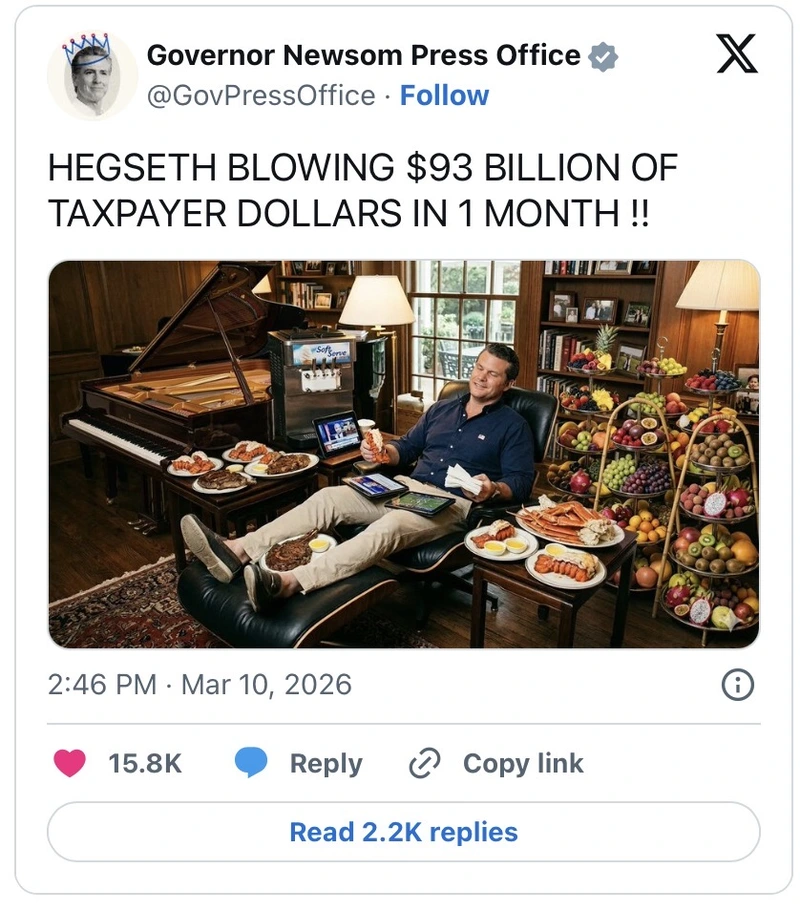
California Governor Gavin Newsom mocked the situation by posting an AI-generated image of Hegseth surrounded by steaks and lobster.
Congress is expected to hold hearings on the Pentagon’s year-end spending practices, and lawmakers from both parties have signaled they will use the report to push for reforms to the use-it-or-lose-it rules.
Open the Books has pointed out that the Constitution already allows military funding to be appropriated for up to two years — meaning Congress could let the Pentagon roll over unused funds instead of forcing the annual September panic.
What This Really Tells Us
The administration that fired USAID workers, slashed Head Start funding, gutted the EPA, and told Americans that government efficiency required painful sacrifice had no problem letting the Pentagon set a spending record on luxury shellfish and grand pianos.
DOGE went after school lunch programs and cancer research funding. It did not go after $7 million lobster orders.
That’s not government efficiency. That’s a protection racket for defense spending. And the $93.4 billion receipt proves it.