
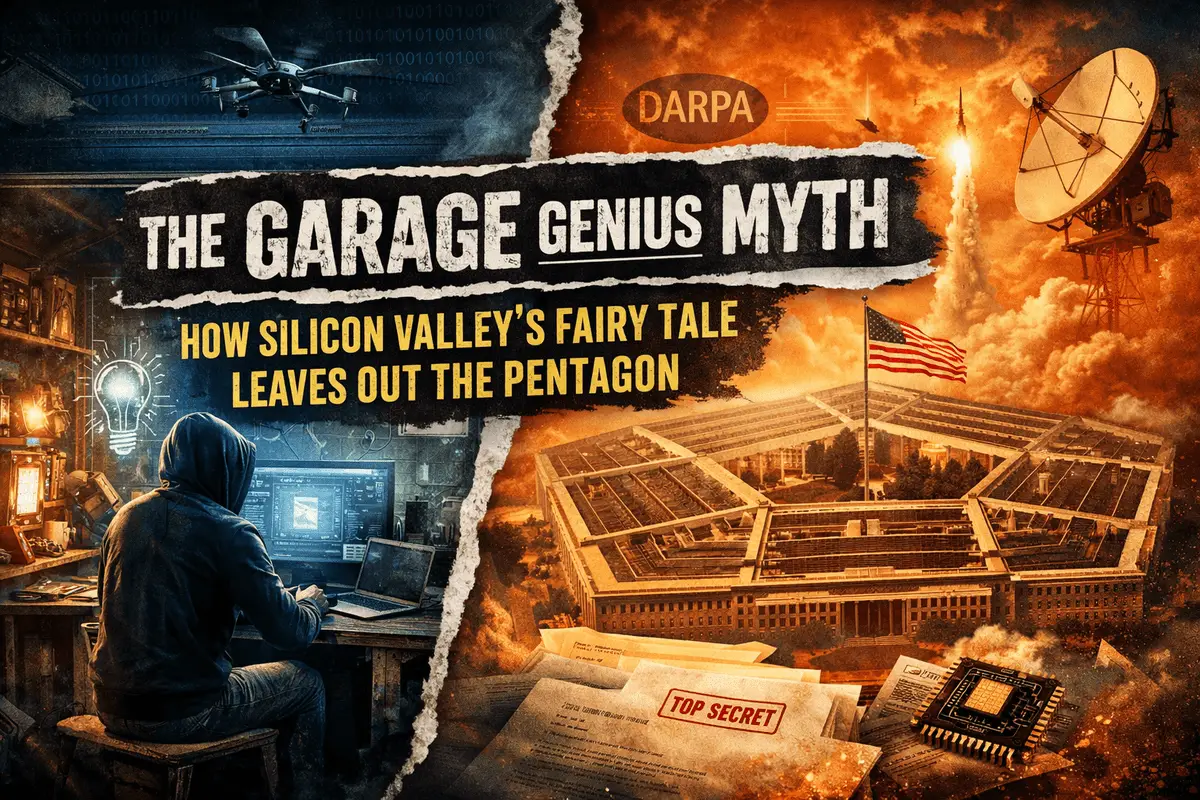

For years, Americans have been told a simple story about Big Tech and felt inspired by the legend of the “garage genius.”
It’s a feel-good story. A few brilliant young men. A garage. A dorm room. A big idea. Through grit and innovation, they built companies that changed the world.
Amazon. Apple. Google. Facebook. Microsoft.
We’re told this is capitalism at its best — pure free-market success.
But that story leaves out something important.
The rise of Big Tech was not just a fairy tale of scrappy entrepreneurs outsmarting the system. It was built on a foundation of massive public investment, military research, and deep connections to the U.S. intelligence community.
And that changes how we should understand the power these companies hold today.
The Military Roots of Your Digital Life
Most of the digital tools you use every day didn’t begin as consumer products.
They began as military projects.

The internet itself started as ARPANET in the late 1960s. It was funded by the U.S. Department of Defense as a way to create a communication network that could survive nuclear war. It wasn’t designed so you could scroll Instagram or order groceries. It was designed for national security.
GPS? That was developed and maintained by the U.S. military. Originally developed in the 1960s to improve military navigation and weapon guidance, the system was officially named NAVSTAR in 1973.
According to GEOTAB, “as of May 2020, GPS.gov confirms there are 29 operational satellites. The satellites circle the Earth two times a day at 20,200 km (12,550 miles) up. The U.S. Air Force monitors and manages the system, and has committed to having at least 24 satellites available for 95% of the time.”
Touchscreen technology? Early research supported by government funding. From drax.com: “Modern touchscreen technology was initially developed by the University of Kentucky, but it wasn’t until 1996, when the NSF and CIA began funding research at the University of Delaware, that the technology truly took off.”
Voice recognition systems? Built from artificial intelligence research financed by DARPA — the Defense Advanced Research Projects Agency. DARPA funded speech recognition research projects from 1971 to 1976, with an initial goal of recognizing 1,000 words. This led to the HARPY system by Carnegie Mellon University (CMU) in 1976.
Even the smartphone in your pocket relies on technologies that were funded, in whole or in part, by federal research dollars.
In other words, taxpayers *funded the early innovation. Private corporations later commercialized it.

That’s not necessarily a bad thing. Public investment in research has led to countless breakthroughs. But the problem is the “garage genius” myth. Americans were told these companies rose entirely through private risk and individual genius.
That’s not the full story.
*Sidenote: Taxpayer dollars also fund drug research by Big Pharma. Drug companies then turn around and charge Americans more than people in any other country for the same medications we funded the development of.
Corporate Welfare Disguised as Free Market Success
There’s another uncomfortable layer.
Many of the companies we now call “Big Tech” benefited from government contracts, research partnerships, tax incentives, and venture capital streams connected to national security interests.
That blurs the line between public and private power.
When companies that control global communication platforms have historic ties to defense agencies and intelligence-backed funding streams, it raises serious questions.
Who ultimately shapes the infrastructure of our information ecosystem?
Who benefits from data collection systems originally designed for surveillance and defense?
Who holds influence when corporate power and state power overlap?
Social Media in the “Pyramid of Power”
Today, social media platforms act as gatekeepers of public conversation. They decide what trends, what spreads, and what disappears into the algorithmic void.
They can amplify social movements. They can suppress them. They can shape public perception during elections, protests, wars, and crises.
But these platforms were not born in a vacuum.
They were built on technology developed for control, coordination, intelligence gathering, and strategic communication.
That doesn’t automatically mean there is a grand conspiracy. It does mean we should stop pretending that Silicon Valley is purely a collection of rebellious outsiders standing apart from government influence.
The relationship has always been intertwined.
And when companies grow so large that their wealth and influence surpass traditional media conglomerates — when they become the digital public square — that history matters.

The phrase “Pyramid of Power” comes from a book that examines the people and institutions that rule the world with the same title, by investigative journalist Derrick Broze. The book was released after his 17-part documentary series on “powerful institutions and individuals who attempt to manipulate our world for their own benefit.”
He’s the founder of multimedia site, The Conscious Resistance Network, and co-founder of The Freedom Cell Network. Broze is also the author of The Conscious Resistance Trilogy, and How to Opt Out of the Technocratic State.

“Garage Genius” Startups Myth
If social media sits in the middle of today’s “Pyramid of Power,” then understanding its origins helps us understand its role.
These companies are not neutral platforms floating above politics. They are powerful institutions built on state-funded infrastructure, operating at global scale, influencing billions of people.
That’s not a fairy tale.
That’s structural power.
The “garage genius” startup story makes us feel inspired. The real story should make us ask better questions.
Who controls the digital commons?
Who benefits from surveillance capitalism?
And when public investment creates private empires, who is accountable to the public?
The point isn’t to reject technology. The point is to understand it.
Because power that hides behind a myth is power that goes unchecked.