

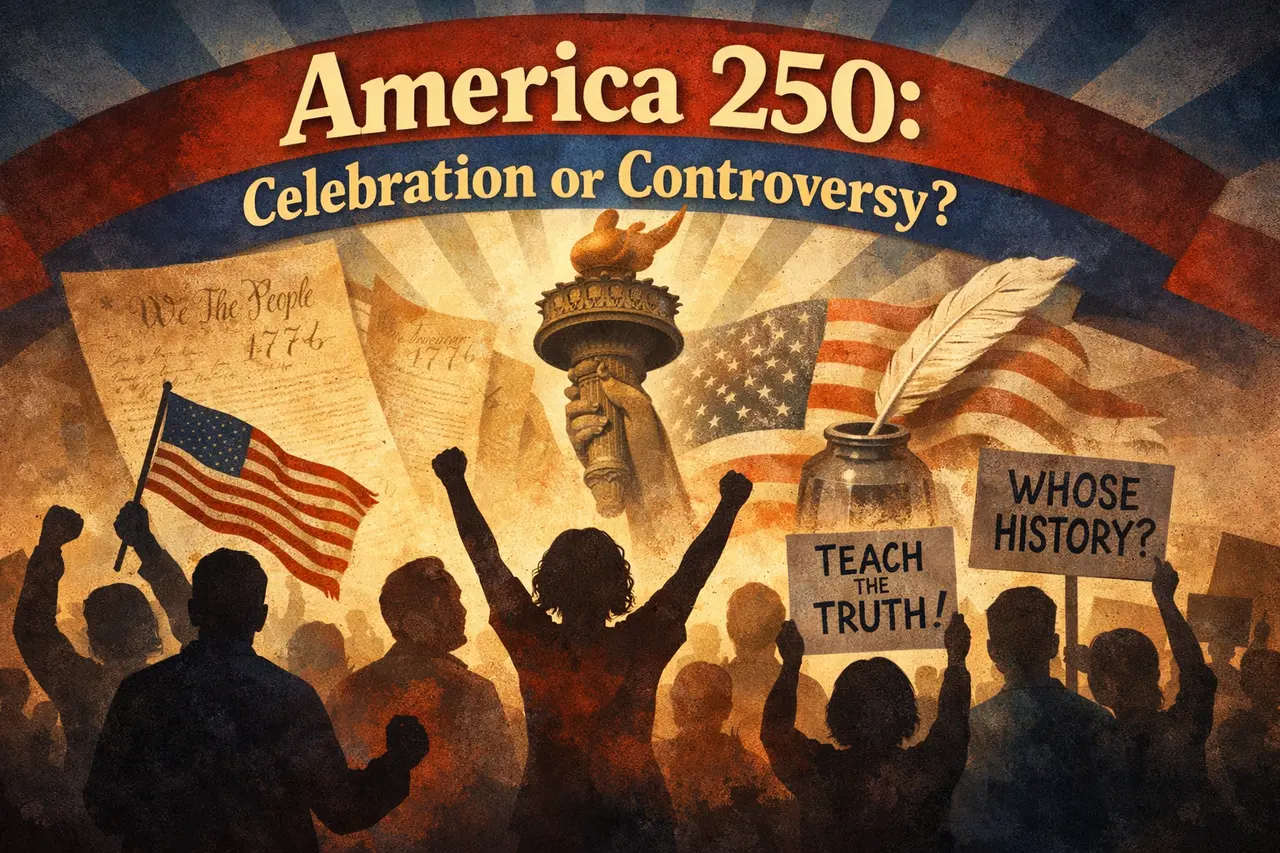
Six 18-wheelers are crisscrossing the United States right now, visiting schools, libraries, and community centers. The Trump administration calls them “Freedom Trucks” — mobile museums celebrating America’s 250th anniversary. But a closer look at who built them, what’s inside, and where the money came from tells a very different story.
What Are the Freedom Trucks?
The Freedom Trucks are part of the administration’s “Freedom 250” initiative, launched by executive order in January 2025 to mark the nation’s semiquincentennial. Each truck is a double-wide 18-wheeler that expands to reveal two rooms of exhibits — one covering pre-Revolution history, the other covering post-Revolution history.
The first truck debuted on January 21, 2026, at Revolution Academy, a charter school in Summerfield, North Carolina.
Inside, visitors can take an “Are You a Loyalist or a Patriot?” quiz, digitally sign the Declaration of Independence, chat with an AI-generated George Washington, and view a “wall of 50 American heroes.” Organizers say the trucks will reach 20 million Americans by the end of the year.
It sounds like a feel-good civics lesson. So why are educators, librarians, and historians raising alarms?
Who Built Them — and With Whose Money?
The exhibits were created by PragerU and Hillsdale College — two organizations with well-documented records of pushing far-right ideology into public education.
PragerU, which is not an accredited university, has been labeled a “political propaganda machine” by Jonathan Zimmerman, a professor of the history of education at the University of Pennsylvania, and has been classified by the Southern Poverty Law Center as promoting far-right propaganda.
Its animated children’s videos have been widely criticized for distorting the history of slavery, misrepresenting the words of Frederick Douglass, and minimizing the experiences of Indigenous peoples. In one notorious video, a cartoon Christopher Columbus tells children that being enslaved was “better than being killed.”
Hillsdale College, meanwhile, is a small ultraconservative institution whose mission statement includes a commitment to “theological education.” The Freedom From Religion Foundation has described both organizations as part of a broader coalition of Christian nationalist groups working to reshape public education.
And the funding? It came from the Institute of Museum and Library Services — the only federal agency dedicated to supporting public libraries and museums. According to critics at EveryLibrary and Book Riot, over $14 million in IMLS money was redirected to the Freedom 250 project.
This happened while the Trump administration was simultaneously trying to dismantle the IMLS entirely.
In March 2025, the president signed an executive order to eliminate the agency. Roughly 80 percent of its staff were placed on administrative leave. Grants to libraries and museums across the country were canceled — funding that had previously supported Braille books for the blind, internet access in rural libraries, summer reading programs, and after-school tutoring.
A federal court eventually ordered those grants reinstated, and Congress maintained IMLS funding for fiscal year 2026 despite the administration’s objections. But the damage had already been done. As EveryLibrary noted in its analysis of the federal budget, the Freedom Trucks function “less as library services and more like propaganda vehicles.”
A Sanitized Version of History
Historians who have reviewed the exhibits say they present a heavily curated, rose-tinted version of American history that glosses over the realities of slavery, the genocide of Native peoples, and the long struggles for civil rights that have defined the American experience as much as the Declaration of Independence itself.

Transportation Secretary Duffy acknowledged as much at the launch event, comparing difficult chapters of American history to “potholes” in a road. That framing — reducing centuries of slavery, Jim Crow, and systemic racism to inconvenient road hazards — tells you everything about the worldview shaping these exhibits.
The original Hill opinion piece promoting the initiative, written by Sonderling himself, accused libraries and museums of being “hijacked by advocates of divisive social theories” and called for a return to telling “the great American story.” In practice, that means presenting a version of history that centers whiteness, celebrates free enterprise, and treats the ongoing fight for justice as a distraction from patriotism.
Controlling the Narrative
The Freedom Trucks represent something larger than a traveling exhibit. They are part of a deliberate, well-funded strategy to control the narrative of American history — to replace the messy, painful, complicated truth with a glossy, feel-good story that serves a political agenda.
When this kind of content rolls up to a public school or community library, it arrives with the full weight and authority of the federal government behind it.
Real patriotism doesn’t require whitewashing the past. It requires confronting it honestly so we can build something better. The founders the Freedom Trucks claim to celebrate were themselves radicals who challenged an unjust system.
The most patriotic thing any American can do in 2026 is to insist on the whole truth — including the parts that make us uncomfortable.
If the Freedom Trucks are coming to your community, show up. Ask questions. And remind your neighbors that a truck full of propaganda is still propaganda, no matter how many flags are painted on the outside. 🇺🇸
Resist Hate (resisth8.com) is committed to reporting news accurately, factually, and with compassion for all people.