

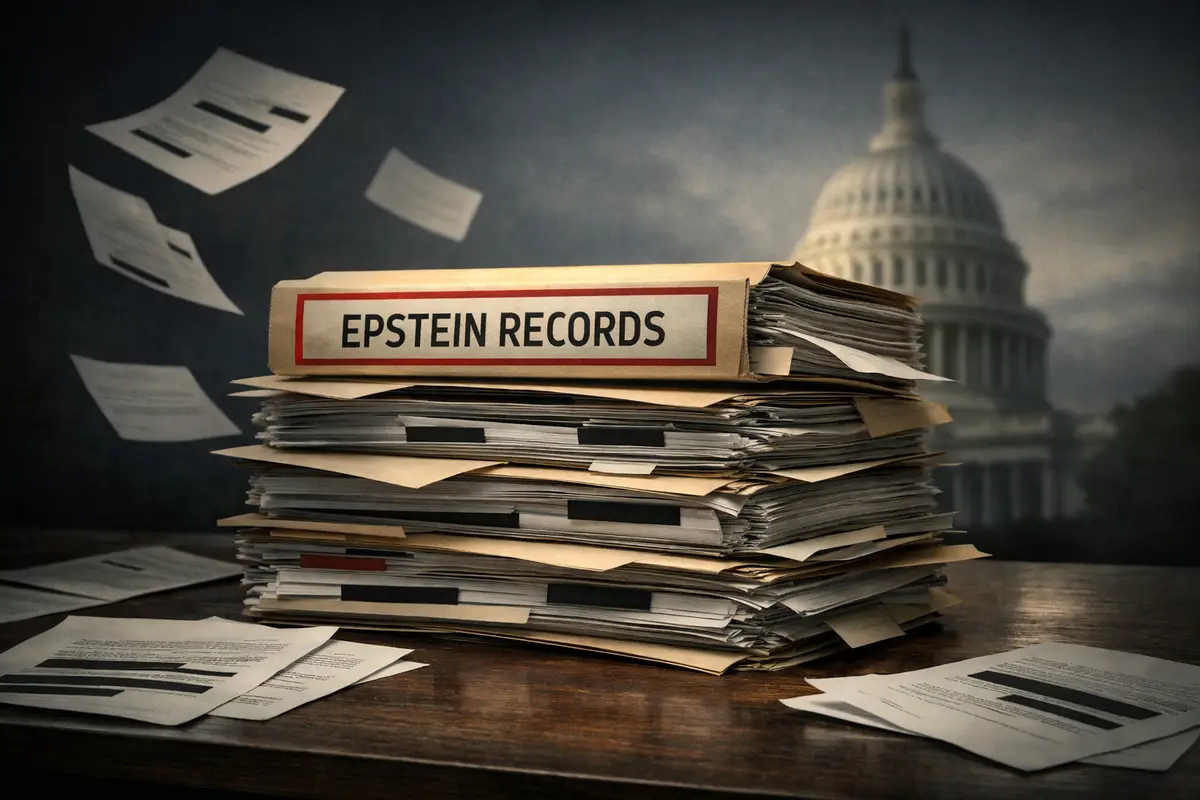
Members of Congress began viewing unredacted Epstein files at the Department of Justice on Monday, and what they found was alarming in two very different ways. Survivors’ names were left in plain sight for the world to see. But the names of wealthy and powerful people connected to Jeffrey Epstein were hidden behind black bars — apparently to spare them embarrassment.
Representative Jamie Raskin, the top Democrat on the House Judiciary Committee, was among the first lawmakers to sit down in the DOJ’s reading room and review the files.
After spending several hours with the documents, he walked out and told reporters that the Justice Department appears to have broken the law.
The Double Standard
The Epstein Files Transparency Act, signed into law in November 2025, required the DOJ to release millions of documents from the Epstein investigation. The law was very specific about what could be redacted: victim names and personally identifiable information could be withheld. Everything else was supposed to be public.
“…it would take a single lawmaker years to review even a fraction of the material.”
The law explicitly states that documents cannot be held back or redacted on the basis of “embarrassment, reputational harm, or political sensitivity, including to any government official, public figure, or foreign dignitary.”
But according to Raskin, that is exactly what happened.
“What I saw today was that there were lots of examples of people’s names being redacted when they were not victims,” Raskin said. He called the redaction pattern “suspicious and baffling.”
At the same time, the DOJ apparently failed to protect the people the law was specifically designed to shield. Raskin said there were roughly 3,000 pages in which survivors’ names were not redacted at all — left visible for anyone to find.
The names of women and girls who were victims of Epstein were exposed to the public, while the names of powerful men connected to the predator were carefully hidden.
Let that sink in. The government protected the reputations of the powerful and left the victims’ identities in the open.


What Raskin Found
During his review, Raskin encountered deeply disturbing material. He said the files contained references to girls as young as nine years old being involved in Epstein’s network of abuse. He described the contents as “gruesome and grim.”
One particular redaction stood out. Raskin described a document in which Epstein’s lawyers discussed President Trump’s connection to the financier. According to the document, Epstein’s legal team wrote that Trump said Epstein “was not a member of his club at Mar-a-Lago, but he was a guest at Mar-a-Lago, and he had never been asked to leave.” This directly contradicts Trump’s public claims that he personally kicked Epstein out of Mar-a-Lago.
That passage had been redacted in the public release of the files — blacked out entirely.
“There is certainly nothing in our federal law that would require redaction in that case,” Raskin said. He was clear that there was no legal justification for hiding a conversation between lawyers that merely contradicts something the president has said publicly.
The name of Les Wexner, the billionaire founder of L Brands who has been photographed with Epstein and appeared in flight records, was also redacted — despite the fact that Wexner is not a victim and his name has already appeared in other public documents.
Trump’s name was redacted “in a number of different places,” Raskin added.
A Reading Room With Four Computers
The conditions under which lawmakers are reviewing these files tell their own story about how seriously the DOJ is taking transparency.
Members of Congress must give 24 hours’ notice before visiting. They cannot bring staff. They cannot bring electronic devices. They sit in a reading room at DOJ headquarters in Washington and review documents on just four computers. They can take handwritten notes — and that is all.
Raskin estimated he was able to review only about 30 to 40 individual documents during his visit. The files comprise more than three million pages, including 2,000 videos and 18,000 images. At that pace, it would take a single lawmaker years to review even a fraction of the material.
“This is going to be an extremely time-consuming and painstaking process,” Raskin said.
And time is not a luxury lawmakers have. Attorney General Pam Bondi is scheduled to testify before the House Judiciary Committee on Wednesday, just two days after the reading room opened. Raskin acknowledged he will not be able to review a significant portion of the files before that hearing.
Representative Jared Moskowitz, a Democrat from Florida, also visited the reading room and confirmed that despite the DOJ’s promises of transparency, some documents still contained redactions. “There are names in legal documents that are still redacted,” he said. He described viewing grand jury testimony with names still blacked out.
Bottom Line
The bipartisan Epstein Files Transparency Act was written by Representatives Thomas Massie, a Republican from Kentucky, and Ro Khanna, a Democrat from California. Both were expected to visit the reading room later Monday and hold a press conference afterward.
The law passed Congress because the American public demanded it. Survivors fought for years to have these records see the light of day. Eight of them even pooled their resources to run an ad during the Super Bowl on Sunday night, calling on Attorney General Bondi to release all remaining documents.
And yet, here we are. The DOJ has released roughly half of the six million pages it says it possesses. What it did release was riddled with redactions that appear to protect the powerful, while failing to protect the people who were actually harmed.
Raskin said he plans to return to the reading room and continue reviewing files. But his initial assessment was damning: the DOJ has not complied with the law, and the pattern of what was hidden and what was exposed looks like a choice — not an accident.
“There are puzzling, inexplicable redactions, and so we need some explanation from the Department of Justice about what their process was,” Raskin said, “and why it seems to have created so many erroneous non-redactions, causing tremendous pain to survivors, and then so many seemingly false redactions.”
The survivors deserve answers. The public deserves the truth. And based on what lawmakers found on Monday, neither is being delivered.