

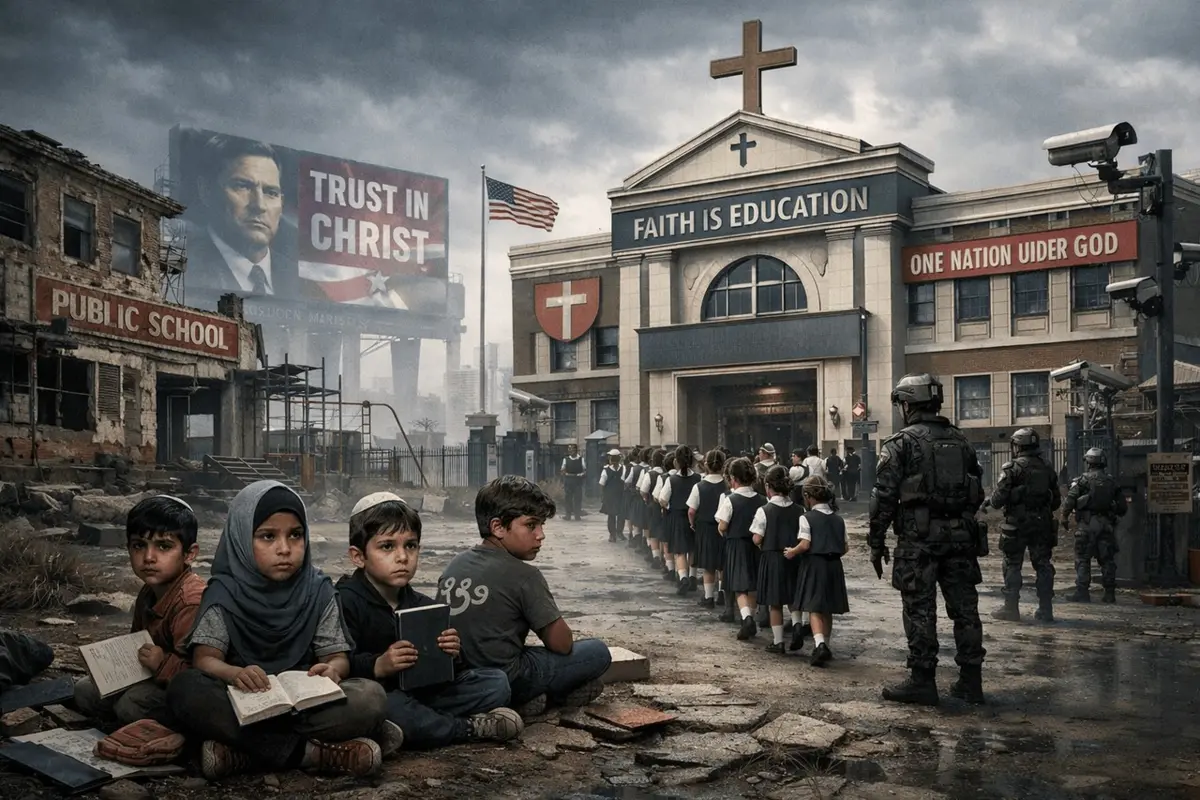
The Republican Party has been openly embracing Christian Nationalism—and several GOP politicians now proudly wear the label. Here’s what that means for the rest of us.
Republican Congressman Josh Hawley stood at the podium during the National Conservatism Conference and said something that would have been unthinkable a generation ago. He told the crowd he was a proud “Christian Nationalist” and claimed that Christian Nationalism actually founded American democracy.
He’s not alone. A growing number of Republican leaders aren’t just flirting with the idea that America should be a Christian nation—they’re saying it out loud. And they’re writing laws to make it happen.
So What Exactly Is Christian Nationalism?

Let’s be clear about what we’re talking about. Christian Nationalism isn’t just going to church and loving your country. It’s a political ideology that says America was built as a Christian nation—and that our laws, schools, and government should reflect that.
It’s the belief that being a “real American” and being a Christian are basically the same thing. And if you’re not Christian? Well, you’re a second-class citizen.
This plays out in ways that affect all of us. When an Alabama judge ruled that unused IVF embryos are legally babies—making it effectively illegal to destroy them—that wasn’t based on science.
It was based on someone’s religious interpretation of when life begins. When the Supreme Court overturned Roe v. Wade, the reasoning had far more to do with faith than with constitutional law.
And it doesn’t stop at abortion.
Christian Nationalist ideology drives efforts to roll back LGBTQ+ rights, block same-sex adoption, and ban books from school libraries. It’s the framework behind laws that privilege one set of religious beliefs over everyone else’s freedom.
Here’s the irony: many Christians don’t want any part of this.

Christians Who Are Pushing Back
A coalition called Christians Against Christian Nationalism released a public statement inviting fellow believers to reject the movement. Their message was direct: Christian Nationalism distorts both their faith and the Constitution.
They wrote that it “seeks to merge Christian and American identities” and that it “often overlaps with and provides cover for white supremacy and racial subjugation.” They called it idolatrous—their word, not mine—to conflate religious authority with political power.
The statement makes something abundantly clear: there is nothing inherently Christian about Christian Nationalism. Plenty of devout Christians see it for what it is—a power grab dressed up in religious language.
Where Did This Come From?
Christian Nationalism didn’t appear overnight. Its roots stretch all the way back to the Puritans, who believed their settlement in the New World was a divine mission. That idea—that America has some kind of special covenant with God—never really went away. It just evolved.

The First Great Awakening in the 1700s laid the spiritual groundwork. But the modern political movement really took shape in 1979 when Jerry Falwell founded the Moral Majority. The goal was to mobilize evangelical voters around conservative causes—and it worked. Ronald Reagan rode that coalition into the White House, and Christian Nationalist ideas became a permanent fixture in mainstream Republican politics.
Then came 2016. Donald Trump’s campaign drew an unmistakable line between religious identity and political loyalty. Evangelicals showed up for him in record numbers, and the alliance has only deepened since.
The Playbook: How Christian Nationalists Operate
If you’ve been paying attention to American politics over the last few years, the Christian Nationalist playbook will sound familiar.
Strong, authoritarian leaders. The movement gravitates toward charismatic figures who present themselves as champions of “the people” against a godless elite. Sound familiar?
Us versus them. There’s a deep in-group mentality. You’re either a defender of the faith and the nation, or you’re the enemy. Political opponents aren’t just people who disagree—they’re threats to the moral fabric of society.
Rewriting history. Christian Nationalists promote a version of American history that erases the contributions of anyone who doesn’t fit their narrative. We saw this in real-time when government agencies claimed to be “getting rid of DEI” but were actually scrubbing the accomplishments of women and people of color from public records.
Legislating belief. The Oklahoma Superintendent of Schools tried to require Bibles—specifically Trump-branded Bibles—in every classroom, and wanted the Ten Commandments posted on every school wall. A judge blocked the Ten Commandments law. And that same Superintendent? He was later caught watching pornography on his office computer.
Which brings up an uncomfortable pattern. Why do so many of these moral crusaders keep getting caught in scandals involving the very things they claim to be protecting people from?
There’s a documentary about a Mormon community where church leaders systematically covered up the sexual abuse of children.

And now we have a president, hand-picked by evangelical Christians, who has done everything in his power to keep the Epstein files under wraps.
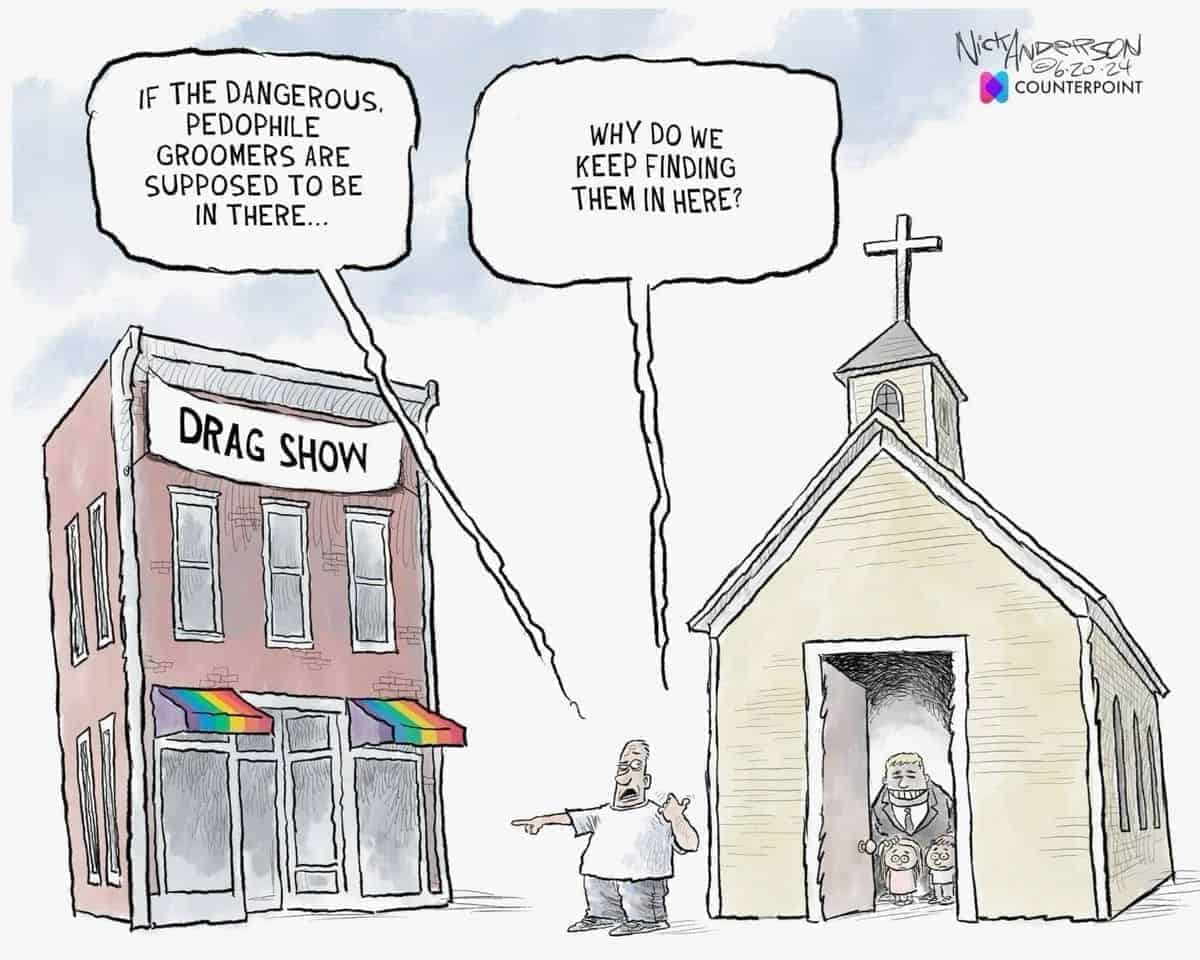
There’s actually a meme that sums it up: the number of children harmed at drag shows is zero. The number harmed in churches? That list is long.
The Courts: Where the Real Damage Gets Done
The impact on legislation is serious, but the courts are where this movement has done its most lasting damage.
Christian Nationalists have pushed hard to seat judges who share their values at every level of the judiciary. The conservative supermajority on the Supreme Court has already thrown out decades of legal precedent to overturn Roe v. Wade, and has issued other rulings that seem designed to benefit Trump and the Republican Party over the will of the majority.
This isn’t just about one case or one election cycle. These are lifetime appointments. The decisions being made now will shape civil rights, education, and social policy for a generation.
The White House Faith Office

The Trump administration made the alliance official when it established a Faith Office in the White House, led by Paula White. She’s the woman who said, “To say no to President Trump is to say no to God.”
Let that sink in.
Trump also gave a speech about “anti-Christian bias” in America and announced a task force to investigate it. The idea that the religious majority in the United States is being discriminated against is absurd on its face—but it serves a purpose. It feeds the persecution narrative that keeps the base angry and mobilized.
This Isn’t Just an American Problem
Christian Nationalism isn’t unique to the United States. Similar movements are growing across the globe.

In Hungary, Viktor Orbán used nationalist Christian rhetoric to consolidate power—and then dismantled democratic institutions to make sure he never had to give it up. His story has an eerie parallel to Trump’s: Orbán was elected, lost reelection, and then won again—only this time, he made sure he’d never leave.
Trump hosted him at Mar-a-Lago and introduced him to the crowd as a great leader. Before the 2024 election, Orbán and a Heritage Foundation executive were spotted entering Mar-a-Lago together.
It doesn’t take much imagination to guess what they were discussing.
In Brazil, political leaders rallied evangelical voters by framing right-wing policies in Christian terms. Trump recently slapped a 50% tariff on Brazil essentially because the country’s courts were holding Bolsonaro—a former leader who attempted a coup—accountable.
In Poland, nationalist movements have invoked Christianity to resist secularism and push back against LGBTQ+ rights.
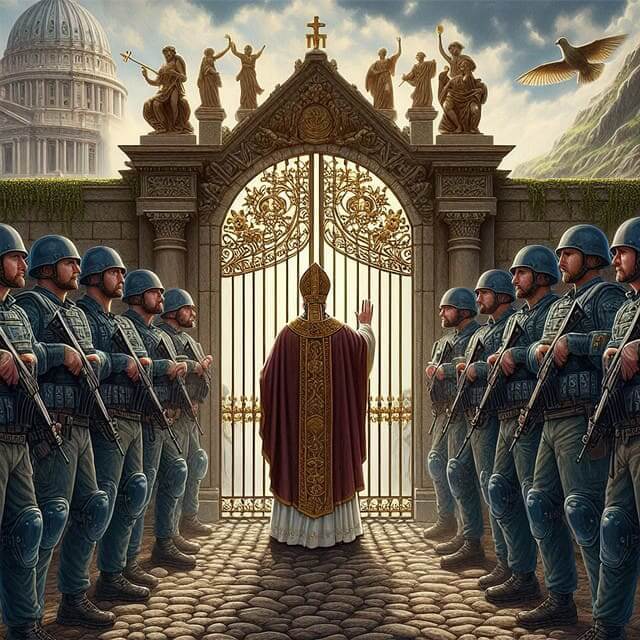
History offers even darker examples. The Catholic Church aligned with fascist regimes during World War II.
In apartheid South Africa, certain Christian groups used the Bible to justify segregation and racial discrimination.
What Happens Next?
Here’s the thing that keeps me up at night: the demographics don’t favor Christian Nationalism in the long run. Younger generations are more diverse, more secular, and less likely to buy into the idea that America belongs to one religion.
But that’s exactly what makes the current moment so dangerous.
The people pushing this ideology know their window is closing, which is why they’re moving so fast to lock in their power—through the courts, through voter suppression, through the erosion of democratic norms.
I often wonder whether the Trump administration realizes they’re deporting some of the most conservative, church-going people in the country.
How does that affect the party’s future—if we even have fair elections to find out?
Several Republican leaders have said on far-right podcasts that the party needs to seize power, fire civil servants, and replace them with loyalists.
That’s not hyperbole. That’s their stated plan.

Why This Matters to All of Us
Christian Nationalism isn’t just a political curiosity or a culture-war talking point.
It’s a direct threat to the separation of church and state, to the civil rights of anyone who doesn’t fit a narrow definition of what it means to be American, and to democracy itself.
As Tim Miller of The Bulwark podcast put it, the choice for voters has become one between “the Godless Democrats and the pretending-to-be-Christian Republicans.”
Whether you’re a person of faith or not, this affects you.
When any one group gets to decide that their beliefs should be everyone’s law, freedom dies—not just for the people being marginalized, but eventually for everyone.
The answer isn’t less religion. It’s keeping religion where it belongs: in our hearts, our homes, and our houses of worship—not in our courtrooms, our classrooms, and our government.
FAQs
What is the difference between Christian nationalism and Christianity?
Christian nationalism is a political ideology that seeks to fuse national identity with Christian beliefs, while Christianity is a religion based on the teachings of Jesus Christ. Not all Christians subscribe to nationalist beliefs, and many advocate for the separation of church and state.
Is Christian nationalism a new phenomenon?
While Christian nationalism has historical roots in the United States, its recent resurgence, particularly in the last few decades, has brought it into the mainstream political conversation. This resurgence often aligns with broader social and political movements.
How does Christian nationalism impact legislation?
Christian nationalism can significantly influence legislation by promoting policies that align with specific religious beliefs, such as restrictions on abortion or the promotion of religious expression in public settings. This often raises concerns about the separation of church and state and the rights of minority groups.
Are there examples of Christian nationalism in other countries?
Yes, Christian nationalism can be observed in various countries around the world, including Poland, Hungary, and Brazil. These nations exhibit similar trends of intertwining national identity with Christianity, leading to policies that reflect traditional religious values.
What are the potential risks of Christian nationalism?
The potential risks include increased polarization, discrimination against minority groups, and the erosion of democratic values. When religious beliefs are intertwined with national identity, it can lead to the exclusion of those who do not share the same faith or values, undermining social cohesion.