
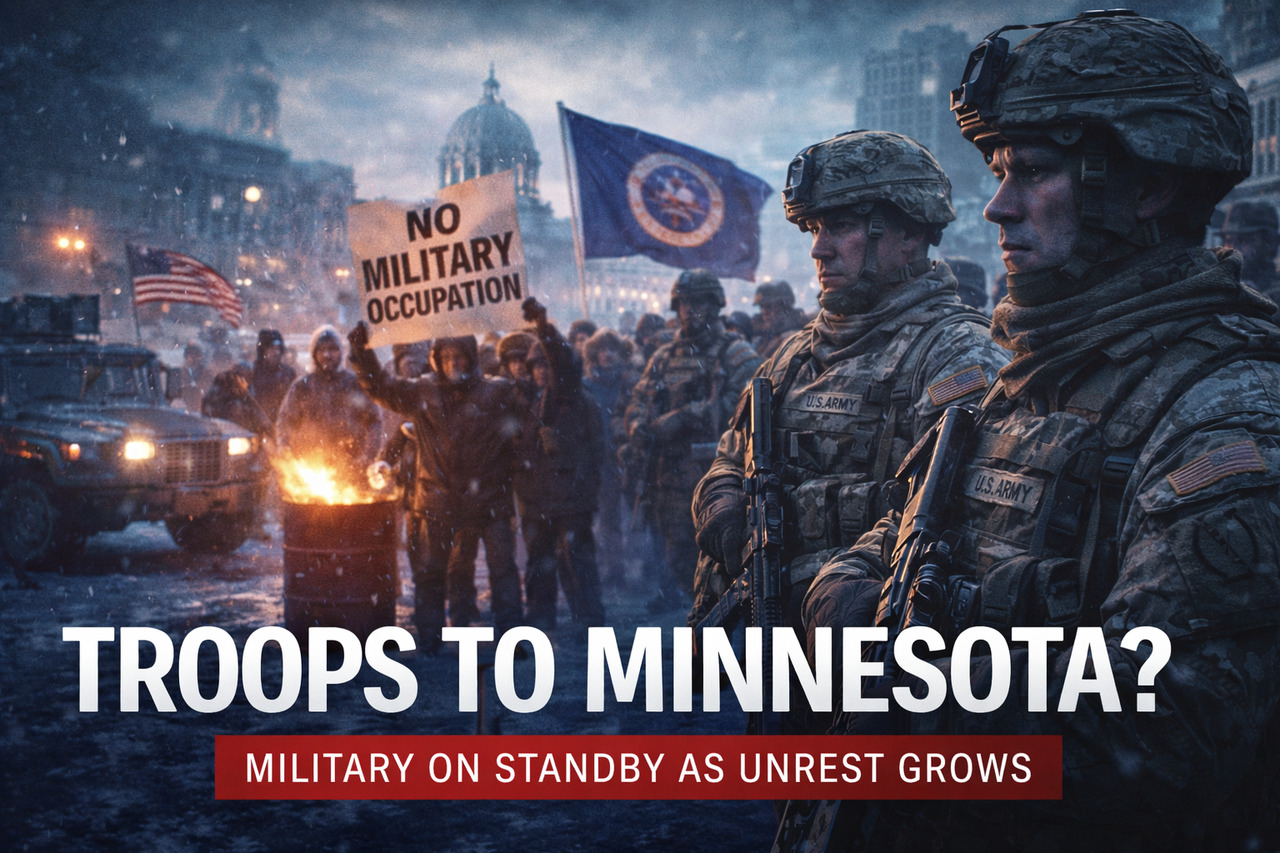
In a development that raises serious questions about federal authority, civil liberties, and the role of the U.S. military on American soil, the Pentagon has placed about 1,500 active-duty soldiers on standby for a potential deployment to Minnesota.
Defense officials say the troops, drawn from units trained for cold-weather operations in Alaska, have been ordered to prepare for deployment if conditions worsen amid escalating protests tied to the shooting of Renee Nicole Good and the mass deportation operation.
The move, first reported by Reuters on January 18, 2026, underscores how deeply the nation is grappling with the fallout of a controversial immigration crackdown — and whether the use of military force within the United States is ever appropriate outside of extreme circumstances.
A Surge of Federal Officers and Rising Tension
The backdrop to this possible military involvement is an extended federal mass deportation campaign known as Operation Metro Surge, where thousands of Immigration and Customs Enforcement (ICE) officers and other federal agents have been deployed to Minneapolis and the broader Minnesota region.
The Trump administration initially framed the effort — which now involves roughly 3,000 immigration agents — as aimed at combating illegal immigration and dangerous criminal activity, though the focus has been overly broad and heavy-handed.
We’ve witnessed women being forcibly removed from their vehicles, individuals being assaulted, car windows being shattered, and American citizens ordered to present their “papers.” The troubling actions of ICE agents and the intimidating turmoil they’ve instigated in Minneapolis have been documented through cell phone footage taken by residents of Minnesota.
Tensions climbed sharply after the fatal shooting of 37-year-old Renee Nicole Good by an ICE agent in Minneapolis early this month. Good, a U.S. citizen and mother of three, was killed while in her vehicle, sparking outrage, protests, and renewed debate about federal tactics and accountability.
Protesters — largely peaceful in many areas — have demanded a halt to the federal surge and justice for Good. Local leaders, including Minneapolis Mayor Jacob Frey and Minnesota Governor Tim Walz, have condemned the shooting and warned that further militarization could inflame tensions rather than calm them.
The Insurrection Act? A Flashpoint in a Constitutional Debate
President Donald Trump has publicly threatened to invoke the Insurrection Act, a seldom-used 19th-century law that allows the president to deploy federal troops domestically without state consent to quell rebellion or enforce federal law. The Pentagon’s preparedness order reflects this threat, though it is not clear whether the Insurrection Act would ultimately be invoked.
Under current U.S. law — particularly the Posse Comitatus Act — active-duty military forces are generally prohibited from acting as domestic law enforcement. The Insurrection Act is one of the few exceptions.
Legal experts cited in related reporting note such use is rare and historically controversial, with past deployments often prompting debate about federal overreach and civil liberties.
The White House has stated that it is typical for the Pentagon to prepare forces in case a presidential decision requires them, but has not confirmed whether a formal order is imminent.
The soldiers in question belong to units under the 11th Airborne Division, chosen in part for their ability to operate in winter conditions — a reminder that weather, geography, and timing all factor into readiness decisions.
Local Resistance and National Guard Mobilization
While the possibility of federal troops being dispatched to Minnesota remains unresolved, state leaders are not waiting. Governor Walz has mobilized the Minnesota National Guard to support local law enforcement and protect peaceful protesters, though these Guard units have not yet been placed on the streets. Their activation signals Minnesota’s intent to safeguard community safety without relinquishing control to federal military forces.
Mayor Frey has been even more forceful, calling military deployment a move that would “exacerbate tensions” in a city already strained by the federal presence — and emphasizing that the right to protest should be protected. Similar concerns have been raised by civil liberties groups, who argue that invoking military force against domestic protests sets a dangerous precedent for democratic dissent.
At the same time, proponents argue that federal support may be necessary if violence escalates and local authorities can’t ensure public safety. That debate — about threat perception, public order, and the appropriate use of force — is likely to shape national discussions long after this specific chapter ends.
For now, the nation watches as Minnesota stands at the crossroads of protest, policy, and constitutional challenge — with 1,500 soldiers on standby and no clear answer yet about whether they will be called into action.