

At Resist Hate, our number one policy goal is simple: get money out of politics. Until that happens, almost nothing else we fight for will be possible.
Our community fights for criminal justice reform, common-sense gun laws, LGBTQ+ rights, civil rights, voting rights, climate justice, healthcare reform, human rights, and other policies that would improve the lives of working-class Americans.
See our About and Mission Statement pages to learn more.
But all of those goals run into the same wall — the outsized influence of money in Washington.
Why Money Is the Roadblock
Getting money out of politics isn’t just one issue among many — it’s the key that unlocks everything else. It’s also the biggest obstacle standing between everyday Americans and real representation in government.
Right now, Congress is full of millionaires. That’s a problem — not just because it signals corruption and insider trading, but because wealthy legislators are fundamentally out of touch with how most Americans live.
They don’t understand what it’s like to choose between rent and groceries, or to skip a doctor’s visit because you can’t afford the copay.
This criticism doesn’t apply to every member of Congress. Some, like Senator Elizabeth Warren and Senator Bernie Sanders, refuse corporate PAC money and have built their careers fighting for working people.
But they’re the exception, not the rule.
The cost of running for Congress makes it nearly impossible for an average working-class person to even try. A Senate campaign costs millions of dollars. In 2020, the Georgia Senate race cost roughly half a billion dollars.
When only wealthy people can afford to run, the people who win are often in it to enrich themselves — not to serve their communities.
And when a candidate isn’t personally wealthy? They rely on big-money donors who expect something in return.
Those donors aren’t funding campaigns out of the goodness of their hearts. They’re investing — and they expect their candidates to vote accordingly.
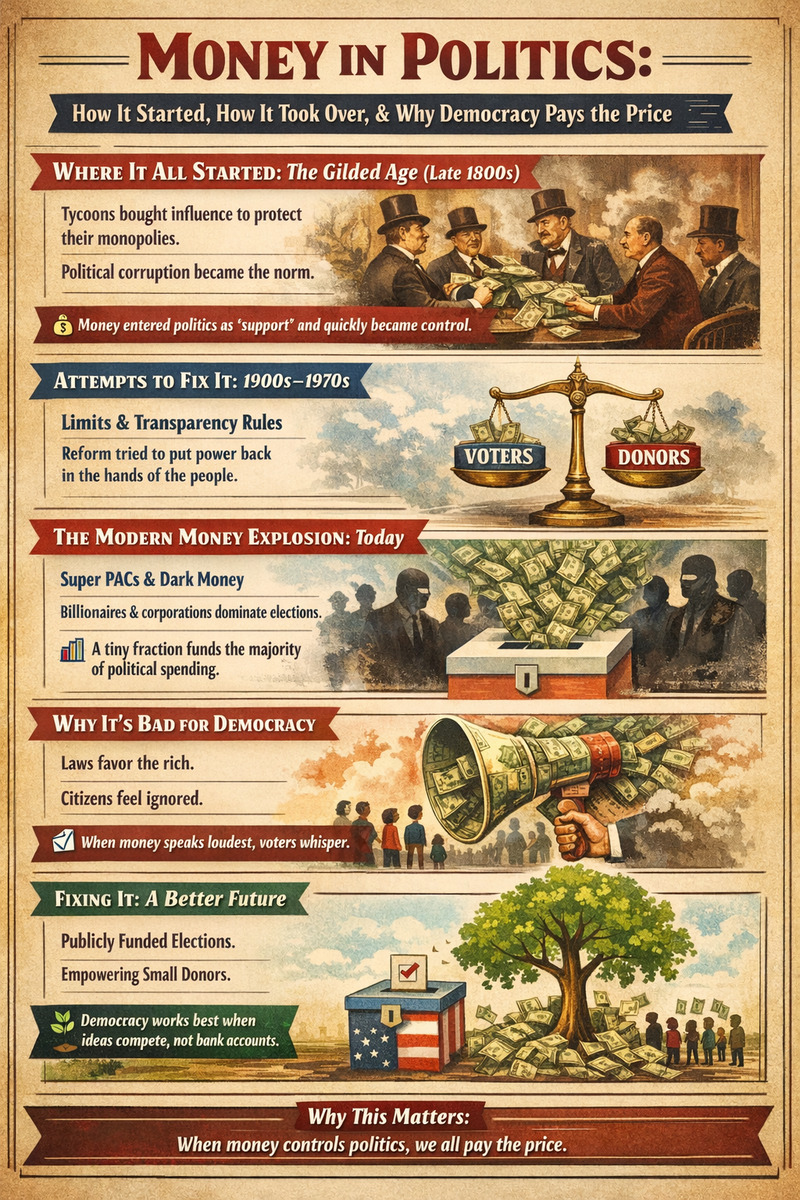
Insider Trading: How Public Servants Become Millionaires
One of the clearest examples of corruption in Congress is insider trading.
Insider trading happens when someone buys, sells, or trades stock based on non-public information they receive through their job.
Members of Congress have access to sensitive economic and policy information before the public does.
That gives them an unfair advantage in the stock market — they can buy stocks that are about to rise or sell stocks that are about to fall, based on information the rest of us don’t have.
This is one of the ways that so-called “public servants” have quietly become millionaires while supposedly working for the American people.
Real People Wanted
Imagine a Congress made up of real, everyday people — nurses, teachers, coaches, small business owners — people who ran for office because they genuinely want to make their communities better. Not because they saw an opportunity to get rich.

If we removed the financial incentive to serve in Congress, we’d attract a completely different kind of candidate: people motivated by public service, not personal gain.
Unfortunately, that’s not the reality we live in. With a few notable exceptions, Congress is dominated by wealthy, well-connected individuals who answer to their donors before their constituents.
If we want to change that, we have two choices: wait for current members to retire or leave office and replace them with people who actually represent us — or fight to end the corruption now.
The Fetterman Example: Proof That Money Corrupts
If you need proof of how powerful money’s influence is in Washington, look at what happened to Senator John Fetterman of Pennsylvania.
Fetterman ran as a progressive. As Lieutenant Governor, he had a track record of fighting for working Pennsylvanians. When he first arrived in the Senate, he made waves by challenging the chamber’s dress code so he could wear his signature hoodie and shorts. He seemed like the real deal.
Then something changed.
Fetterman began appearing on major news networks promoting Israel’s military actions in Gaza, repeating talking points like “Israel has a right to defend itself” — even as the humanitarian crisis deepened.
Over time, his positions drifted further and further from the progressive values he campaigned on.

The shift was hard to ignore. Money from AIPAC and the Israel lobby had found its way into the equation, and Fetterman’s voting record began to reflect it.
Some people argue Fetterman held these views all along and simply pretended to be progressive during his campaign.
That doesn’t hold up.
As Lieutenant Governor, he consistently championed progressive causes and pushed back against Republicans. If he had been faking it, he would have run as a moderate — which would have been the smarter strategy in a state with so many conservative rural areas.
Running as a progressive didn’t give him any tactical advantage. Democrats were fortunate that 2022 saw record voter turnout nationwide.
Your Secret Weapon: Facts and Data
Here’s the good news: we have the tools to expose this corruption, and they’re free and available to everyone.
By combining two publicly available websites, you can build an airtight case against any politician who claims to be independent of special interest money.
OpenSecrets.org lets you look up any politician and see exactly who their donors are and how much money they’ve received from each one.
It’s all public data, laid out in a clear, searchable format.
Congress.gov lets you look up any bill introduced in Congress and see how every member voted.
You can read the full text of any legislation — which is invaluable, since media coverage often oversimplifies or misrepresents what’s actually in a bill.
Here’s how to use them together: find a politician’s top donors on OpenSecrets, then check how that politician voted on bills that affect those donors’ interests on Congress.gov. When the votes line up with the money, you have your answer.
Their top donors + how they voted = the corrupting influence of money in politics.
For example: if a senator’s top donors include the NRA and gun lobby, and that same senator voted against a bill designed to prevent mass shootings, you can say — backed by facts and data — that this senator voted the way his donors paid him to vote, not the way his constituents wanted him to vote.
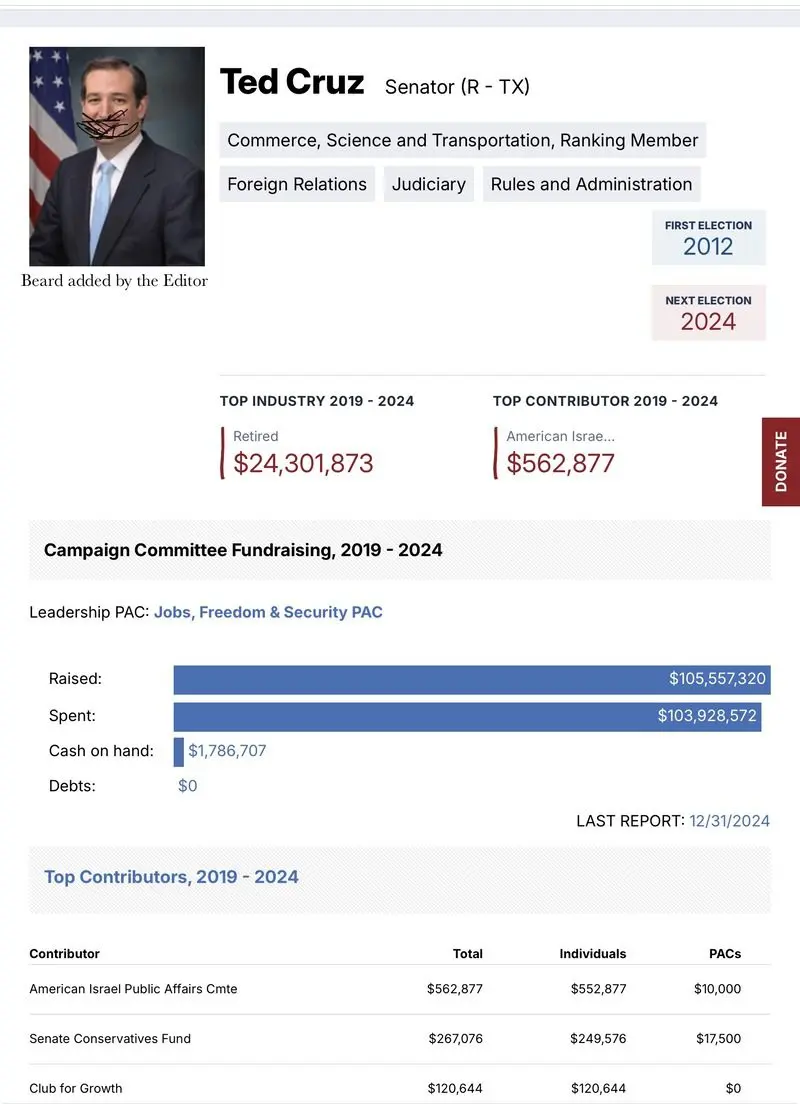
That’s the kind of argument that’s impossible to dismiss, because it’s built entirely on public records.
They Work for Their Donors — Not for Us
This is precisely why getting money out of politics matters so much. Right now, most politicians work for their donors. We need to build a system where they work for us again.
In a healthy democracy, the incentive structure is straightforward: if a politician does a good job fighting for their constituents, those constituents donate to their reelection campaign and vote for them again.
If a politician does a bad job, they don’t get the funding or the votes to stay in office.
That’s how it’s supposed to work. But when politicians can rely on wealthy donors and corporate PACs instead of their constituents, they have no reason to listen to the people they represent.
They serve whoever writes the biggest check.
Without an informed electorate, politicians can lie about their record during campaigns and coast to reelection.
That’s how ineffective members of Congress end up holding their seats for 30 or 40 years.
It’s also why some voters consistently vote against their own best interests — they’re getting their information from media outlets that launder politicians’ reputations rather than hold them accountable.
This is what “a government by the people, for the people” is supposed to mean.
Our representatives are supposed to be our equals — people we chose to go to Washington and do things that make our lives better. That’s the whole idea behind self-governance.
But right now, most politicians don’t care about earning our votes, because they aren’t dependent on us for the money they need to run their campaigns.
“For Ozempic, Americans pay around $969/month. Canadians pay $155/month, Danes: $122/month and Germans: $59/month. For the exact same drug.”
In a world where the system worked the way it’s supposed to, we’d have universal healthcare, paid family leave, free pre-K and community college, and infrastructure that isn’t crumbling.
Millions of Americans wouldn’t be uninsured or unhoused.
Money in politics has blocked all of it.
Americans Pay More for Less
Here’s a fact that doesn’t get enough attention: even though the United States is the richest country in the world, it is the only developed nation without universal healthcare and paid family leave.
Dozens of other countries use tax revenue to provide these basic services for their citizens. America doesn’t — and it’s not because we can’t afford to.
Americans pay more than four times what people in other countries pay for prescription drugs. Why? Because pharmaceutical companies have spent billions lobbying politicians to vote against government-funded healthcare programs like Medicare For All.
Instead, we’re stuck with a system built around private insurance companies and for-profit hospitals that drive up costs to enrich their executives and shareholders.
The result is a healthcare system where a single dose of Tylenol can cost hundreds of dollars in a hospital, and life-saving medications are priced out of reach for millions of Americans.
Consider Ozempic: USA Today interviewed the manufacturer in 2024. The drug company charged American patients $969 per month for the same drug that cost $155 in Canada, $122 in Denmark, and $59 in Germany.
An ABC7 report on Congress grilling weight-loss drugmakers a year ago. (video)

When asked about the price difference, the company’s CEO said the U.S. price is simply what they negotiated with American insurance companies.
That’s not a healthcare system — it’s a profit machine. And it exists because the politicians who could change it have been paid not to.
Having privatized healthcare, insurance, and even prisons means these institutions exist to generate profit — not to serve people.
Their priority is their bottom line and shareholder returns, not patient outcomes or public safety.
The Bottom Line
Unless we get money out of politics and end this corruption, our representatives will never pass legislation that helps the average American.
Working-class families will continue to struggle as the wealth gap grows wider.
The donors have bought our politicians. It’s time to take back control.