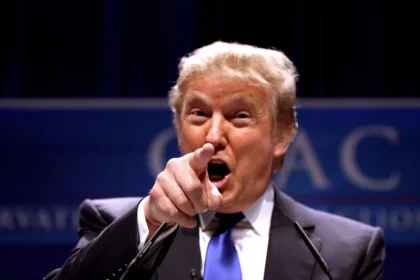



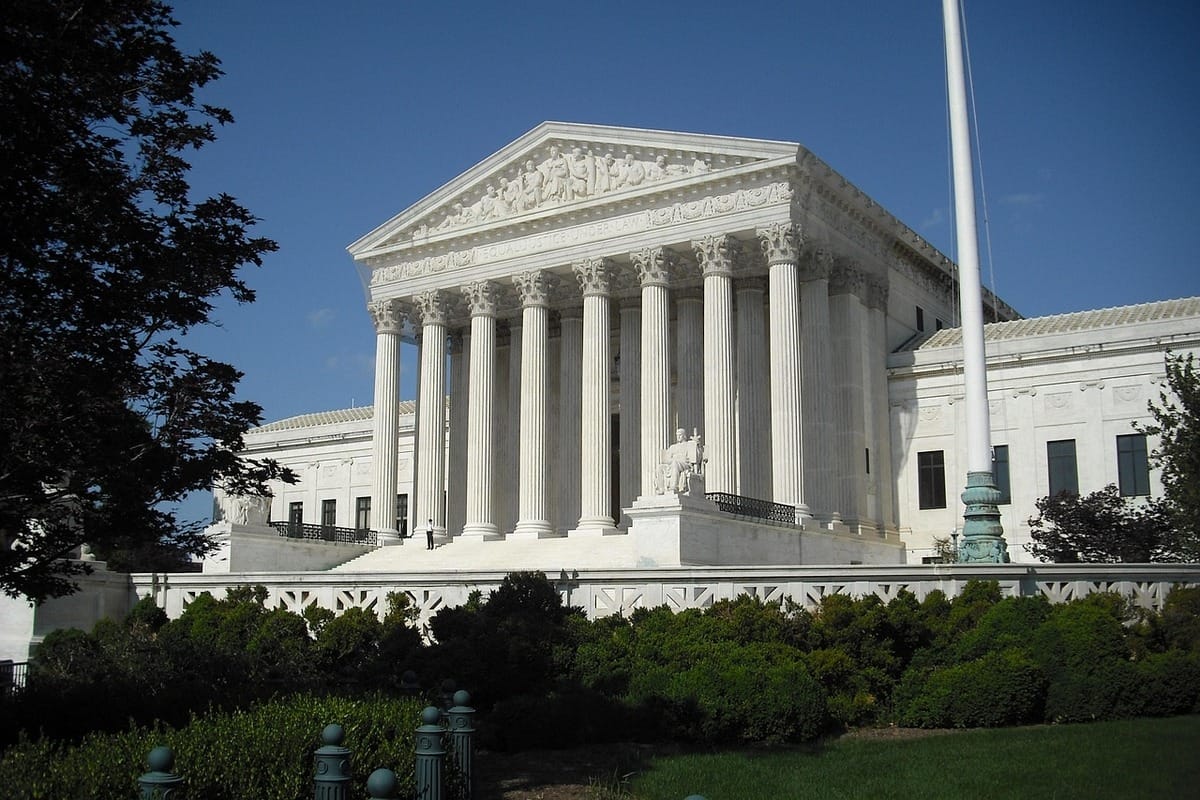
The Supreme Court delivered a historic rebuke to President Donald Trump on Friday, ruling 6-3 that he overstepped his authority by using an emergency powers law to impose sweeping tariffs on goods from nearly every country on Earth.
The Supreme Court ruling on tariffs immediately invalidates the centerpiece of Trump’s trade agenda and sets firm constitutional limits on how far any president can go in using emergency declarations to reshape the economy.
Chief Justice John Roberts authored the majority opinion, joined by liberal Justices Elena Kagan, Sonia Sotomayor, and Ketanji Brown Jackson, along with fellow conservatives Neil Gorsuch and Amy Coney Barrett. Justices Clarence Thomas, Samuel Alito, and Brett Kavanaugh dissented.
The ruling centers on the International Emergency Economic Powers Act (IEEPA), a 1977 law designed to give presidents tools for responding to genuine national emergencies.
Trump invoked this law to justify tariffs that touched virtually every U.S. trading partner, from the “Liberation Day” reciprocal tariffs announced in April 2025 to the 25% duties on goods from Canada, China, and Mexico that the administration tied to fentanyl trafficking.
Roberts was blunt in his assessment. The statute, he noted, never mentions tariffs or any equivalent term, and no president in the law’s nearly fifty-year history had ever attempted to use it for this purpose.
The scope of power Trump claimed—the ability to impose tariffs of unlimited amount, duration, and scope on any country at any time—amounted to a unilateral authority to tax the American people without Congressional approval.
That power, Roberts made clear, belongs to Congress under the Constitution and always has.
What This Means for American Families
For everyday Americans, this ruling could bring meaningful financial relief. Research from the Tax Foundation found that Trump’s tariffs cost each U.S. household roughly $1,000 in 2025, with that figure projected to climb to $1,300 in 2026. A separate analysis from the Yale Budget Lab estimated that consumers were paying between $1,300 and $1,700 more per year than they would have before the tariffs took effect.
New York Federal Reserve researchers calculated that households and businesses absorbed about 90% of the tariff costs—not foreign countries, as the administration repeatedly claimed.
The Tax Policy Center estimates that if the IEEPA tariffs are not replaced through other legal channels, American families could see an average savings of about $1,200 in 2026.
That’s real money for families who have spent over a year paying higher prices on everything from groceries to clothing to building materials while being told by the White House that other countries were footing the bill.
A Check on Unchecked Power
This decision matters far beyond trade policy. For over a year, the Trump administration operated on the assumption that declaring a national emergency gave the president virtually unlimited economic authority.
That theory has now been rejected by a bipartisan supermajority of the Court, including two justices Trump himself appointed.
The ruling reinforces a principle that should never have been in question: the power to tax the American people belongs to their elected representatives in Congress, not to any single individual in the White House.



When a president can bypass Congress to impose hundreds of billions of dollars in costs on American families and businesses simply by declaring an emergency, that’s not governance—it’s rule by decree.
It is worth noting the irony: this is the same Court that blocked President Biden’s student loan forgiveness plan by insisting Congress must explicitly authorize policies with major nationwide impact.
That same standard now applies to Trump’s tariffs. Emergency powers are meant for emergencies, not for implementing an entire economic agenda that Congress never approved.
What Happens Next
The ruling does not eliminate all tariffs. Duties imposed under other laws—including those on steel and aluminum—remain in place.
The administration has already signaled it may attempt to reimpose similar tariffs through different legal mechanisms, though Trump himself has acknowledged that alternative routes would be slower and more difficult.
There is also the question of refunds.
U.S. Customs and Border Protection collected approximately $130 billion in IEEPA tariff revenue from over 300,000 importers. Whether and how that money gets returned to the businesses—and ultimately to the consumers who paid those inflated prices—will be a major legal and logistical challenge in the months ahead.
U.S. stock markets rose immediately following the decision, reflecting the widespread understanding among economists and investors that these tariffs were hurting the American economy far more than they were helping it.
The goods trade deficit actually grew to a record in 2025 despite the tariffs—the opposite of what the administration promised.
Today’s ruling is a reminder that the Constitution still means something, and that no president—regardless of political party—is above the law. The system of checks and balances was designed for exactly this moment. And today, it worked.